


Welcome to The Update. In today’s issue:
South Korea’s older workers show that Europeans could retire later
In brief: using reason to find a partner, American buildup around Iran, and more
The long decline of night work
Since the Industrial Revolution, our jobs have gradually improved, becoming better paid, more interesting, and less dangerous. Economists Jeff Biddle and Daniel Hamermesh detail another aspect of this development: that fewer and fewer Americans are working in the evenings and at night. Of course, daytime work was always the norm.
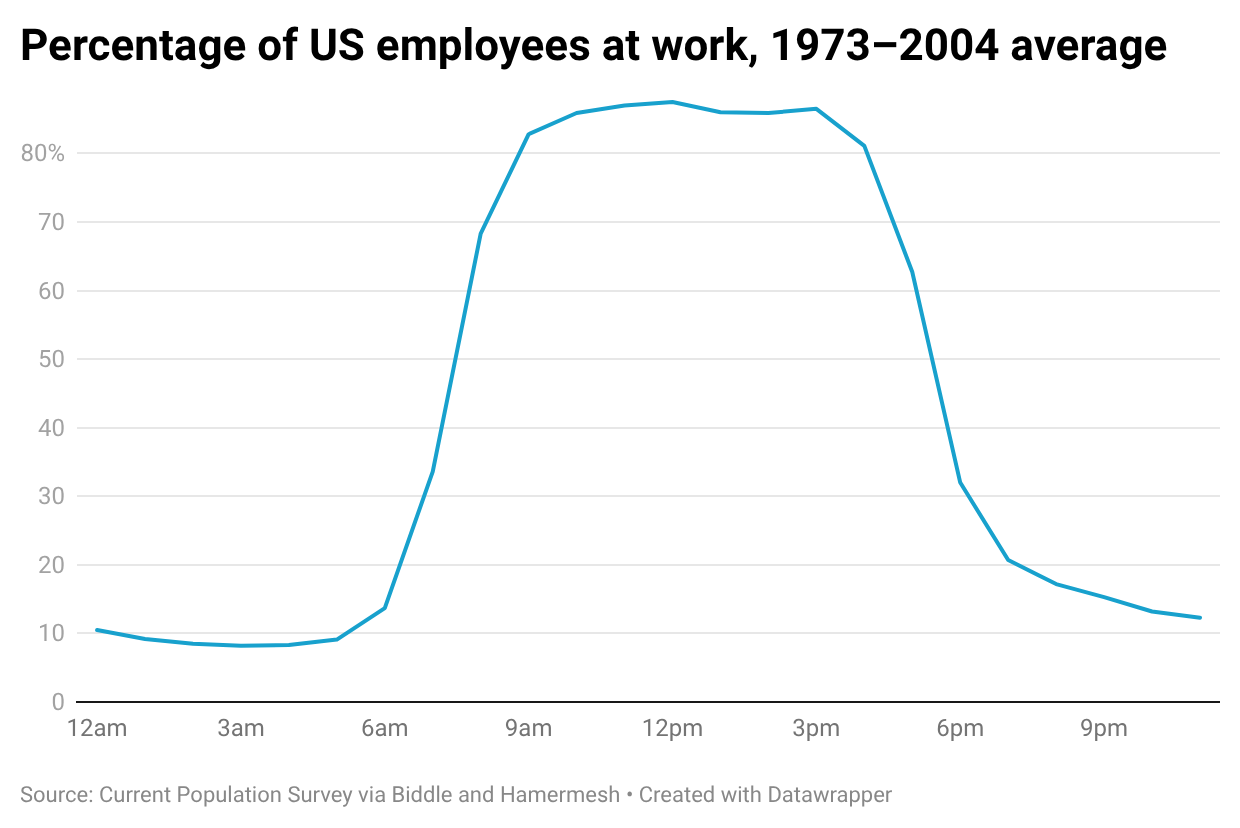
But it has grown stronger with time.
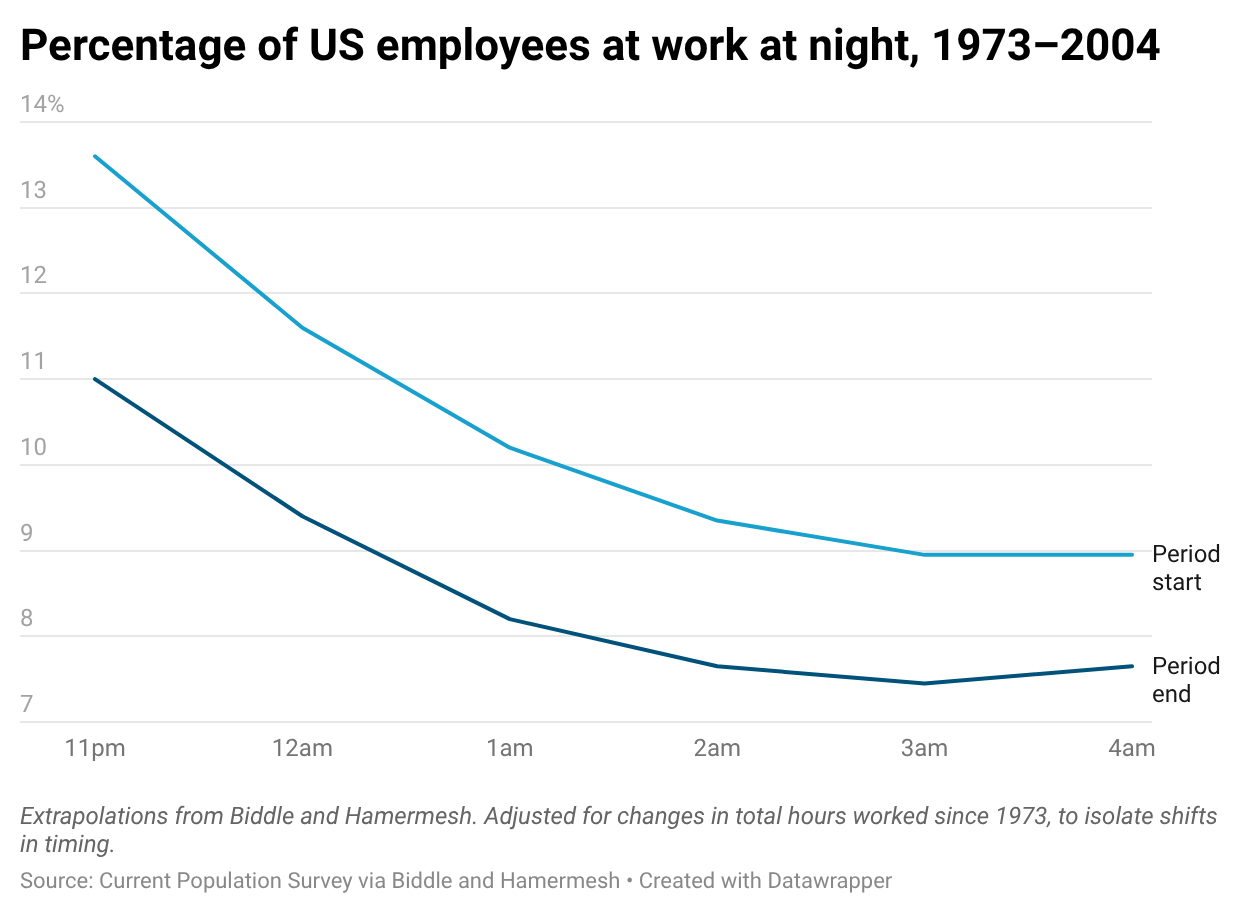
These estimates are based on surveys of when people usually start and end work. From 2003 onward, the paper instead relies on time diaries, asking workers what they did at each hour of a particular day. The two methods produce different numbers but show a similar trend over time.
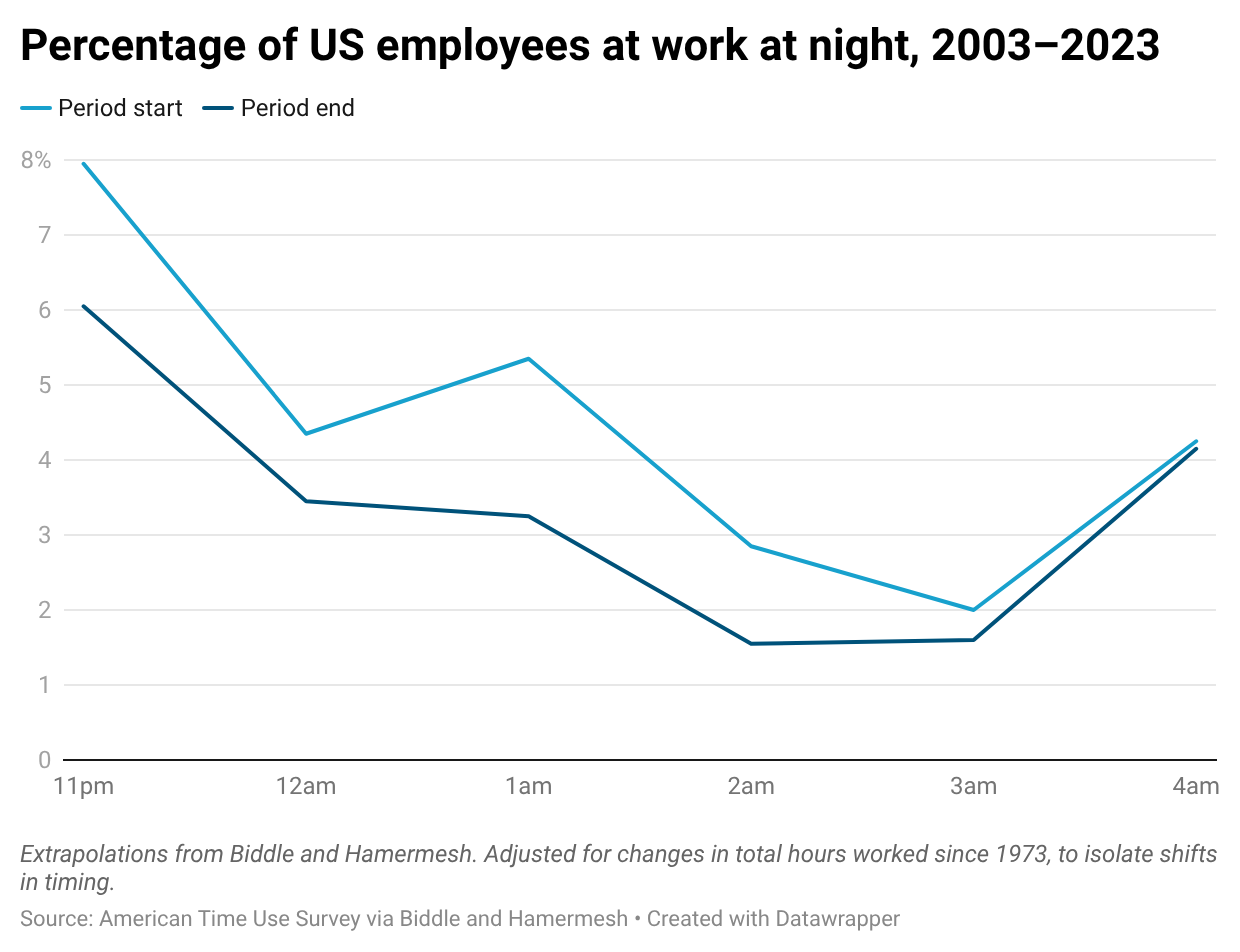
Together, these studies suggest that the share of Americans working in the middle of the night has fallen by more than 50 percent since the 1970s.
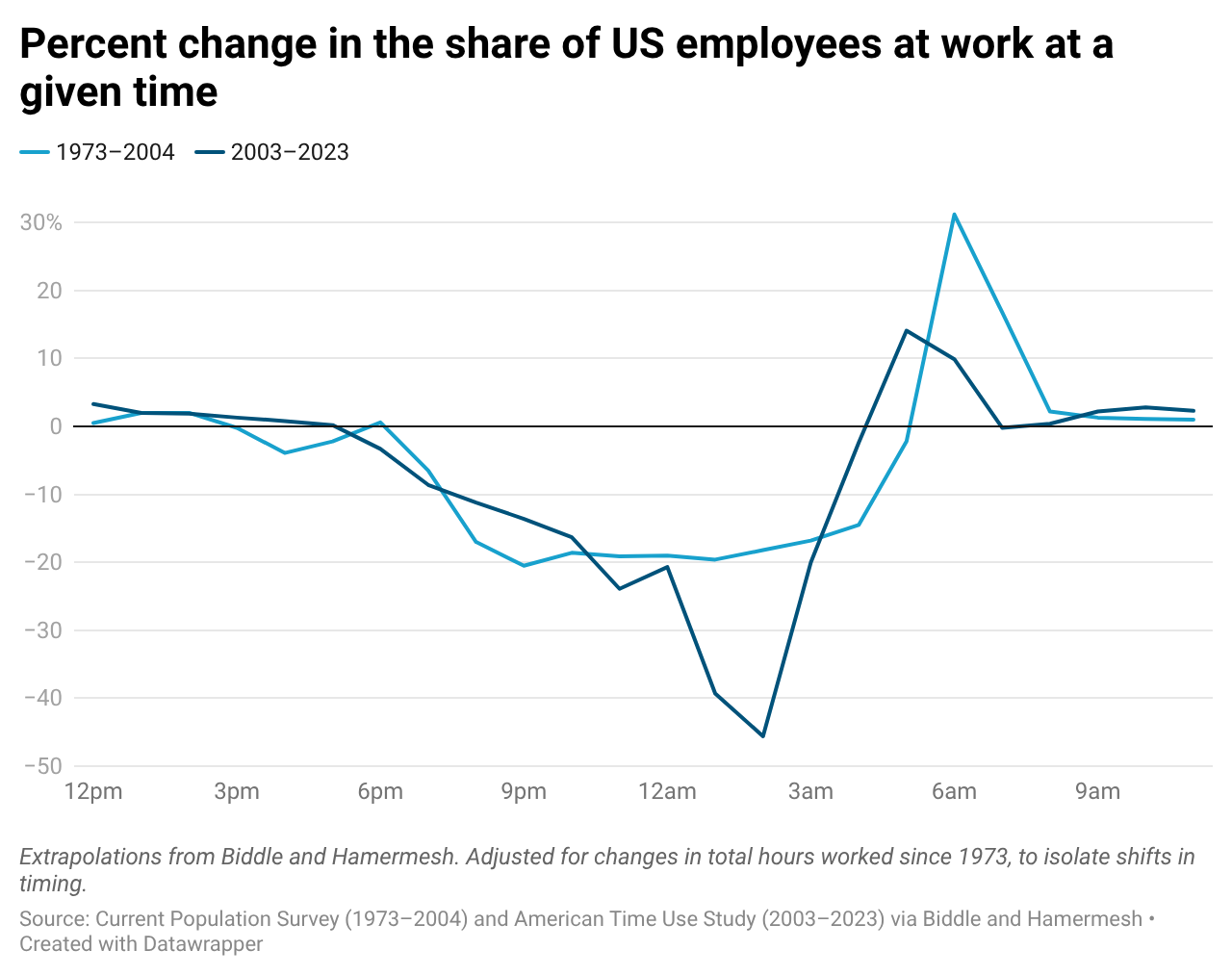
When I came across this paper, my first guess was that the fall in night work might be driven by the decline of manufacturing (where shift work is common) and the continued rise of white-collar office jobs (where it isn’t). But Biddle and Hamermesh show that changes in job types have not contributed much to the fall in night work. People work less at night across all major industries, with the exception of retail, where changes in logistics and longer opening hours have led to more evening and night work.
Instead, the key explanation is simply that Americans have become richer. Today’s workers can afford to avoid night work to an extent that previous generations couldn’t. Even though employers have raised premiums for night work, the number of workers who are willing to do it keeps falling. The decline of night work is another unheralded benefit of economic growth.
Cheaper housing could slow the fall in population
In many countries, high housing costs lower fertility rates. But if the population declines, shouldn’t this eventually reduce housing costs as demand falls? And couldn’t that in turn increase fertility rates?
Economist Nicholas Decker argues that it could, and that standard population projections ignore this feedback cycle. He estimates that taking it into account raises the projected American population in 2100 by five to ten percent relative to a baseline model from the Census Bureau. Obviously, this figure is hugely uncertain, but so are existing population projections.
Europe’s conservative interior and left-leaning west coast
What are the geographical patterns of European party politics? Here’s a map of the political color of prime ministers or presidents (depending on who’s more influential) in the EU and adjacent European countries. This measure is admittedly imperfect – the three categories are coarse-grained, and many governments are multi-party coalitions – but even so, it reveals an interesting pattern. While the Atlantic seaboard mostly has centrist or left-wing leaders, conservatives dominate further east.

* The prime minister in most countries, the president in France, Serbia, and Cyprus. The categorization is broadly based on European party affiliation, but involves several judgment calls.
New issue of Works in Progress
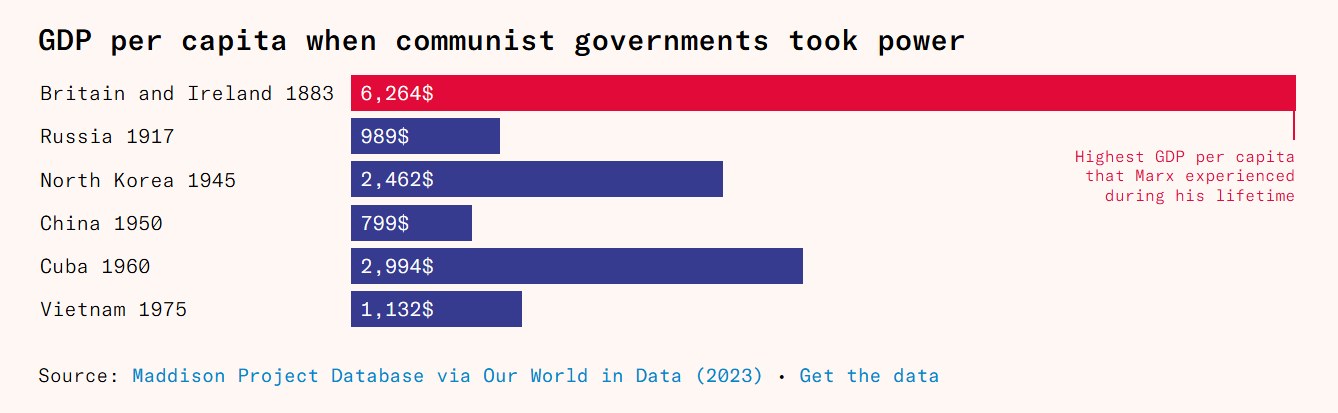
Issue 22 of Works in Progress is out, with nine articles on a wide range of themes. Michael Hill writes about how Communist countries struggled to reform their economies. Marx wasn’t much concerned with wealth creation, as he thought that Communist revolutions would take place in rich countries such as Britain, where he lived. But in fact, the countries that turned Communist were all poor and desperately needed economic growth. Sadly, their policies instead led to stagnation, and attempts to change course repeatedly failed.
Part of the problem was that since artificially low prices had become communist dogma, reforms typically led to price increases, which people never like. Also, many reformers simply didn’t know how the economic system worked, due to the dire state of communist economics and autocratic secrecy. In 1983, Mikhail Gorbachev was refused access to the state budget, even though he was a member of the Politburo. As Michael explains, this lack of knowledge may have contributed to the runaway inflation under Gorbachev’s leadership (1985–1991).
Elsewhere, Olympia Campbell describes the enormous variation in human marriage customs, and Alex Wakeman tells us how wild cabbages gave rise to dozens of vegetables.

I’ve covered the other articles previously:
You can subscribe to the beautiful print magazine for $100 per year.
South Korea’s older workers show that Europeans could retire later
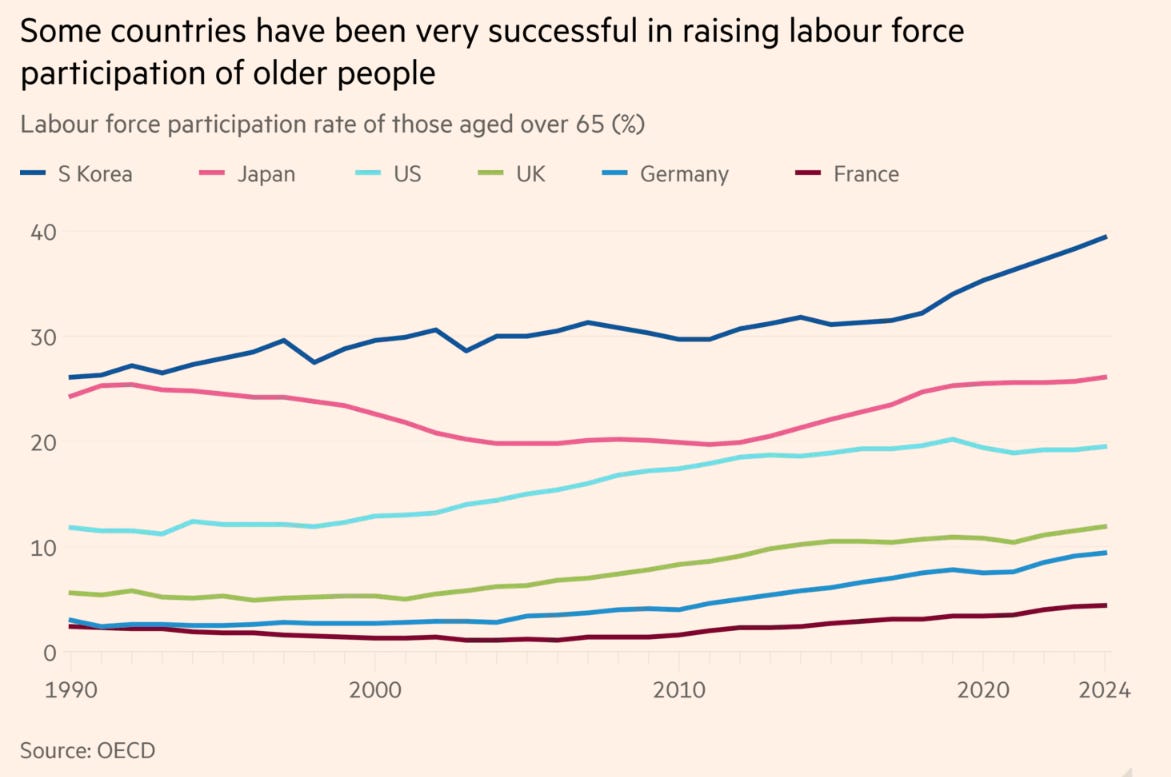
Even though people in rich countries have been retiring later since the turn of the millennium, I think retirement ages should rise further. While some argue that older people simply can’t work longer, the fact that South Koreans over 65 are ten times more likely to work than their peers in France suggests otherwise. Early retirement is not the physical necessity it is often claimed to be.
In brief
Aria Schrecker makes the case for using reason rather than intuition to find a partner
American annualized Q4 growth was 1.4 percent, below expectations
Rob Wiblin interviews Ajeya Cotra on using AI to make AI safe
Claims that public disorder is rising in the US are overstated
The number of people overseeing Waymos remotely is very small
What Coefficient Giving’s Abundance and Growth Team is reading
That’s all for today. If you like The Update, please subscribe – it’s free.
I would have expected the rise in healthcare employment would result in more night work in the ED, hospice etc. But, looking at the charts in the paper, it seems that the proportion of healthcare work done at night has dropped along with all the other employment categories.
The housing prices impact on fertility rates feels like a modern Malthusian trap. We’ve raised the bar for the quality of life we expect and then the world isn’t keeping up and so there are fewer kids.
I think this is obviously a very small part of a wider picture of why people are having fewer kids. 5% is a small fraction of the entire change, but it’s interesting to think Malthus’s thoughts might still be relevant.