


Welcome to The Update. In today’s issue:
What gymnastics tells us about human progress
Why is it so common to doubt human progress, with some even claiming we’re doing worse than previous generations? I think one reason is that progress can be hard to measure. It gives the skeptics wiggle room.
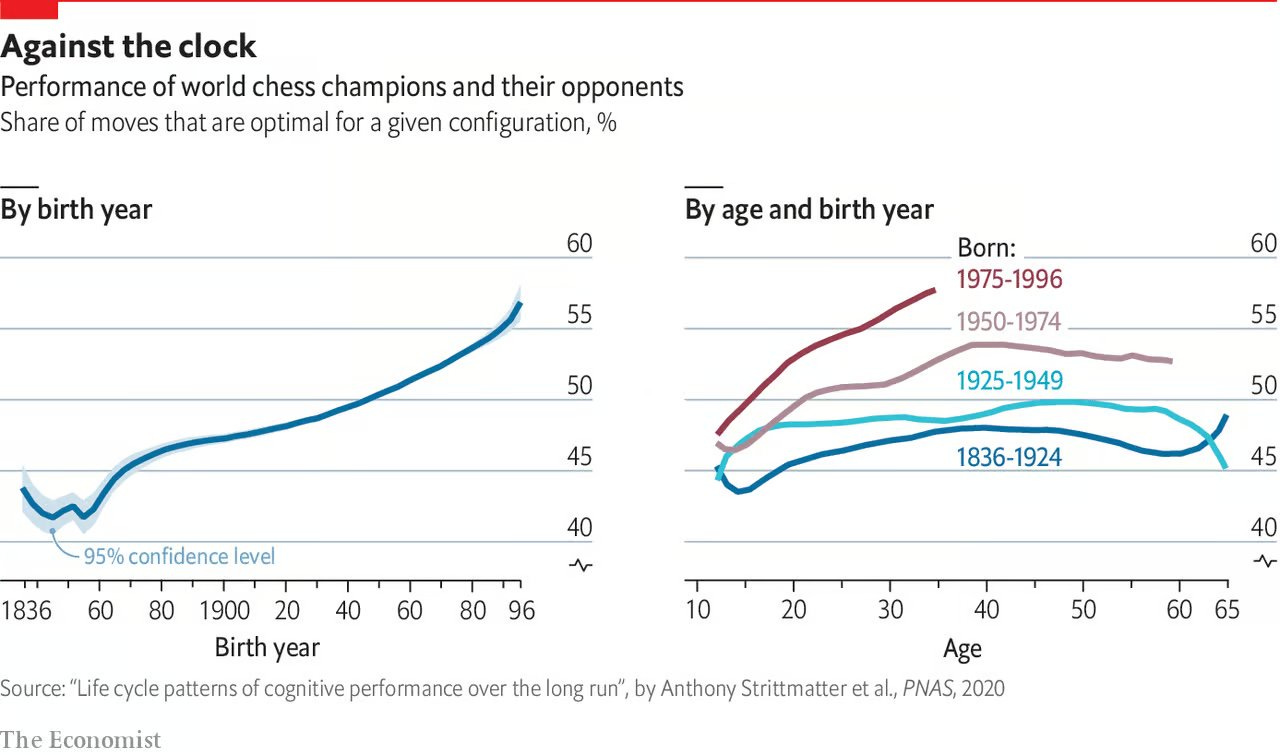
But there are some domains where progress is impossible to deny. It’s demonstrably true that chess masters have improved with time.
And gymnastics has changed beyond recognition.
The driver of this progress is that people are always chasing it. When someone finds a better strategy or technique, it spreads – gradually raising the standards.
This logic extends well beyond chess and gymnastics. In domains where quality is harder to judge, progress can be slower – but I don’t think it stops. Scientific methodology is a case in point: studies were much less rigorous a century ago than they are today. Over the years, scientists have identified flaws in their methods and found ways to correct them.
This account of how progress works reveals a deeper reason it’s underestimated. People aren’t thinking clearly about human agency. They don’t see the constant pursuit of improvements, and so view change as haphazard. But in the modern world, it is overwhelmingly unidirectional.
The US redistributes more than most people think
The American tax system is often framed as tilted toward the rich, but as The Economist shows, it has grown more progressive with time. Today, the famous one percent pay around half their income in tax.
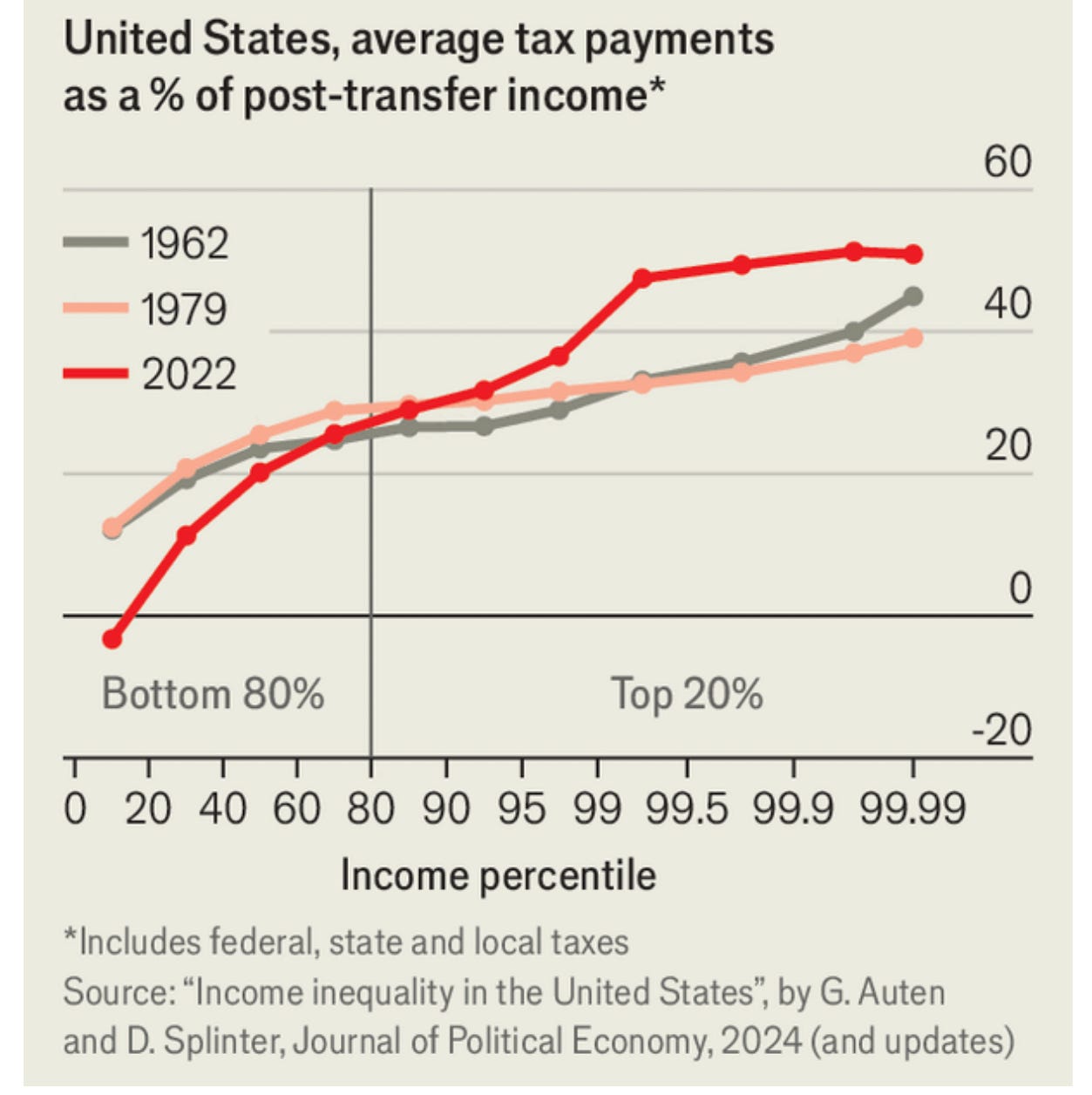
Note that the scale on the X-axis changes at the 80th percentile.
Likewise, tax cuts and welfare programs for the poorest Americans have been far more effective than generally realized.
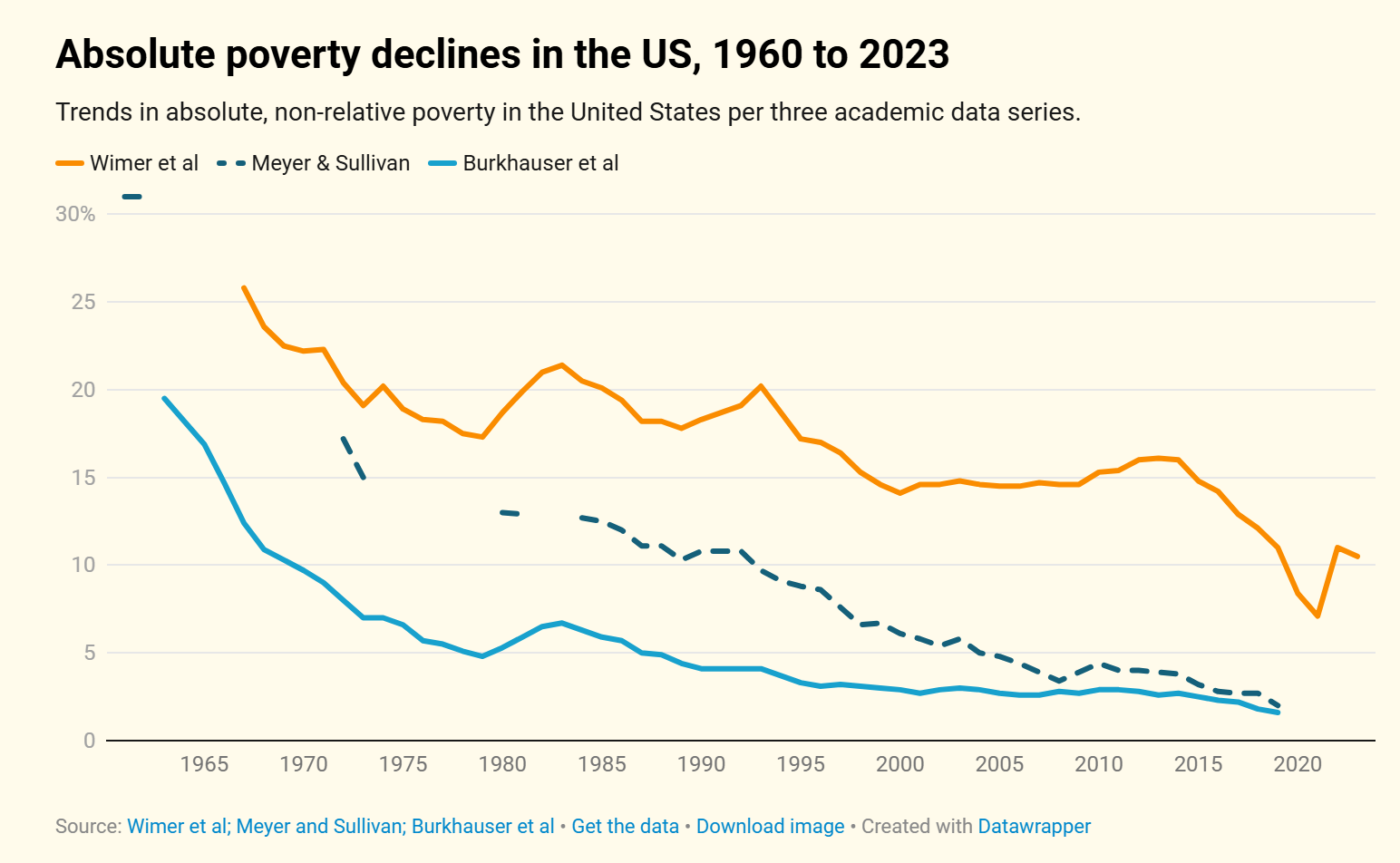
Dylan Matthews had planned to write a book about this positive development, but apparently it wasn’t what publishers wanted to hear:
Almost everyone I talked to about this, from agents to editors to funders, was at minimum surprised to hear that the safety net has grown. At worst, they were actively skeptical that this could be true, and insisted living standards for the poorest Americans must be worse now than they were 50 years ago.
Seems like a shame: I’d have liked to read that book.
The crime shift from theft to fraud
In Sweden, crime has been transformed in the last 20 years. While the number of thefts has roughly halved, fraud has risen sharply and is on track to become the largest category of crime. Sweden is by no means unique – though the magnitudes differ, other countries have seen the same shift.
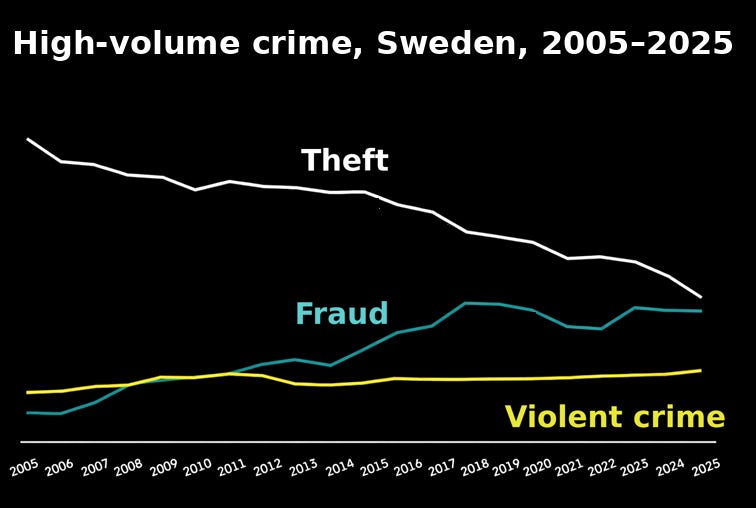
Adapted from Sveriges Television.
Europe is held back by rigid employment protection
Why is Europe falling behind the US? In Works in Progress, Pieter Garicano argues that a major reason is that it’s so hard for European companies to lay off staff. Mandatory severance packages and strict restrictions on firing make restructuring expensive and slow. Large Spanish companies have to pay more than five years’ salary to each dismissed worker.
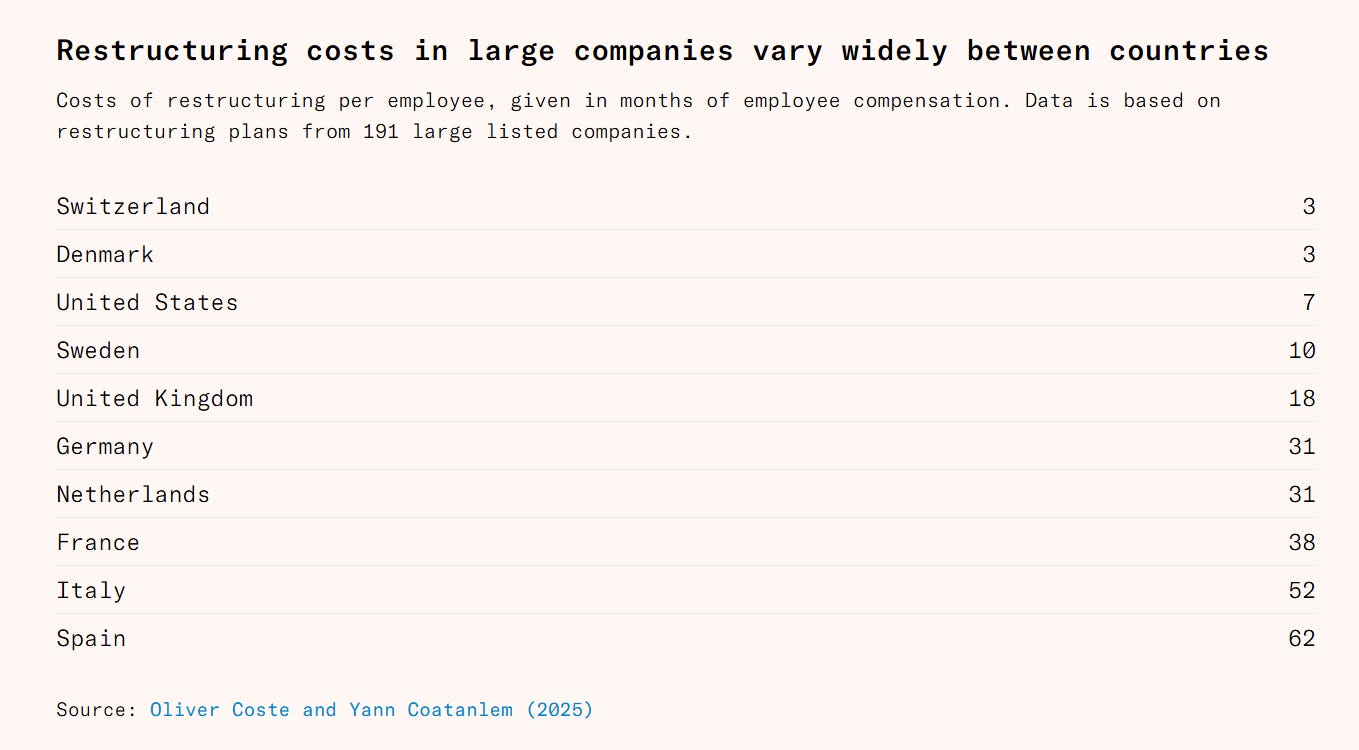
The costs of shutting down failing projects make European companies more risk-averse and less innovative. But in many countries, wholesale labor market reform has proved politically difficult. This suggests that more targeted strategies should be tested. An idea I particularly like is removing employment protection for high-income workers, who have less need for it. Since they drive a large share of innovation, this could have an outsized effect.
AI isn’t a partisan issue in the US
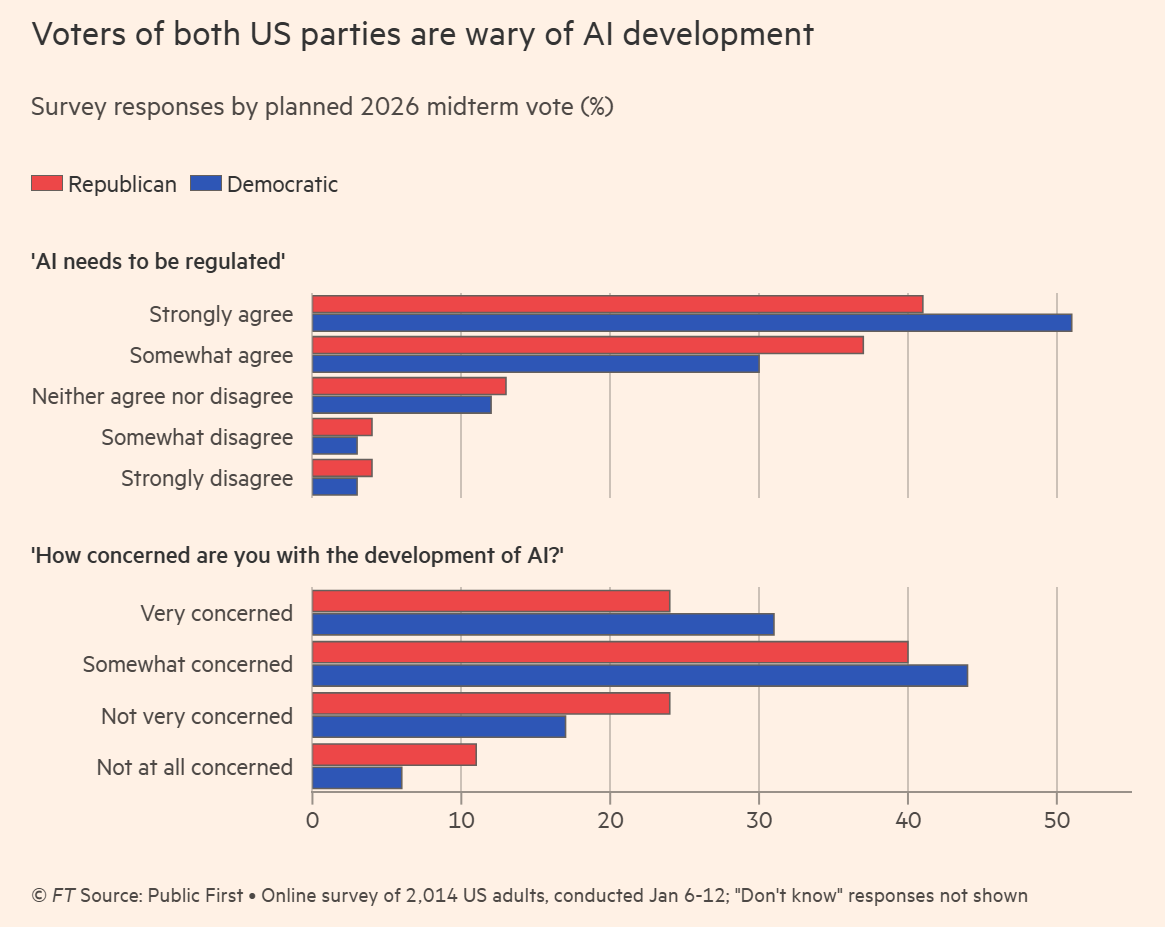
While many political issues have become polarized along party lines in the US, that has so far not happened to AI. A majority of both Republicans and Democrats are concerned with the development of AI and believe it needs to be regulated. However, AI is still a relatively niche issue, and polarization could rise as it grows more salient.
Four minutes of air conditioning
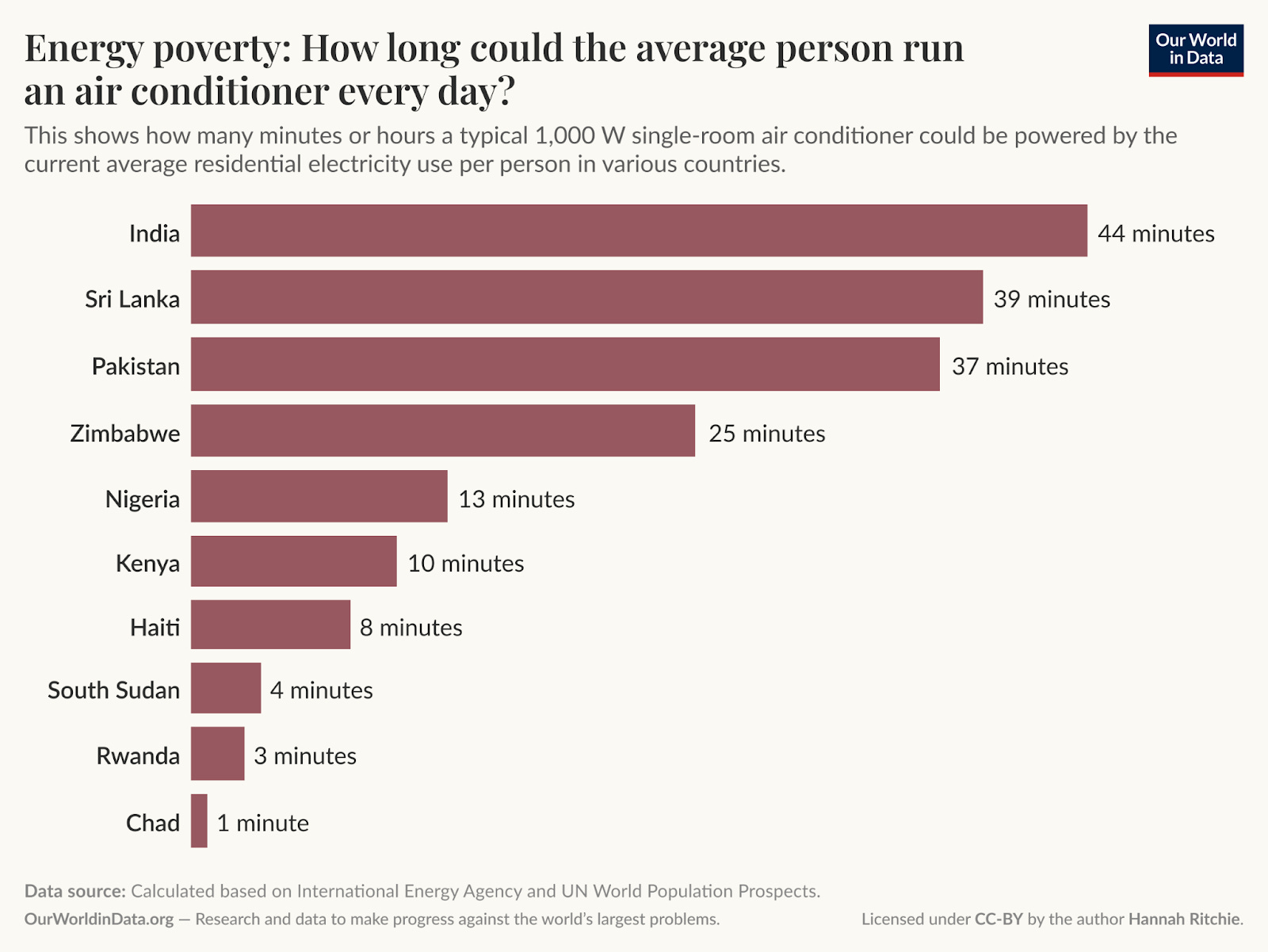
Gaps between rich and poor countries are usually measured in dollars, but it can be hard to interpret what such figures mean. Prices of specific goods and services vary enormously: while haircuts are much cheaper in poor countries, iPhones are often at least as expensive as in the rich world. This means it can be useful to complement dollar figures with estimates of consumption of essential goods – such as energy, a resource that can be put to an extremely wide range of uses.
On this metric, the differences between rich and poor countries are staggering. In much of sub-Saharan Africa, electricity consumption per capita is only around one percent of what it is in the US. In South Sudan’s capital Juba, temperatures exceed 35 degrees Celsius for five months of the year, and yet air conditioning is out of the question for the vast majority of the population. As Hannah Ritchie writes, people in South Sudan use so little electricity that just four minutes of air conditioning would equal their entire daily consumption.
Data center power use rising quickly in the US
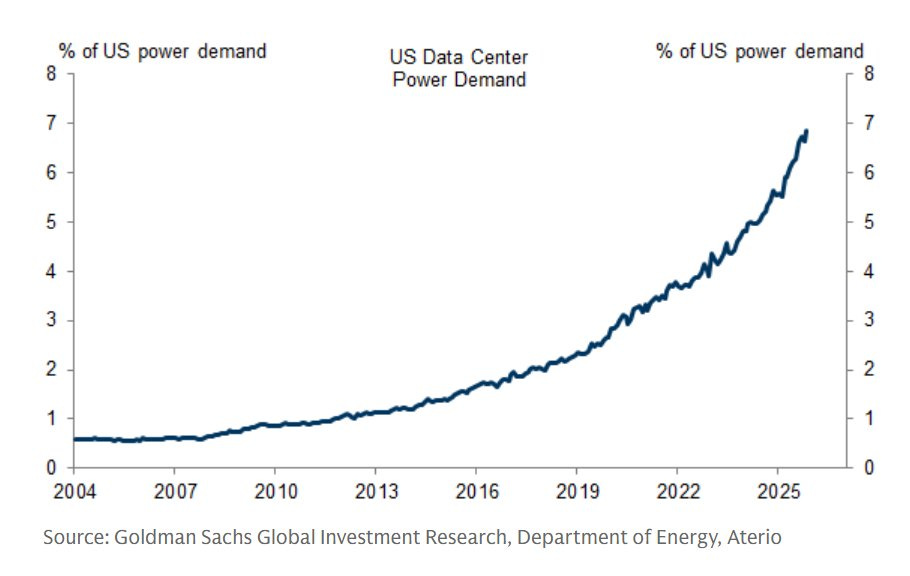
The share of American electricity consumed by data centers has increased rapidly on the back of AI progress and now stands at seven percent.
In brief
Falling American crime figures are not about underreporting or better medical care
Cambridge fellowship on AI consciousness and moral status in August
Jennifer Doleac on why solving more crimes is a stronger deterrent than longer sentences
The US to adopt a faster drug trial framework – Ruxandra Teslo explains
Trump has been briefed on different ways to strike Iran
Polymarket and Metaculus estimates of an attack are rising
Former South Korean president Yoon Suk Yeol sentenced to life in prison for insurrection
That’s all for today. If you like The Update, please subscribe – it’s free.
Like many discussions of progress, I think the periodization here is somewhat problematic. In many fields (air travel, agriculture, antibiotics), there was enormous progress from 1945 to 1985 and then less significant but still visible progress from 1985 to 2025. Gymnastics is like this as well -- Mary Lou Retton is closer to a modern gymnast than the ones in your 50s video.
Interesting about progressive tax in US. But also worth also looking at what has happened to wealth inequality and housing access.