


Welcome to The Update. In today’s issue:
Central Stockholm renters face a 20-year wait due to rent control
More AI-written code in Western countries than in China and Russia
In brief: insurance for self-driving cars and how to get more good shops
American voters reject Trump’s most aggressive policies
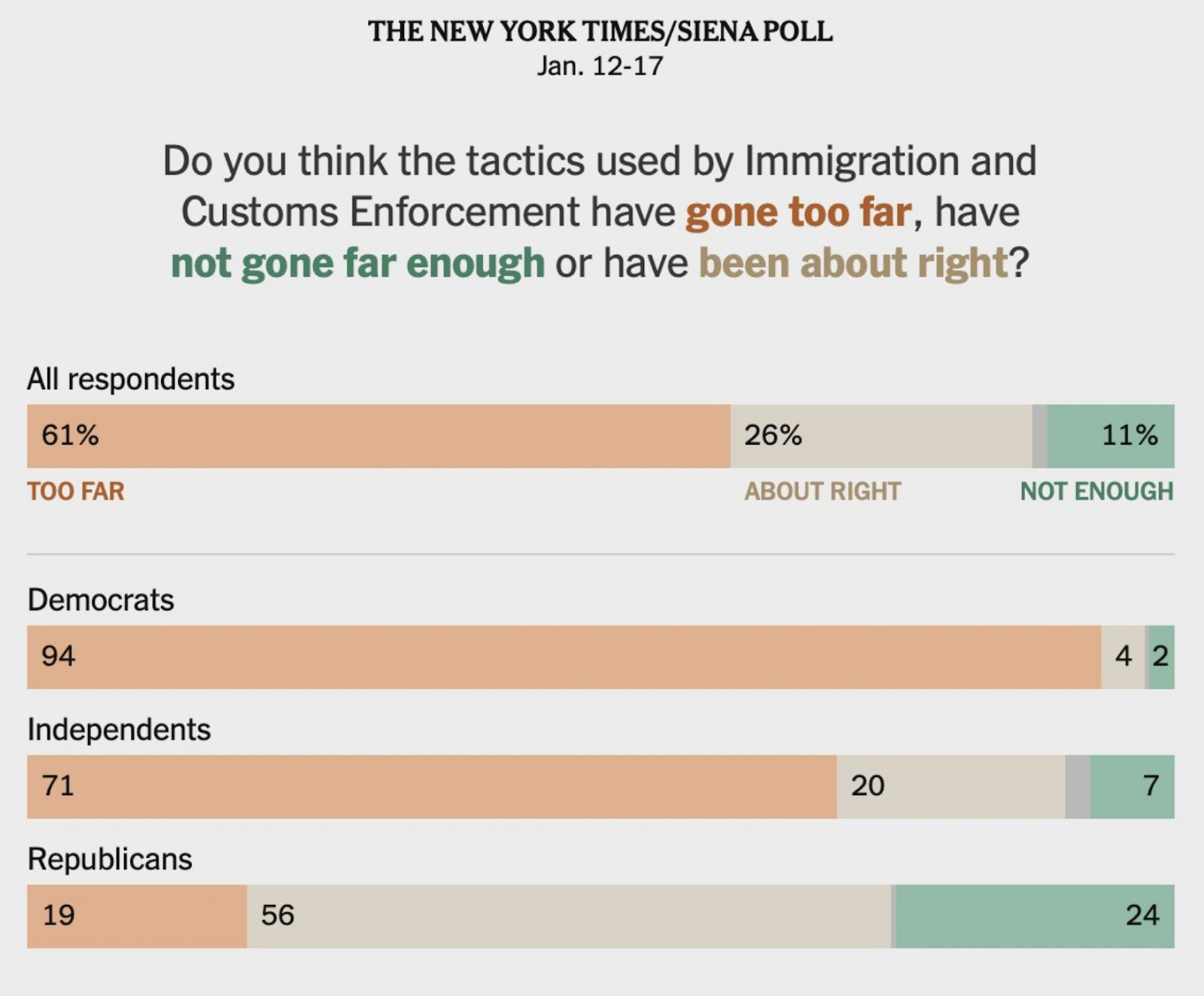
Following the death of Renée Good and a series of other incidents, Immigration and Customs Enforcement (ICE) has dominated American headlines and received an immense amount of criticism. A Siena poll commissioned by The New York Times suggests that many Americans agree with the critics. While a slim majority supports deportations of illegal immigrants, 61 percent think that ICE’s tactics have gone too far. (Note that this poll took place before Saturday’s killing of Alex Pretti by the US Border Patrol.)
Another aggressive policy that’s received a lot of attention is Trump’s attempt to acquire Greenland. As I’ve reported before, it isn’t popular either.
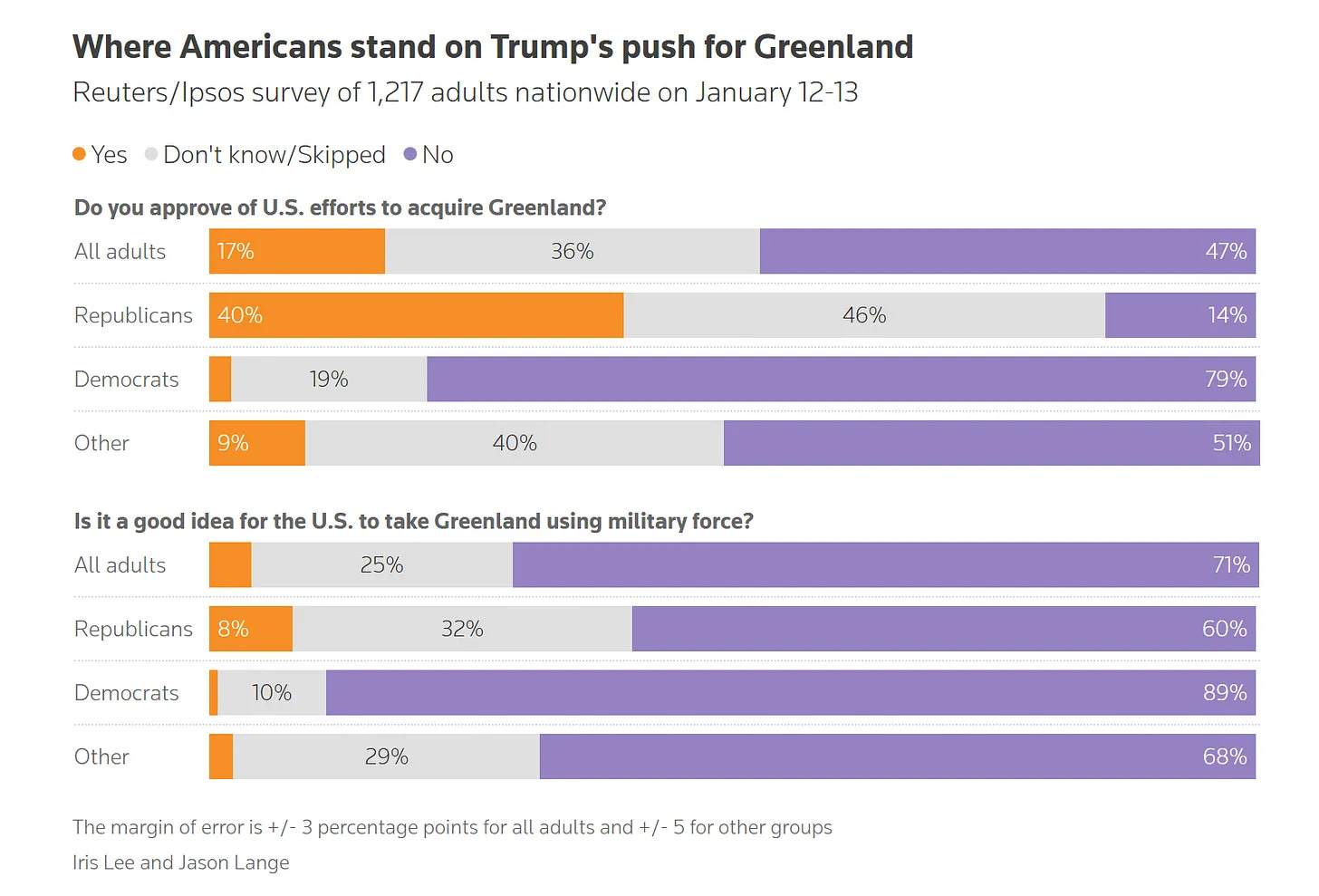
Recent weeks have seen plenty of gloom about the future of the world, but results like these suggest we shouldn’t jump to pessimistic conclusions prematurely. Much of the current chaos stems from the fact that Trump is unusually erratic and prone to flights of fancy. Over the long run, the median voter tends to substantially influence (though not wholly determine) policy outcomes. Therefore, I find it encouraging that they reject some of Trump’s most aggressive policies.
Central Stockholm renters face a 20-year wait due to rent control
If you’re looking for a standard rental contract in Stockholm, you’ll have to be prepared to wait. Apartments are allocated through a waitlist, and in 2025, new tenants in the city center had waited an average of 21 years. Rents are regulated, and can be far below half of market rents at the most attractive addresses.

Average wait time for all rentals (blue) and newly built rentals (red) in Stockholm. Source: Stockholm Rental Agency.
The system disfavors immigrants and young people – who haven’t had time to move up the waitlist – and is a good example of how unfair and inefficient rent control often is. The Moderate Party, which leads the current government, recently proposed a radical reform: allowing landlords to charge market rents for new contracts. It would reduce the relevance of the waitlist, which would be an improvement. But I think it’s too controversial to get the necessary support, so I’m betting against it – by keeping my spot in line.
Chinese lending to Africa has collapsed
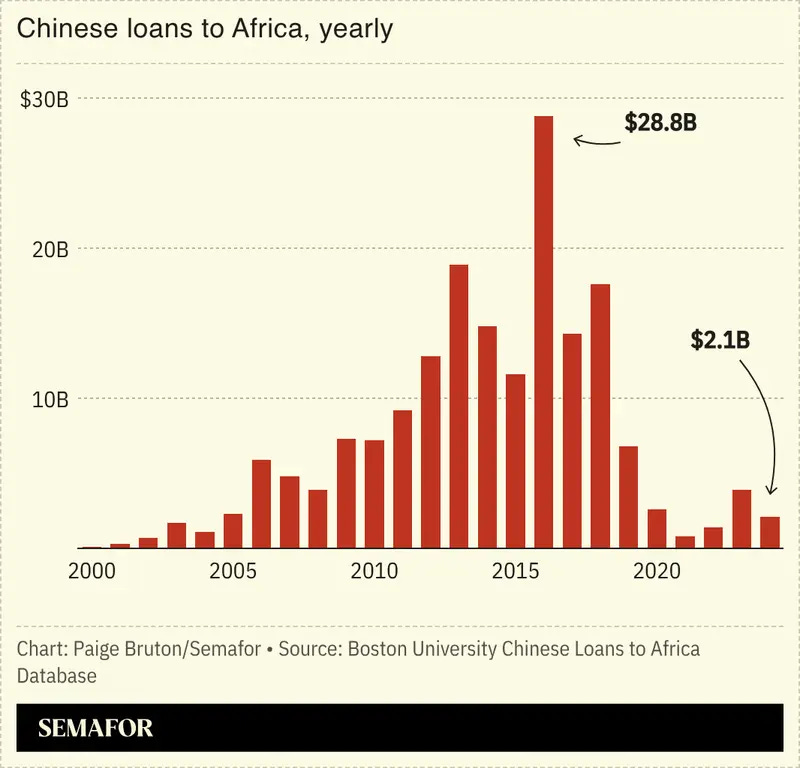
In the 2010s, there was much talk about the buildup of Chinese lending to Africa, which peaked at $29 billion in 2016. But since then, lending has fallen more than 90 percent to $2.1 billion in 2024. By contrast, Chinese exports to Africa have grown rapidly, reaching $225 billion last year.
Web search isn’t over just yet
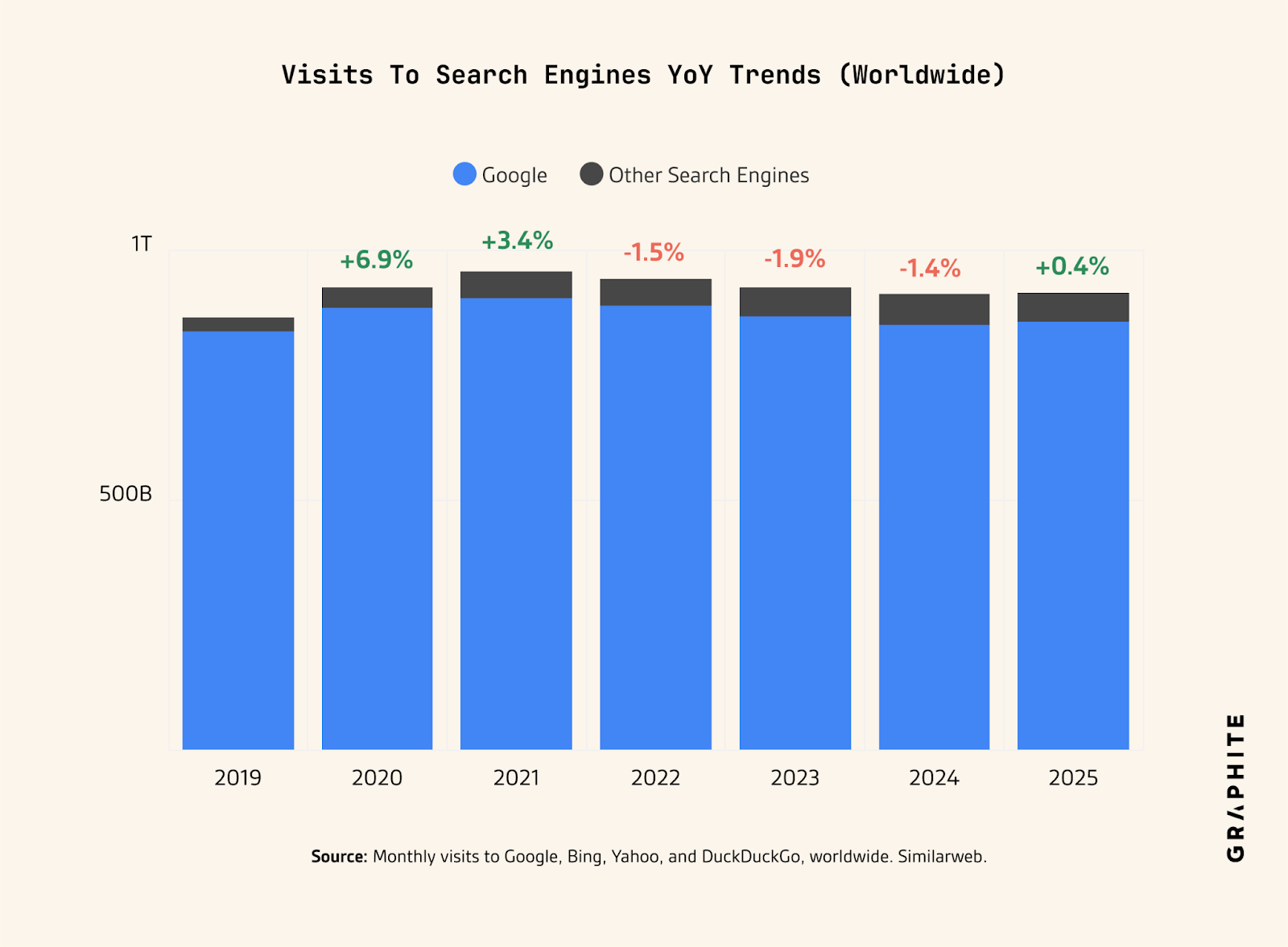
The increasing use of AI chatbots has led some people to claim that web search is already becoming obsolete. But an analysis by the consultancy Graphite finds that search has actually remained stable in the last few years. Some of the talk of the end of search may be due to AI enthusiasts overgeneralizing from their own social circles.
The muted impact of the one-child policy
I wrote the other day that the one-child policy has been overstated as an explanation of the decline of Chinese fertility. The economist Jesús Fernández-Villaverde recently posted a chart that illustrates this point vividly. China and Taiwan were the same country up until 1949 and have much in common – but Taiwan never had a one-child policy. So, which of these lines is China, and which is Taiwan?
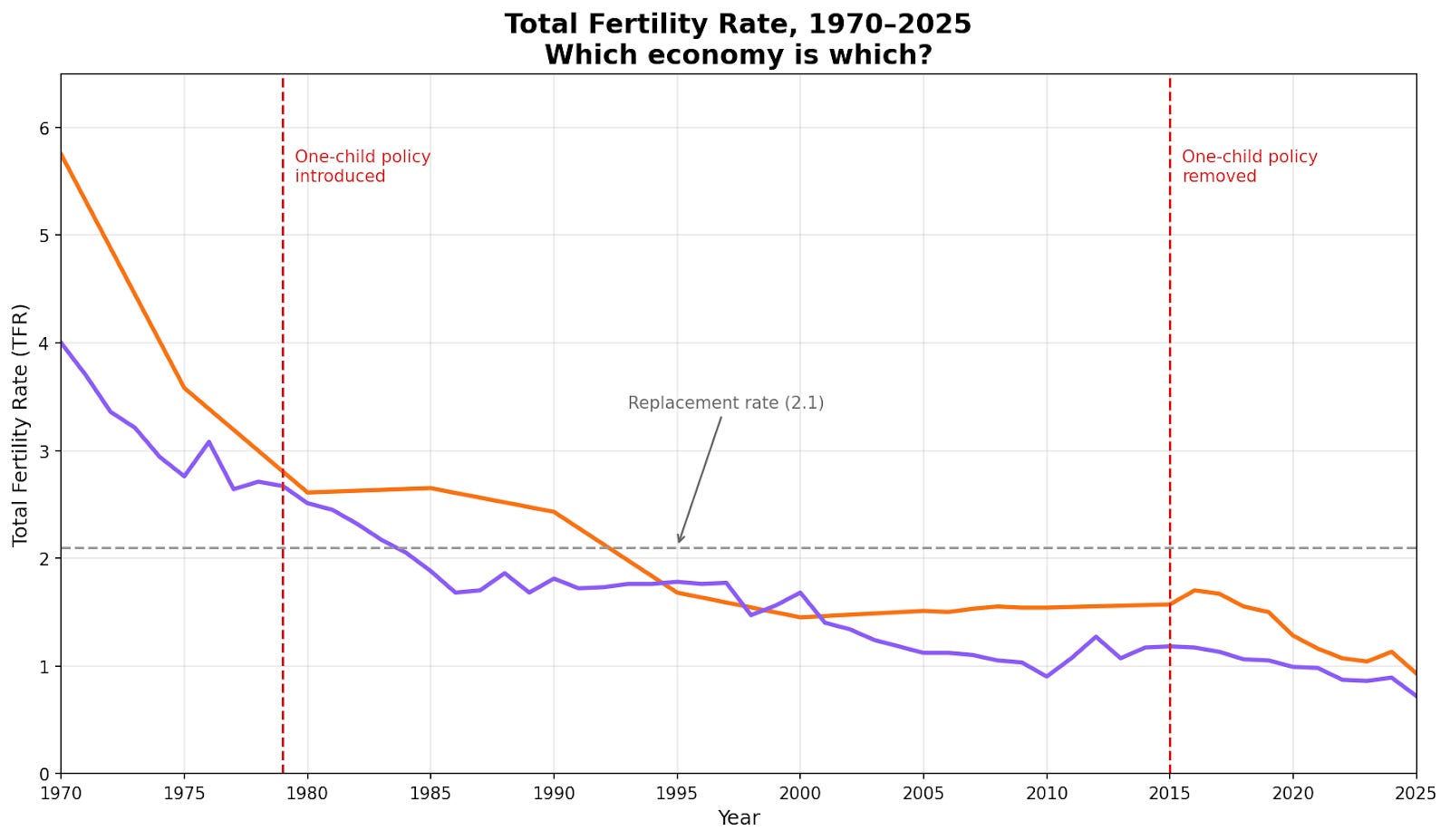
Surprisingly, China is orange, and Taiwan is purple. When the one-child policy was introduced, the total fertility rate fell faster in Taiwan – and when it was abandoned, it fell faster in China. It’s precisely the opposite of what you would have expected. Of course, this doesn’t mean that the one-child policy had no impact at all, but it does suggest it was smaller than some people assume.
More AI-written code in Western countries than in China and Russia
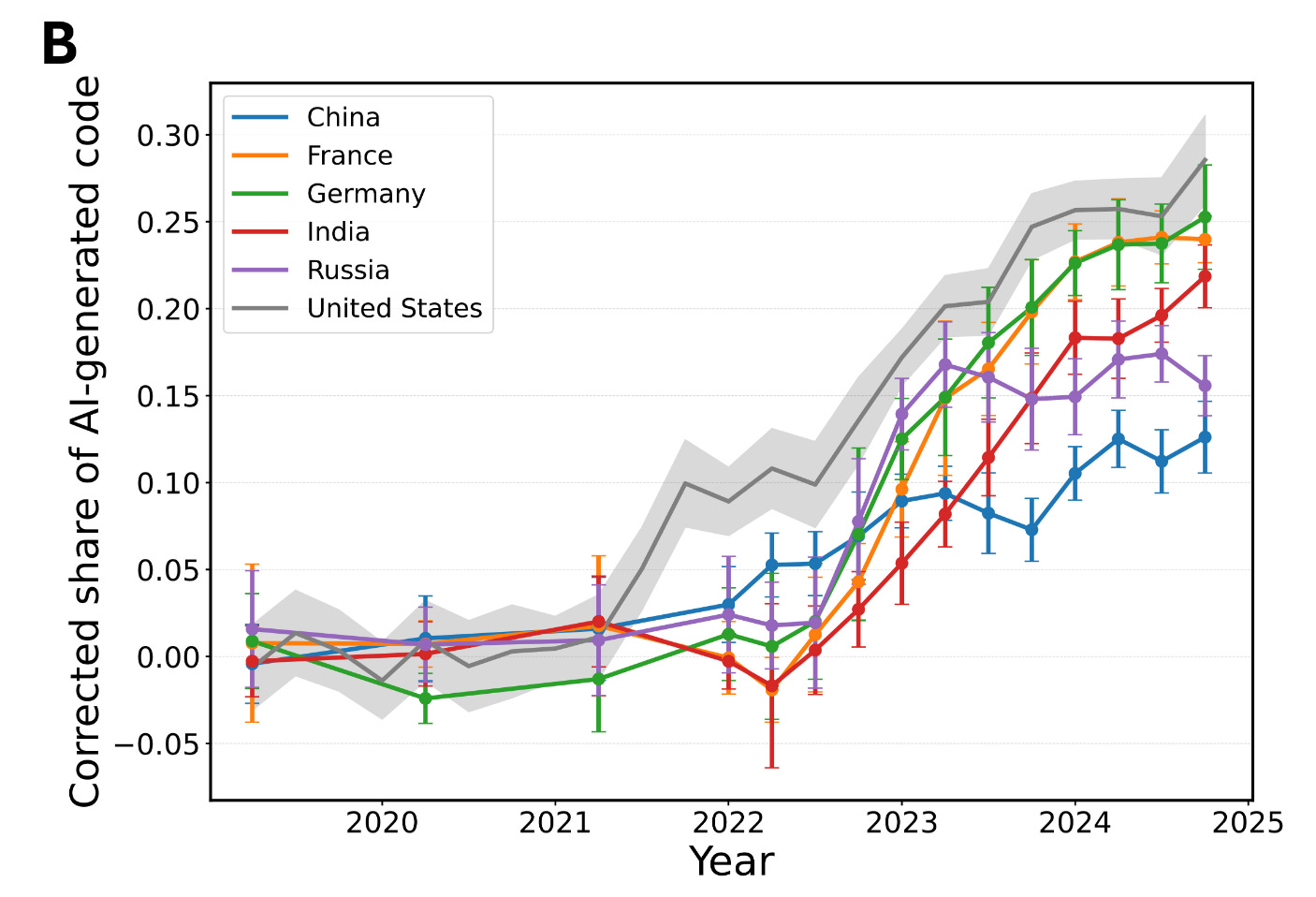
Anthropic CEO Dario Amodei says that 100 percent of his code is written by the company’s AI coding assistant, Claude Code. But what about the average developer? A new paper in Science studied this question by scanning open-source code for signs that it was created or substantially changed by AI. By the end of 2024, 29 percent of Python functions in the US were essentially written by AI, with France, Germany and India close behind (these numbers are likely higher today). By contrast, Russian and Chinese developers lagged behind, possibly in part because they lack access to frontier tools like ChatGPT and Claude. The researchers also found that using AI increased developers’ productivity by 3.6 percent, based on comparisons of output before and after adoption.
In brief
Retail shops create value not only for shop owners, but also for owners of surrounding land. But as Phil Levin and Ben Southwood write for Works in Progress, we often don’t get enough good shops, because of how we organize ownership and taxation. Ownership tends to be too fragmented for shops to capture the value they create for their surroundings. Taxation has the opposite problem: authorities are so large that they don’t know how to promote local business. To get more good shops, we may need more unified ownership and more localized taxation.
The insurance company Lemonade says Tesla’s most advanced driving assistance software reduces risks so much that it’s halving per-mile rates. As the economist Arpit Gupta argues, these incentives are likely to drive the adoption of self-driving cars: ‘An insurance doom/boom loop will reward self-driving cars and penalize human drivers, which will nudge adoption and ultimately ~eliminate the auto insurance industry.’
That’s all for today. If you like The Update, please subscribe and share with your friends.
You’re totally mischaracterizing the rents in Stockholm. What you present is actually an example of how popular government housing is! Everyone who rents in Sweden WANTS to live in government housing. The government needs to build more of it. In Sweden, we have rent control through NIMBYism: you cannot buy an apartment and rent it out unless everyone else in the building agrees to let you do that (and no one does because they don’t want renters living there). So unless you own the entire building, you cannot rent out apartments.
I feel mildly annoyed when I see non-Americans tell Americans "this is what you guys voted for". Trump did not run on acquiring Canada or Greenland. Nor were those major priorities during his previous term. Perhaps it is reasonable to hold us accountable for electing a guy who is generally a bit crazy, and getting a bit of craziness as a result. But from a pragmatic perspective, it seems better to tell Americans: "This is NOT what you voted for. If Trump wanted to acquire Canada/Greenland, he should've run on that, don't you think?"
I saw an Economist article which claimed that early on in Russia's invasion of Ukraine, many Russians were against it. But as Russians saw the rest of the world verbally attacking all of Russia for the invasion, they scurried out of the rhetorical no-man's-land and fell in line behind Putin. Now he doesn't face much internal resistance. I am worried something similar will happen in the US.
Why create loyalty to Trump when you could give people an opportunity to distance themselves from him?
On a tangential note, I've started wondering if the key value of democracy is not in predicting who will make for a good leader (such predictions are difficult even for expert forecasters), but rather in removing bad leaders and replacing them with someone else. (One thing I'm a little confused by is people saying "I told you so" about Trump, without mentioning anything about his first term.)