


Welcome to The Update. In today’s issue:
AI companies could grow huge even without transforming the economy
Most of the American electricity growth came from solar in 2025
Robberies and burglaries have fallen by 80–90 percent in the US
Chinese fertility at record low
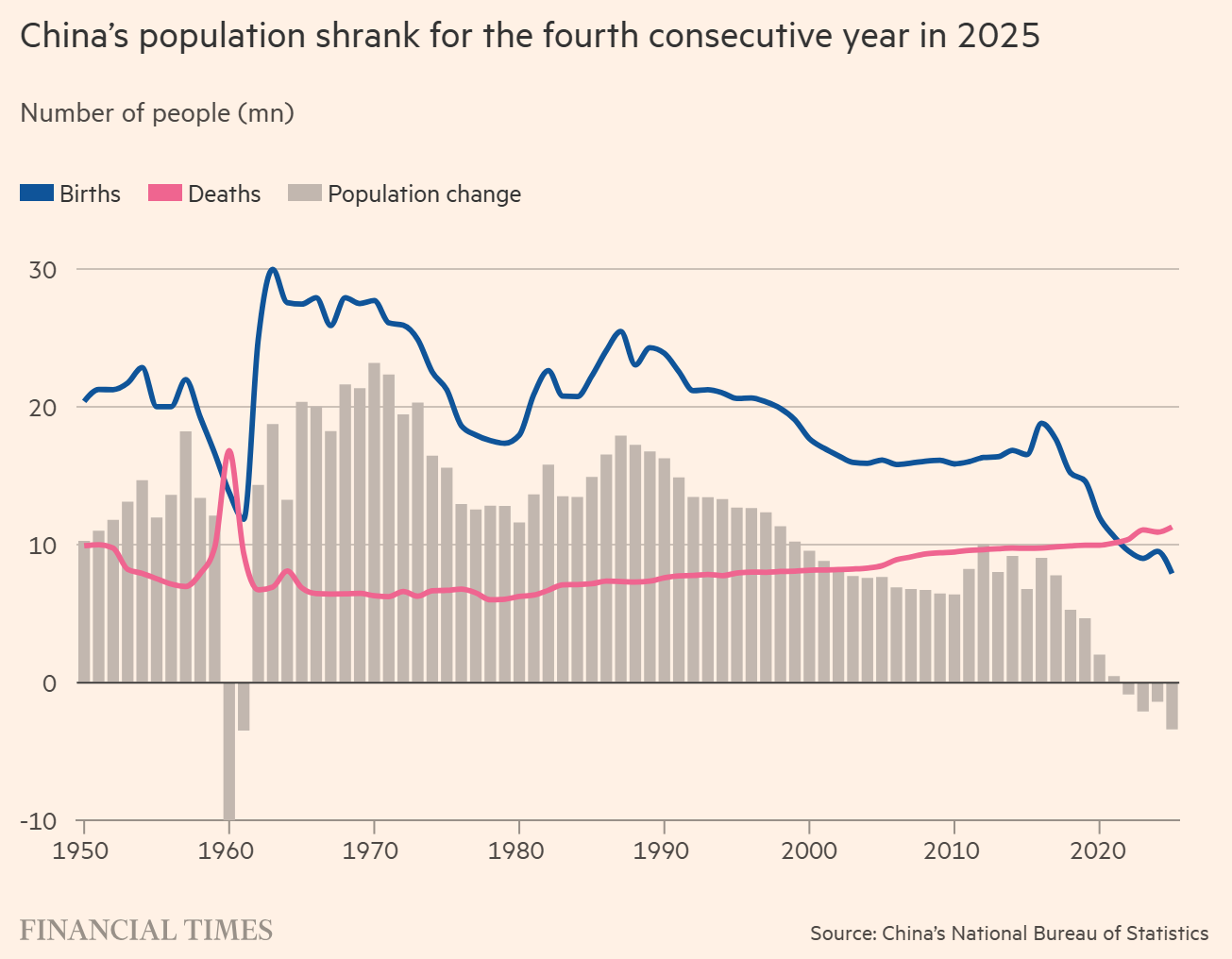
The Financial Times reports that China’s total fertility rate dropped to 0.98 in 2025. According to official statistics, the number of births is now less than half of what it was in 2015, when the one-child policy was abandoned. In my view, the significance of that policy for the Chinese fertility rate has been overstated. The more important factor is that China is subject to the same cultural changes that drive down fertility in many countries around the world, not least its East Asian neighbors.
The low number of births meant that China’s population fell by 0.24 percent to 1.405 billion in 2025. Long-term projections are uncertain, but one UN study estimates the population will more than halve by the end of the century.
AI companies could grow huge even without transforming the economy
Dwarkesh Patel recently claimed that ‘AI models keep getting impressive at the rate the short timelines people predict, but more useful at the rate the long timelines people predict’. We combine an underestimate of technical progress with an overestimate of how much economic impact a given rate of technical progress will have.
It’s a view that resonates with many, and I think it has a lot of truth to it. At the same time, the story is a bit more complicated than it might seem. In a series of 2025 predictions collected by AI Digest, forecasters were on average almost correct on technical benchmarks, but severely underestimated revenue growth at AI companies. Together, OpenAI, Anthropic, and xAI had $30.4 billion in annualized revenue by the end of the year, almost twice the median estimate of $16 billion.
Dwarkesh is focusing on more salient forms of economic impact, such as massive job automation. It’s true that this hasn’t happened – and in this way, his line is correct. We do overestimate how easily technical progress translates into these forms of economic impact. But I think we also overestimate how transformative an impact is needed for AI revenue growth to take off. Internet companies such as Alphabet and Meta became enormous without fundamentally changing the economy. This suggests that AI companies could grow very big even if we don’t see a transformative economic impact anytime soon.
Why we can trust that Waymos are safe
Kelsey Piper has published a thorough fact check of David Zipper’s claim that ‘we still don’t know if robotaxis are safer than human drivers’. One point I found particularly convincing is that we can broadly trust Waymo’s claim that its cars are involved in 80–90 percent fewer crashes leading to serious injuries than cars with human drivers. Waymo is more transparent about its crashes than the law requires, and its data is regularly reviewed by external analysts such as Understanding AI. Also, since the media tends to cover serious accidents, I think we’d soon learn if there were lots of cases that Waymo failed to report. As I’ve argued before, Zipper’s fight against self-driving cars is doomed to fail.
Foreign investments in China are falling
According to multiple metrics, foreign investors have become less keen to invest in China. The Economist looks at greenfield foreign direct investments – building new factories or other facilities, as opposed to buying ones that already exist. This metric has fallen for more than a decade.
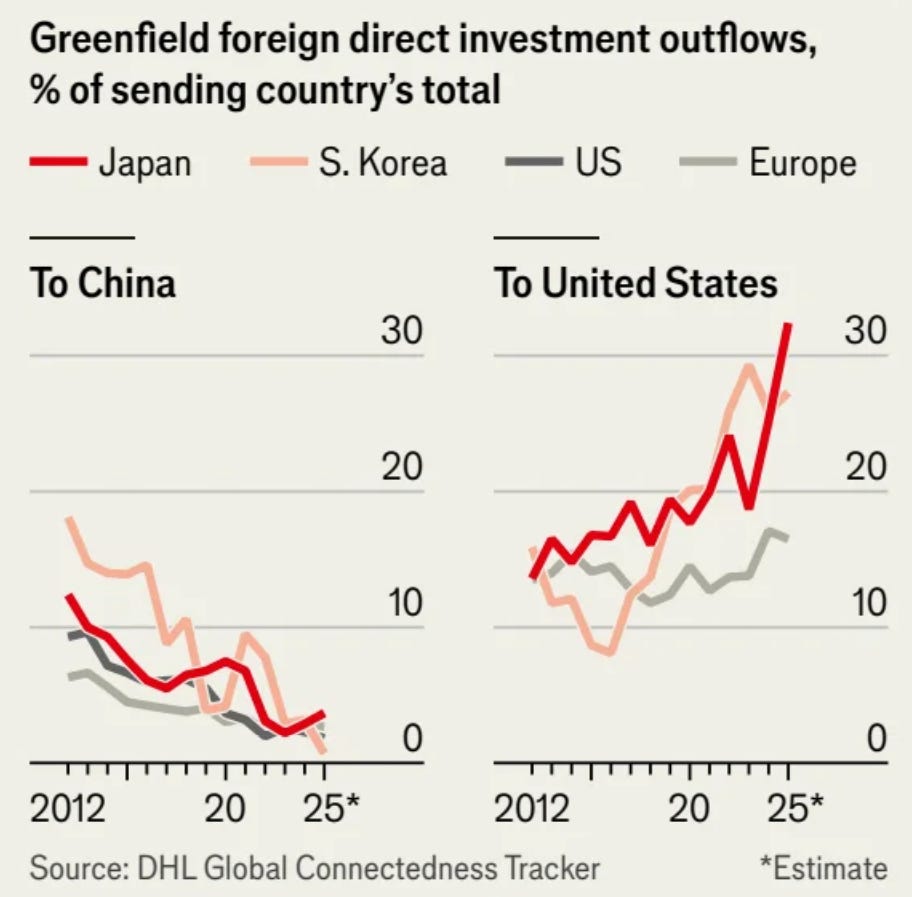
Robin J Brooks instead looks at foreign capital inflows, which surged during Covid but have dried up since 2022. He attributes this to Russia’s invasion of Ukraine – many investors lost money when Western sanctions hit, and Brooks argues they now fear a similar scenario if China invades Taiwan.

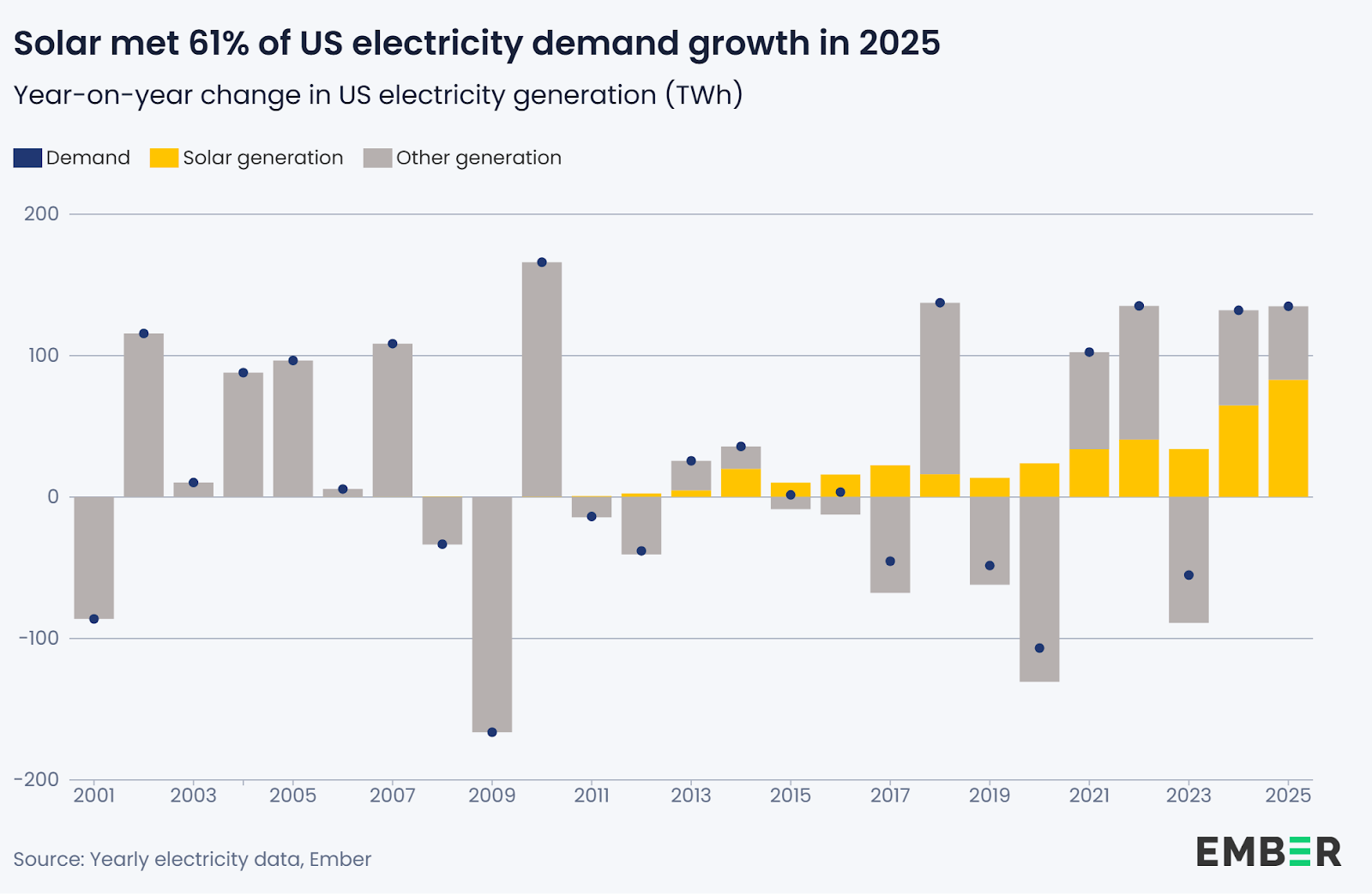
Most of the American electricity growth came from solar in 2025
American solar electricity generation grew by a record 27 percent in 2025, to 387 terawatt hours. Overall, American electricity demand grew by 135 terawatt hours (3.1 percent), with solar supplying more than half of that increase. This increase meant that solar accounted for 8.5 percent of total American electricity generation in 2025.
Robberies and burglaries have fallen by 80–90 percent in the US
Our World in Data has published some fascinating charts of American crime trends from 1979 to 2024, showing that several crimes affecting ordinary people have seen steep declines. If we include the double-digit falls in 2025, robberies are down by around 80 percent since the peak in 1991, and burglaries have fallen almost 90 percent since 1980. Homicides have not fallen quite as much, but are still down by more than half since 1980.


In brief
As Jason Crawford often says, everything has to be invented. This is very true of food safety, which was atrociously bad in the early industrial era. Phoebe Arslanagić-Little writes for Works in Progress about the dreadful state of Victorian bread, and how it was fixed by the doctor John Dauglish. He discovered that you can make bread rise by forcing carbonated water into the dough – a method that made bread production both cheap and clean, allowing him to outcompete the old unsanitary bakeries.
Dylan Matthews writes about the impact of LLMs and social media on public discourse, a topic I discussed last week. He argues that while some technologies push our worldviews apart – like the printing press during the Reformation – others bring them closer together – like broadcast media. While social media is in the former camp – separating us into bubbles – today’s LLMs are in the latter, as they tend to converge on the same fairly accurate responses regardless of who is asking.
The first volume in Stewart Brand’s Maintenance: Of Everything is out today from Stripe Press. By default, most things corrode with time – and it takes persistent and often ingenious efforts to keep them from falling apart. Yet the success of these maintenance efforts makes them invisible, since we don’t notice when things are working. In this book, Brand addresses this blind spot, showing that maintenance is essential to civilization.
That’s all for today. If you like The Update, please subscribe and share with your friends.
I find that the effects of the one-child policy tend to be understated.
Just measuring direct impacts, absent the one-child policy, there would be something like 40 million more Chinese females of child bearing age (about 25% more). That’s more than enough to smooth off that birth-death ratio table, not to mention the indirect effects (normalising small families etc.).
In the absence of any family planning policies, it’s plausible that China could have a population around 1.9 billion today, with a fertility rate closer to Vietnam (TFR: 1.9).