


Welcome to The Update. I am experimenting with briefer and more frequent newsletters. We’ll see where it lands.
In today’s issue:
The quixotic fight against self-driving cars
The self-driving Waymo cars had a good 2025. Despite being both slower and more expensive than their competitors, they’re popular with customers and have already taken ten percent of the ride sharing market. And Waymo has also received positive attention for its safety record. According to the company’s own data, its cars are involved in 90 percent fewer crashes resulting in serious injuries than other cars. In addition, most of the crashes are actually the fault of a human driver, as Kai Williams notes. This means that accident rates should drop further once a larger fraction of cars are self-driving.
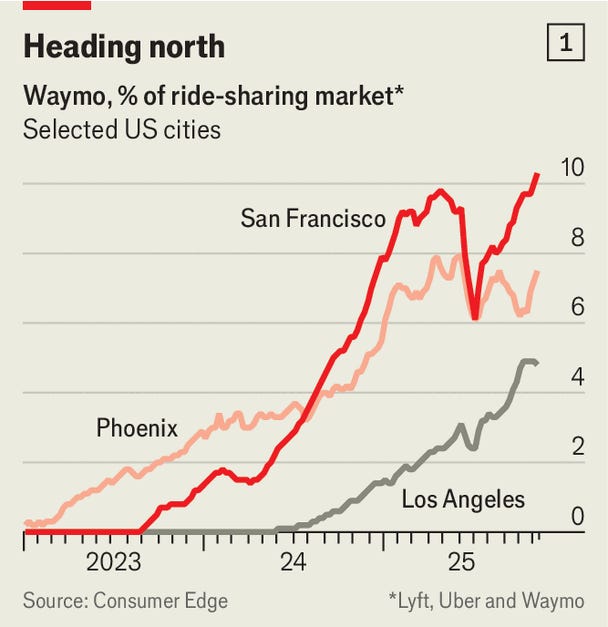
But not everyone is thrilled. Self-driving cars are coming to Europe, but David Zipper of the MIT Mobility Initiative urges Europeans to think again. The safety benefits of self-driving cars are ‘of dubious relevance to Europe’, where ‘roadways are already much safer than those in the US’, he writes.
This seems like an odd argument. Even though it’s true that American road safety is worse, the problem is very significant in Europe, too. Besides injury and death, there are many hidden costs, as people avoid biking on roads, prevent their kids from roaming, and adjust their behavior in many other ways to protect themselves. Self-driving cars offer tremendous benefits, and with time, people will come to appreciate that. Governments that block them will face increasing resistance, as voters see the technology working elsewhere. Zipper is fighting a losing battle.
Vaccine development has accelerated
In an article for Works in Progress, Saloni Dattani gives a thorough overview of the history and potential future of vaccines. The first vaccine was the result of luck, as cowpox infection happened to offer cross-protection against smallpox, which is far more dangerous. But this success inspired attempts at replication – and in the late 1800s and early 1900s, scientists developed vaccines against many of humanity’s ancient enemies: typhoid, plague, tuberculosis.
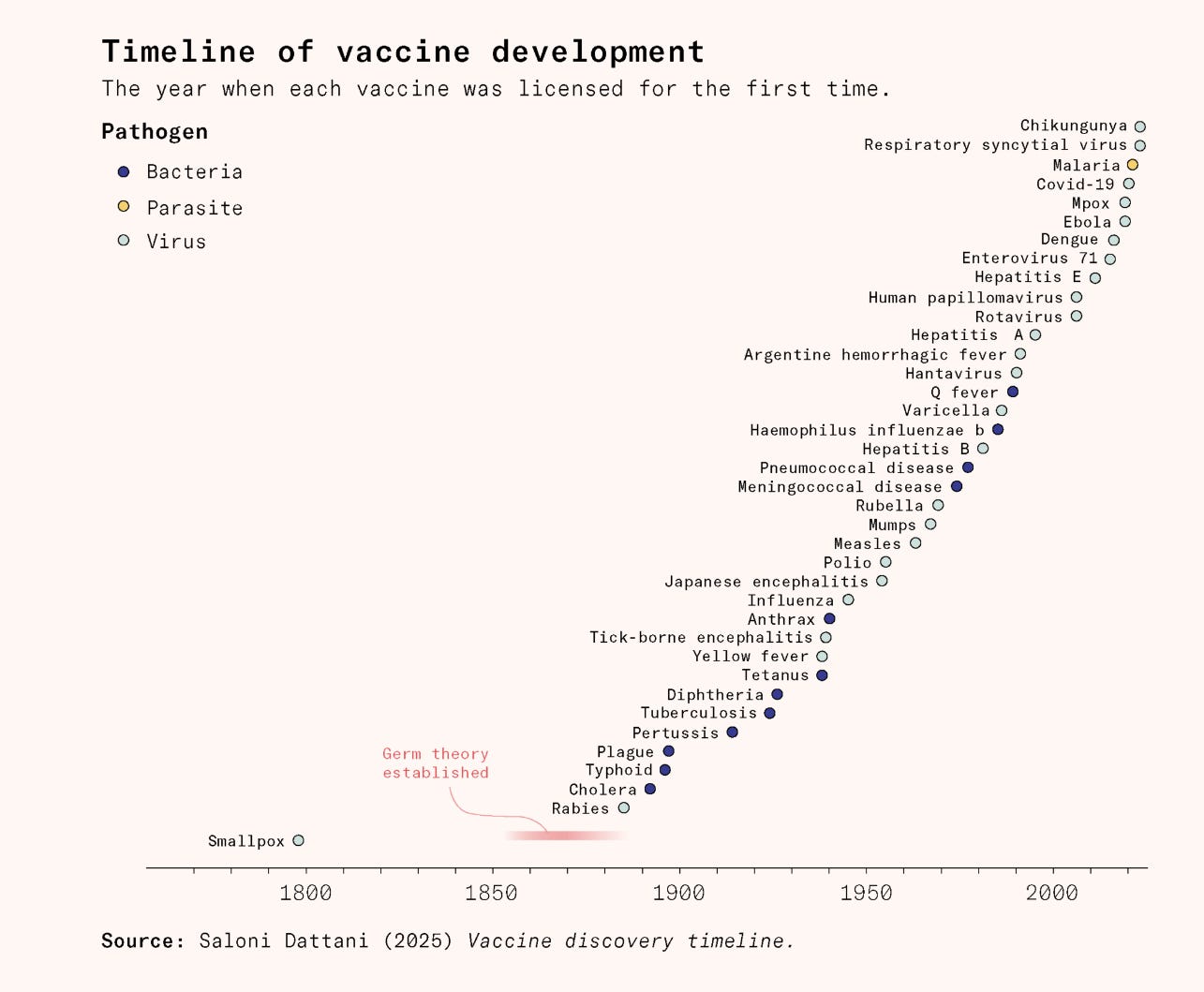
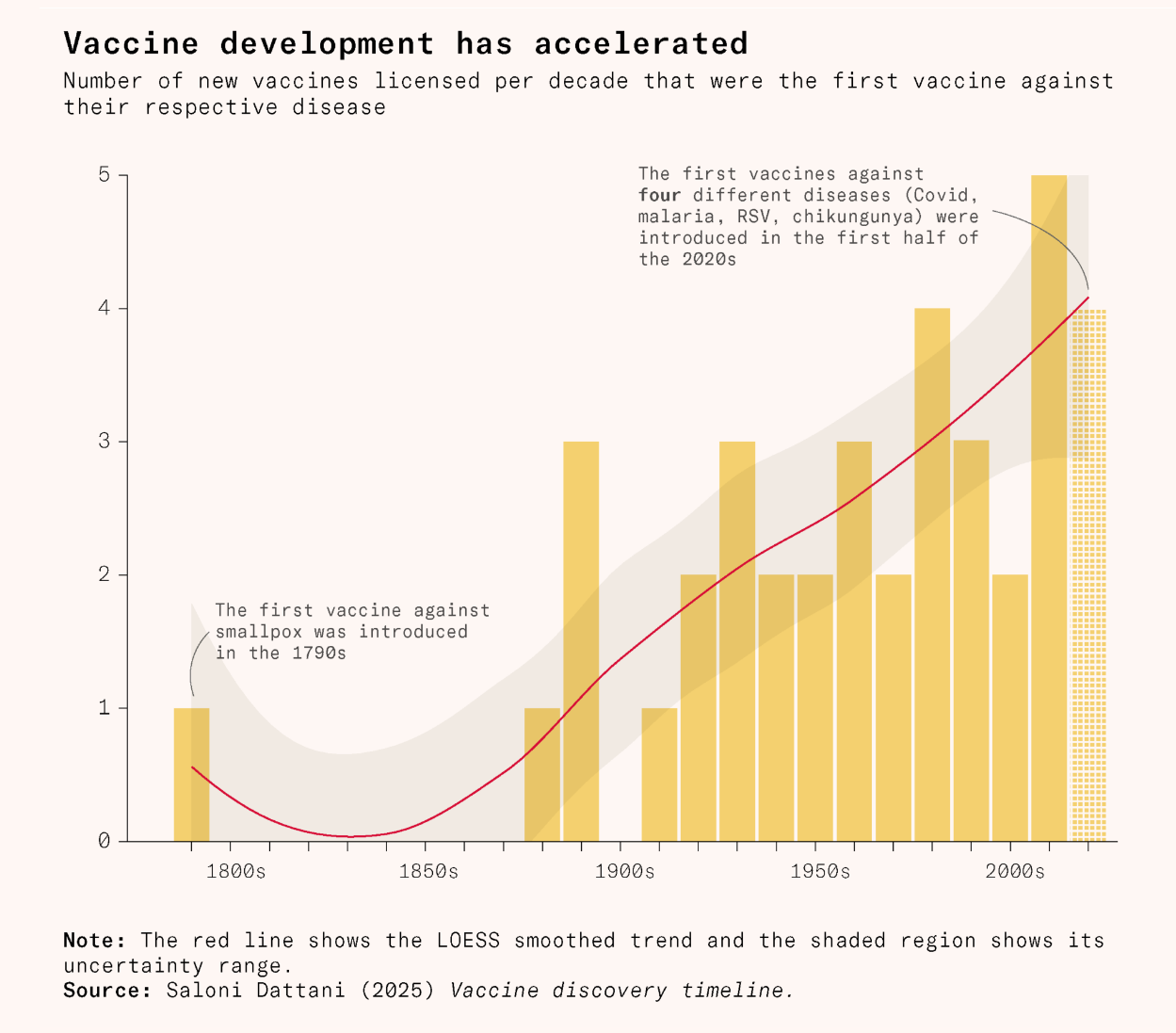
It’s well known that technological progress sometimes slows down as the lowest-hanging fruit gets picked. But this has not happened in vaccine development. As Saloni explains, progress has actually accelerated thanks to a range of technological breakthroughs, from cheaper sequencing of virus genomes to the use of mRNA, which allows the body to produce the immunity-inducing protein itself. In the 2010s, we got vaccines against a record-breaking five diseases – and the 2020s are on track to do even better, thanks to the vaccines against Covid, malaria, RSV, and chikungunya.
Forecasters put the chance of Iranian regime change this year at 42 percent
As Amwaj Media reports, the US raid on Caracas has led to intense debate among Iranians. Several of Iran’s allies – al-Assad in Syria, Hezbollah in Lebanon, now Maduro in Venezuela – have suffered defeats in the last few years, and some ask if Iran is next. The country’s main ally is Russia, which has its hands full and couldn’t protect al-Assad and Maduro. In addition, the protests against the regime have recently gained steam. The Sentinel Global Risks Watch forecasters estimate the chance of a regime change this year at 42 percent.
AIs that don’t need humans
As I’ve reported previously, the debate on whether we’ve reached artificial general intelligence (AGI) yet suffers from a basic problem: that people disagree about what it actually means. We need new concepts, and Ajeya Cotra puts forward ‘self-sufficient AI’: AI systems that could ‘keep making more copies of themselves indefinitely’ (using chip factories and other physical infrastructure) even if humanity went extinct.
As Ajeya points out, what concepts you define depends on your focus. This one is particularly useful for those who worry that AI could wipe out humanity, since systems that aren’t self-sufficient couldn’t survive if they killed us all. Others are more interested in the near-term economic impact of AI, and they may want to create other concepts. We shouldn’t replace AGI with just one concept – we need several, each precise and fit for purpose. Self-sufficient AI seems like a good start.
Food production has outpaced population growth
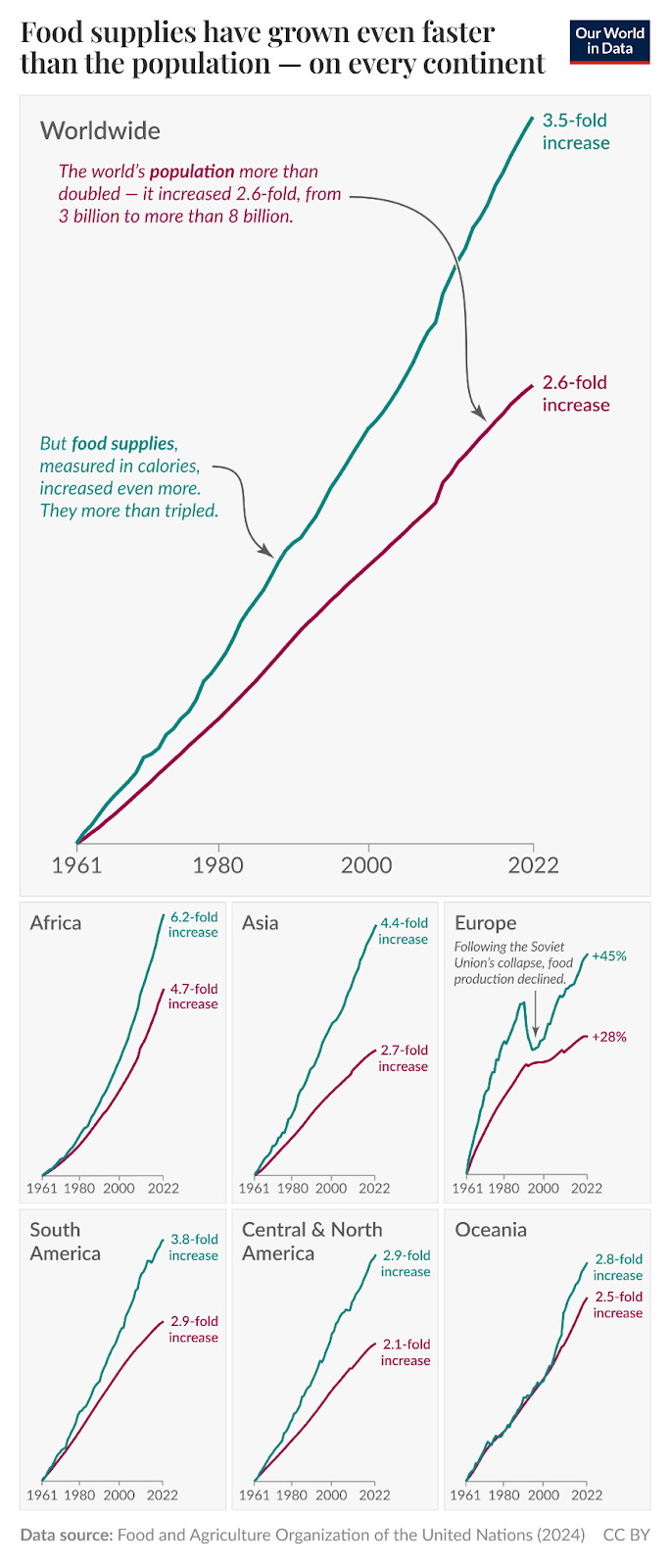
In the 1960s, many believed that food production wouldn’t keep up with population growth. Paul Ehrlich famously claimed that hundreds of millions would starve to death in the 1970s and 1980s. But thankfully, his dire prediction didn’t come to pass. As Our World in Data shows in a new visualization, food supplies – measured by calories – have grown substantially faster than population on every continent. Even in Africa, where population growth has been fastest, food supplies have outpaced it by a third. While hunger remains a big problem – and while it’s crucial to increase sub-Saharan agricultural productivity – we’ve made more progress than once expected.
The cost of noise
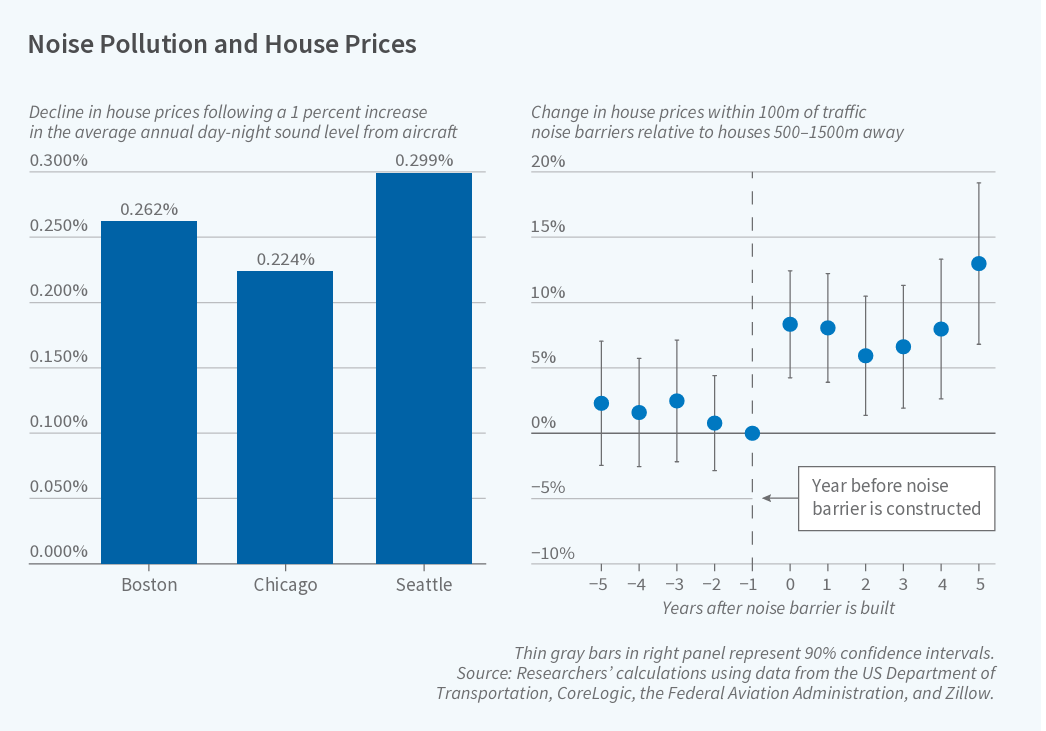
Most people find noise annoying and would pay to avoid it. But how much would they pay? What is the cost of noise? A recent article in the National Bureau of Economic Research’s Digest highlights two papers that seek to answer those questions. In ‘Planes Overhead’, Florian Allroggen and colleagues look at how changing flight paths have affected property prices near airports in Boston, Chicago, and Seattle. They find that when sound levels increase by one decibel, house prices decline by 0.6–1.0 percent – a substantial amount, given that the observed increases reached up to ten decibels.
In the other paper, ‘The Traffic Noise Externality’, Enrico Moretti and Harrison Wheeler study the cost of another kind of noise: traffic. When noise barriers are introduced, prices of properties within a hundred meters increase by 6.8 percent, on average. Based on the impact on property prices, they estimate the total cost of traffic noise to be $110 billion – more than $300 per American. But they also think that noise levels could fall a lot – enough to eliminate 70 percent of this cost – if Americans switched to quieter electric vehicles.
ChatGPT’s market share is shrinking
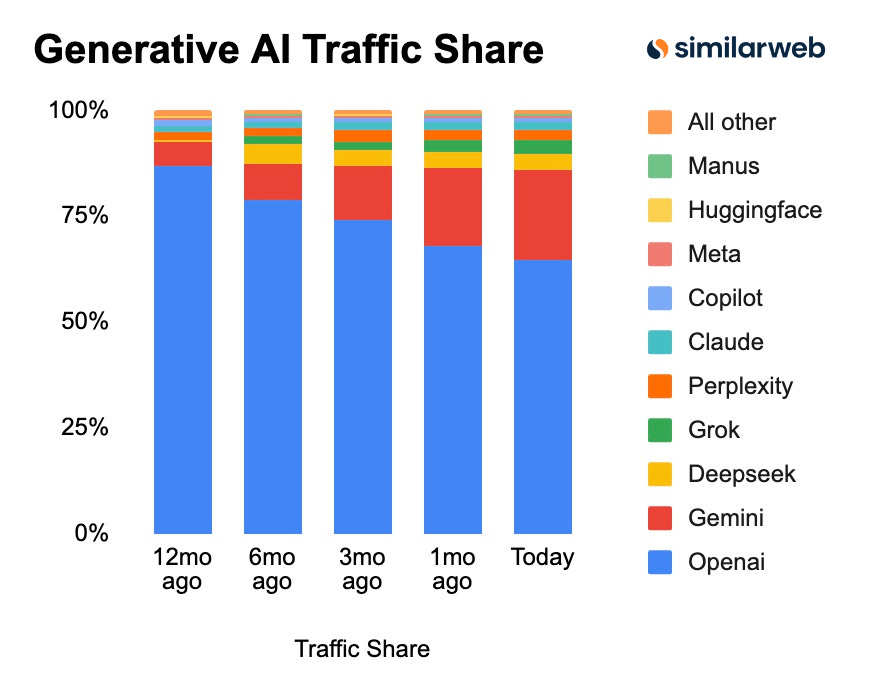
ChatGPT has dominated the generative AI market since its launch in November 2022, to the point where many people haven’t even considered using any of its competitors. But recently, its market share has been shrinking. According to Similarweb’s data, ChatGPT now has 64.5 percent of the market, down from 86.7 percent a year ago. The main competitor is Google’s Gemini, whose market share has almost quadrupled – from 5.7 percent to 21.5 percent – in the same period. One factor is likely that big tech companies’ existing customer bases give them an advantage in the AI race.
That’s all for today. If you like The Update, please subscribe and share with your friends.