


Welcome back to The Update. I hope you’ve had a good start to the year.
In today’s issue:
Why is crime plummeting in the most liberal places in the world?
In the heated debate over crime in Western countries, two places that are often mentioned are San Francisco and Sweden. San Francisco is cited in US discussions of urban decline, whereas Swedish gang shootings have become a talking point across Europe. Since both places are unusually liberal – Harris beat Trump by five to one in San Francisco, and Sweden has the most progressive values in the world – these problems have naturally attracted political attention.
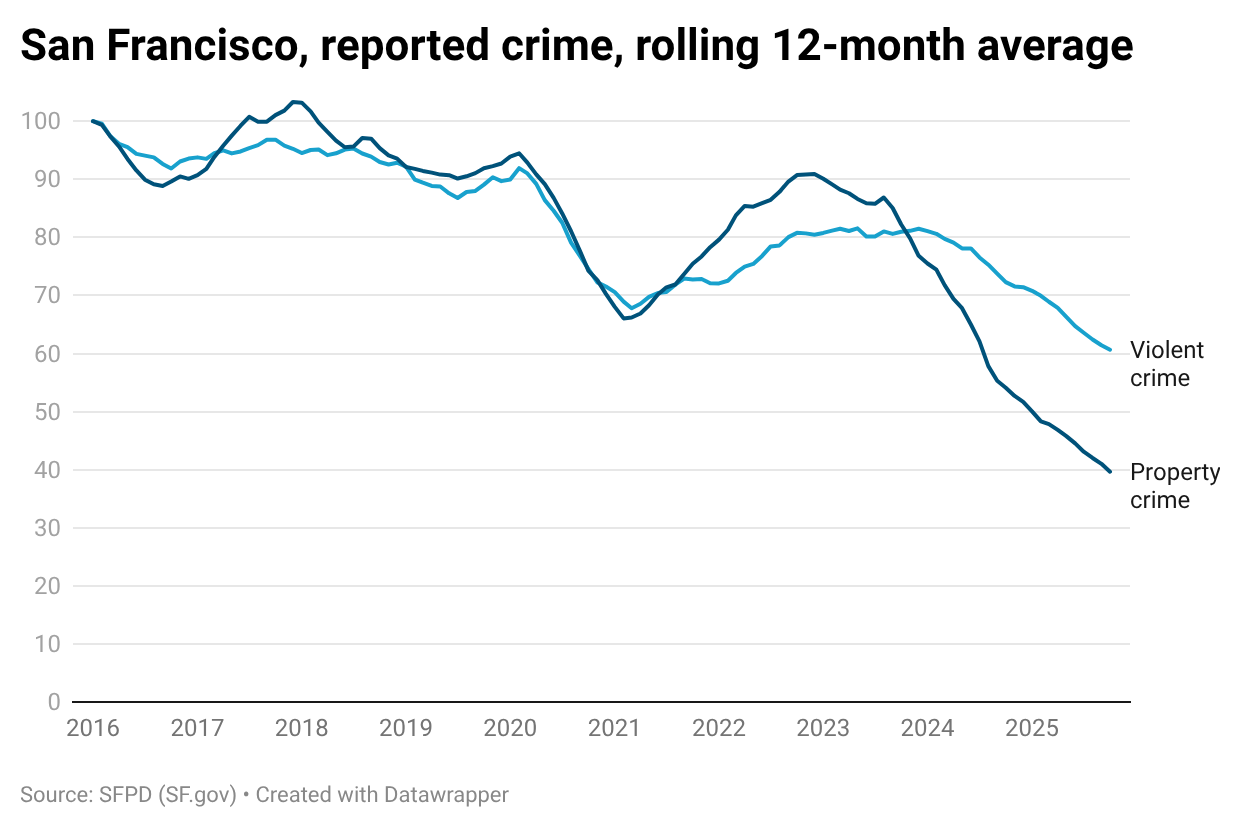
But recently, the trends have reversed. In San Francisco, violent crime has declined by more than a quarter over the past three years, and property crime has dropped by more than half:
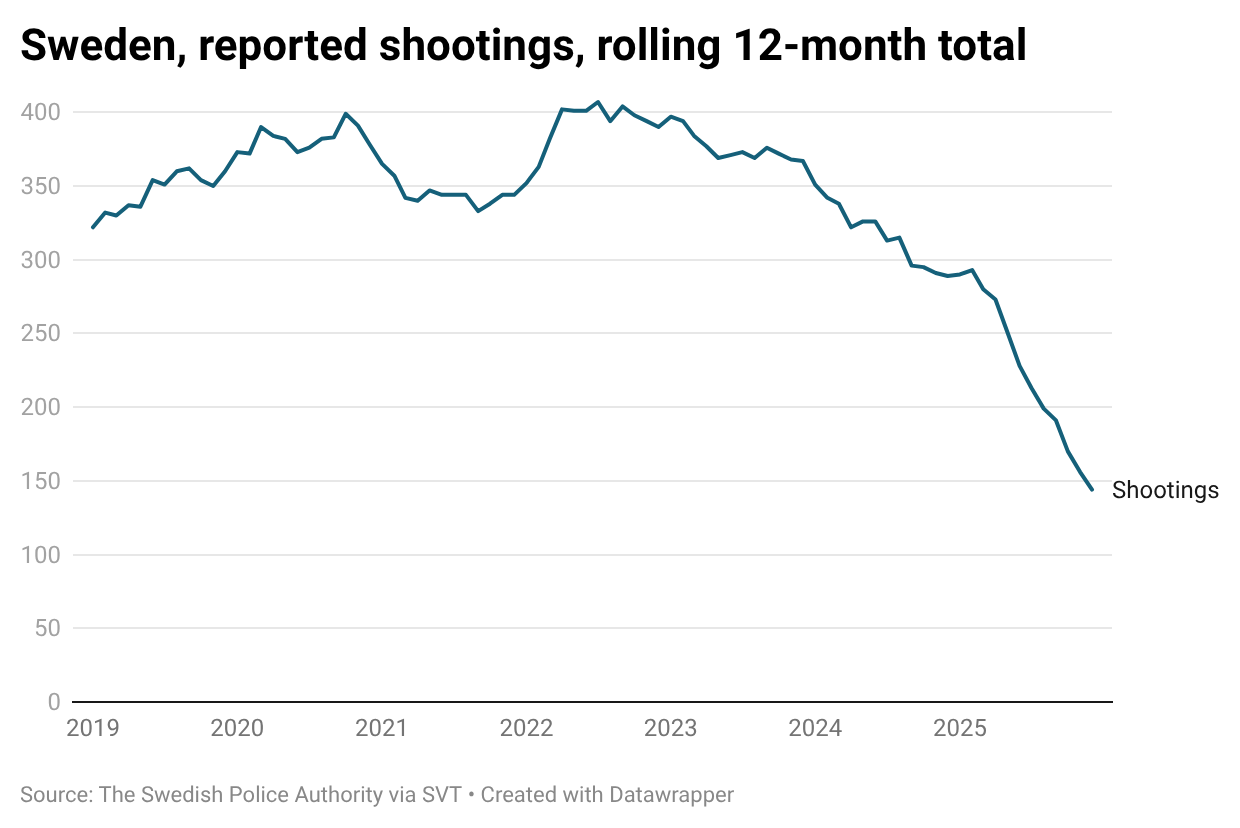
Meanwhile, Swedish shootings have fallen by almost two thirds during the same period:
One explanation for these trends is that the softer policies San Francisco and Sweden have long been known for are finally bearing fruit. But another – which I find more plausible – is that the reversal is happening because both San Francisco and Sweden have moved toward more centrist crime policies. Either way, it’s a cause for optimism: crime rates are already falling in many Western countries, and some of the places that were struggling are now doing better.
How fast is the US growing?
While the American labor market is weakening, growth numbers for the third quarter turned out to be unexpectedly high: 4.3 percent. Naturally, this received plenty of attention, especially since many had expected the tariff increases to be a bigger drag on the economy. At the same time, we need to keep in mind what the 4.3 percent figure means. It’s the annualized growth rate for the third quarter: the annual rate you’d get if growth continued at the same pace for a year. But that rarely happens – quarterly rates often spike and dip. The most recent figure for actual annual growth (Q3 2024 to Q3 2025) is 2.3 percent.
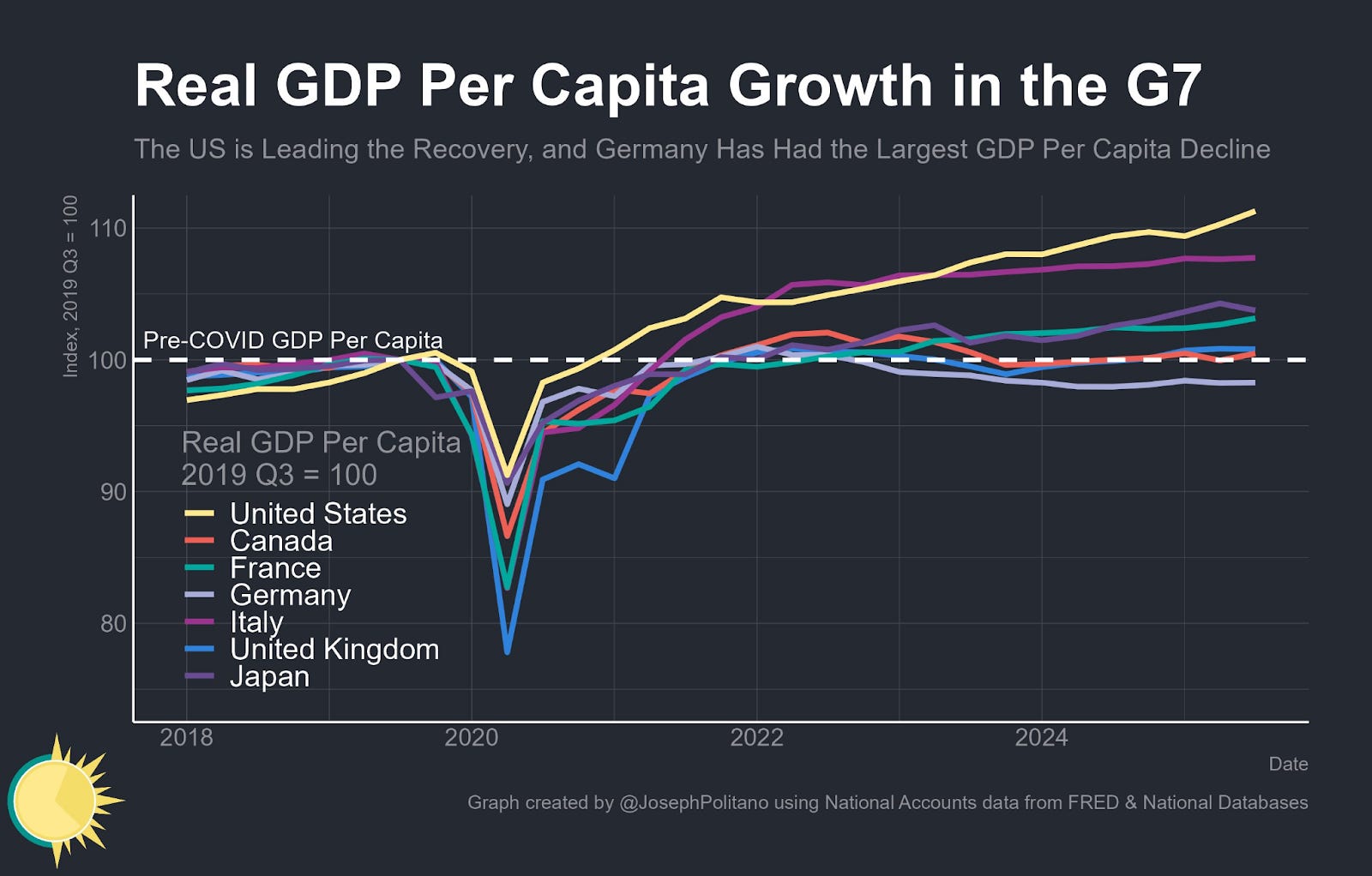
The debate over the Q3 numbers is an example of how we’re often too shortsighted when we discuss economic growth. Given how much it fluctuates between quarters, it tends to be better to zoom out and look at multi-year trends – as in this Joey Politano chart showing how the US has kept outperforming the rest of the G7 since before Covid-19.
How luxury apartments lower rents for everyone
Many people are opposed to new luxury housing, believing that it doesn’t reduce the cost of living for ordinary people. But recently, rents in US cities such as Austin, Denver, and Phoenix have fallen, precisely because of an influx of new luxury apartments. What critics fail to see is that these apartments have knock-on effects on the rest of the market. The luxury apartments themselves may be rented by the affluent – but the homes they leave will go to people further down the ladder, whose homes will in turn become available to still others. Through such moving chains, new luxury apartments free up homes for people with lower incomes and reduce rents across the board.

The war has strengthened support for Putin
The Russian invasion of Ukraine has been very costly for Russia, with extensive sanctions and more than 200,000 soldiers killed. One might think it would lead to reduced support for President Vladimir Putin, but recent research shows that the invasion strengthened his approval rating by 13 percentage points. This rally ’round the flag effect has continued to hold up, with the mobilization in September 2022 leading only to a temporary blip.
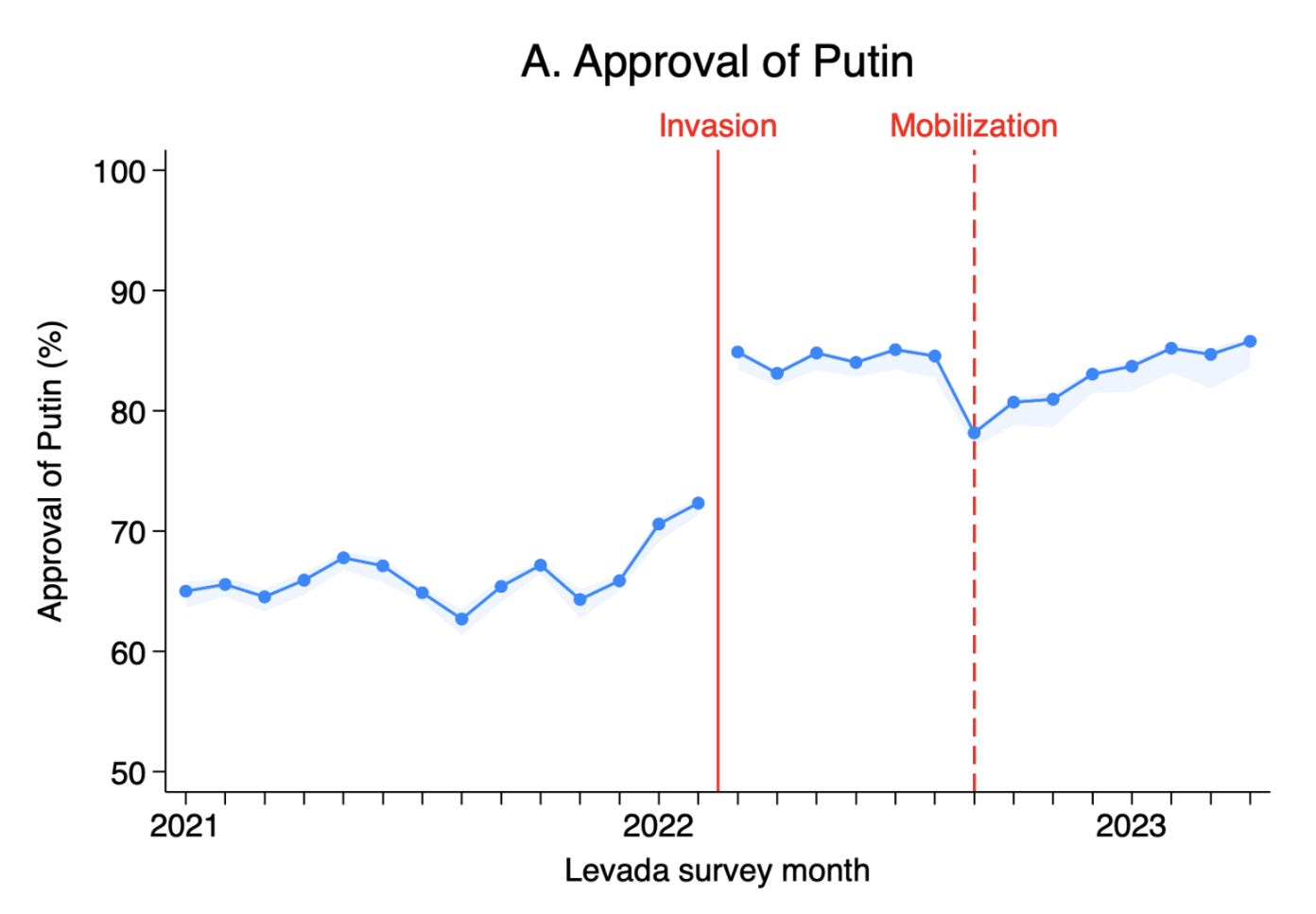
As I reported on 16th December, Russian support for the war itself has recently decreased – but Putin still has a stable 85 percent approval rating.
A striking fall in American death rates
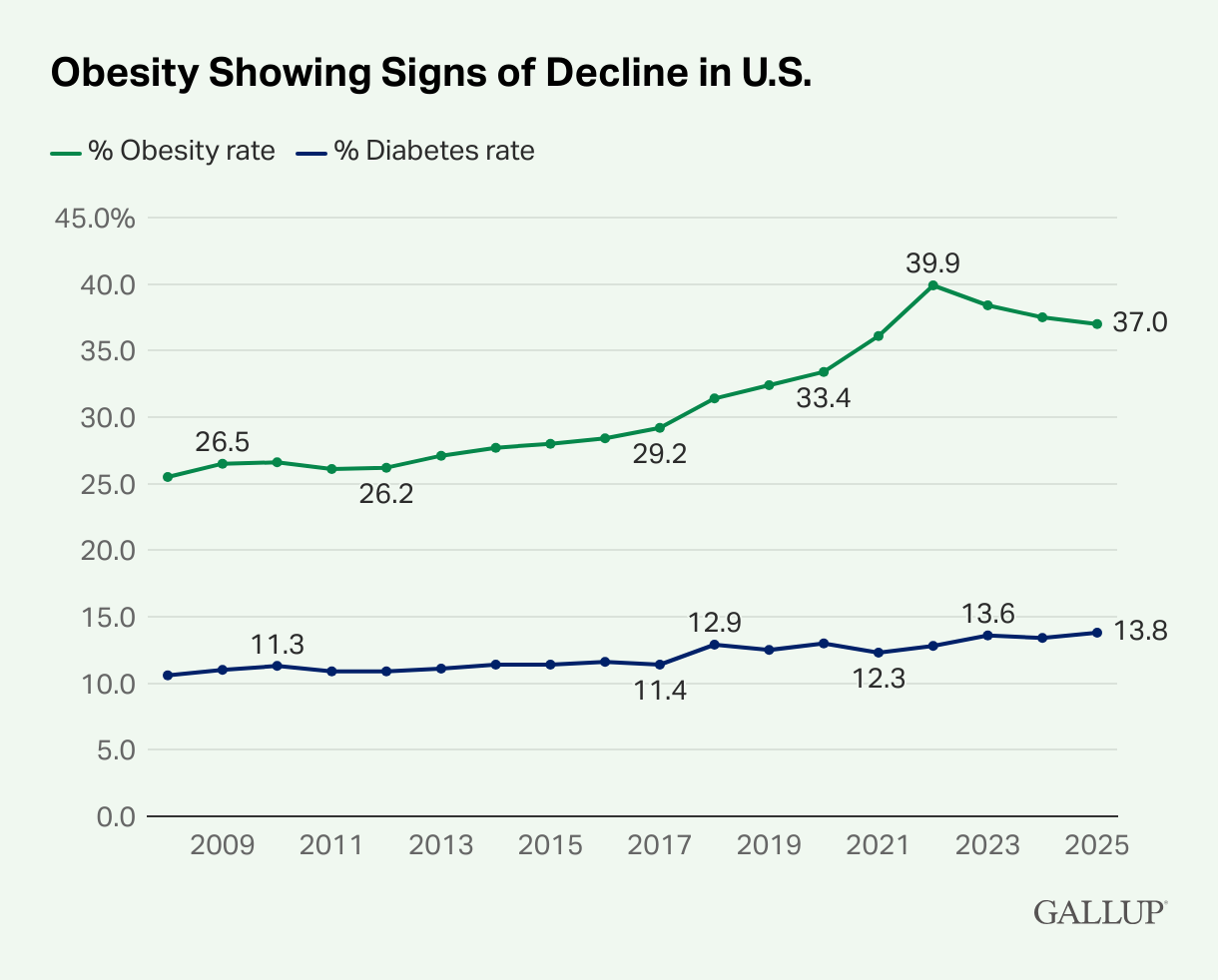
Noah Smith reports on ten positive trends in the US, including falling death rates from multiple causes. The US has long had a lower life expectancy than other rich countries, but now big improvements are underway. Deaths from homicide, traffic accidents, overdoses, and alcohol are all down, and even suicides decreased slightly in 2024. Moreover, the long-term rise in obesity – another leading cause of premature death – began to reverse in 2022, likely thanks to new GLP-1 drugs. It’s striking that so many disparate trends are improving at the same time. If these improvements continue, the US should close some of the life expectancy gap with its peer countries in the years to come.
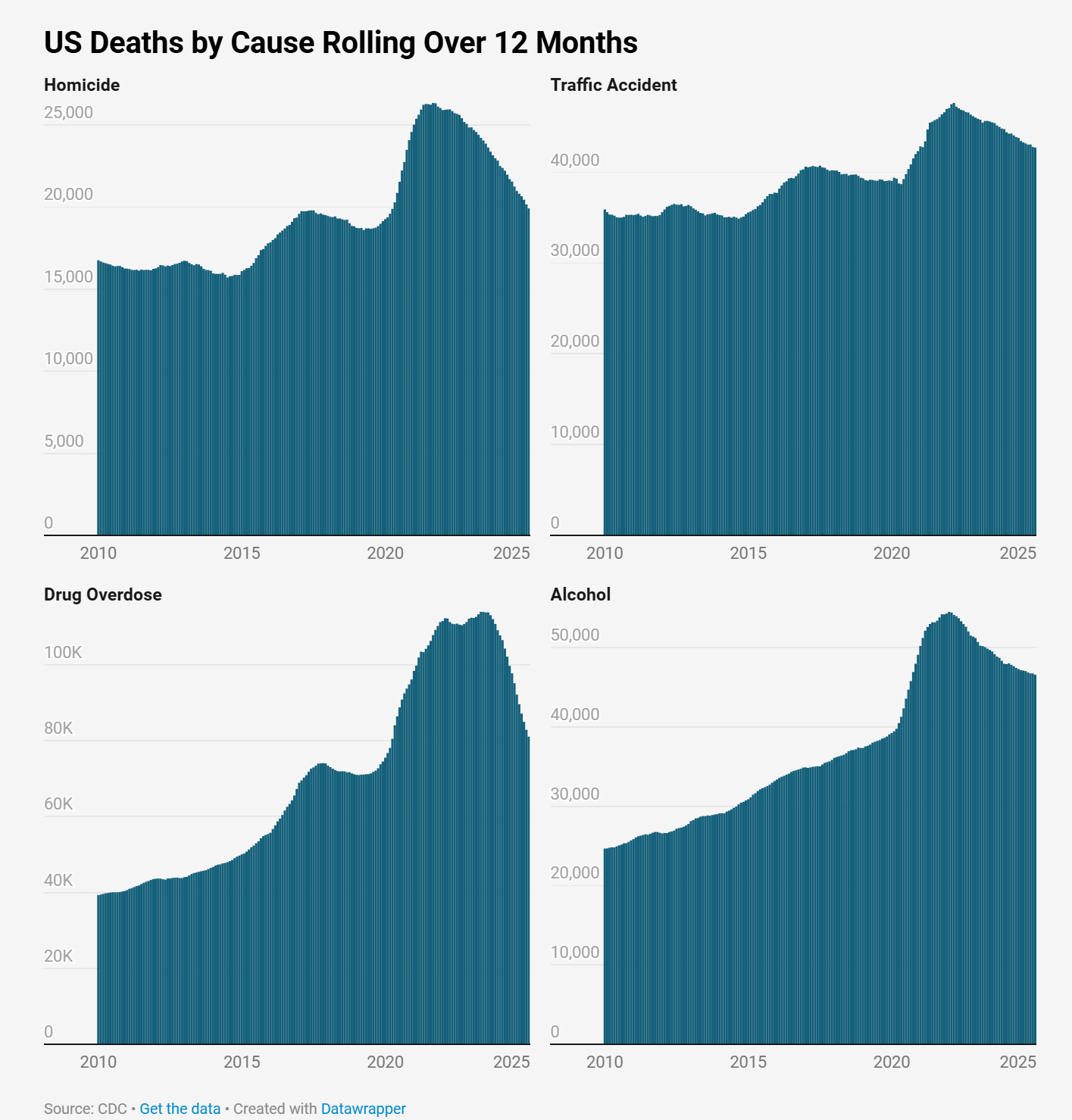
Source: Jeff Asher, who has an excellent article on these trends.
New book on progress: The Techno-Humanist Manifesto
Jason Crawford is turning his essay series The Techno-Humanist Manifesto into a book, to be published by MIT Press in early 2027. The series presents a broad philosophy of progress, including both an extensive argument for why progress is good and an explanation of why it occurs. It has many detailed descriptions of specific scientific and technological breakthroughs, as well as a vivid account of the innumerable ways in which progress has improved life on Earth.
One concept I found especially illuminating was ‘the flywheel of progress’: the idea that different drivers of growth reinforce each other in positive feedback loops. For instance, better technology leads to better infrastructure, which leads to more wealth, which in turn is invested in even better technology and infrastructure. These feedback loops mean that once progress takes off, it gains ‘almost unstoppable momentum’.
But how is progress doing today? Jason argues that excessive bureaucracy and a romantic backlash against progress have landed us in a crisis. This is one of the few places where I part ways with him. While it’s true that there’s some resistance to progress, we need to keep it in proportion. In everyday discourse about economic growth, it’s completely taken for granted that growth is a good thing. The flywheel is far stronger than the forces trying to hold it back. Many of Jason’s essays are written from a long-term, historical perspective – and it’s instructive to apply the same perspective to our own time. How are people going to look back on our era in the centuries to come? I think the story they’ll tell is that of the flywheel’s continued momentum.
Less has changed than Americans expected in 1998
If you ask people whether some future event is going to occur, they are systematically biased toward saying ‘yes’. They overestimate how much things will change. This bias was on full display in a Gallup poll from 1998, which asked Americans what would happen by 2025 (I added the icons).
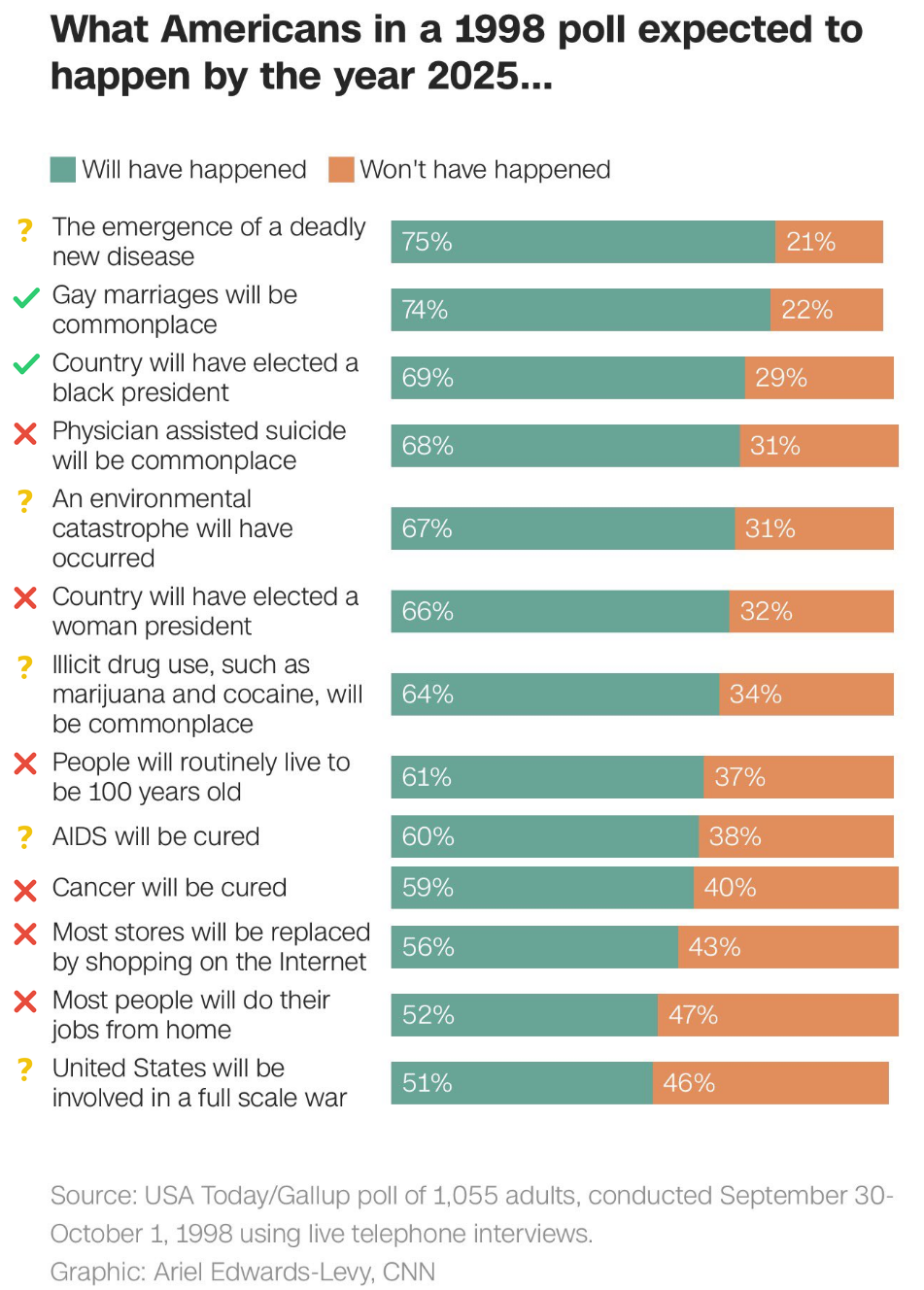
In my judgment, only two of these predictions were clearly correct, while six were wrong. The remaining five are matters of definition. What counts as a ‘deadly’ disease, an environmental ‘catastrophe’, a ‘cure’ for AIDS, and a ‘full scale’ war? And the drug prediction depends on which word you emphasize, as marijuana use is now widespread but no longer illicit in many jurisdictions.
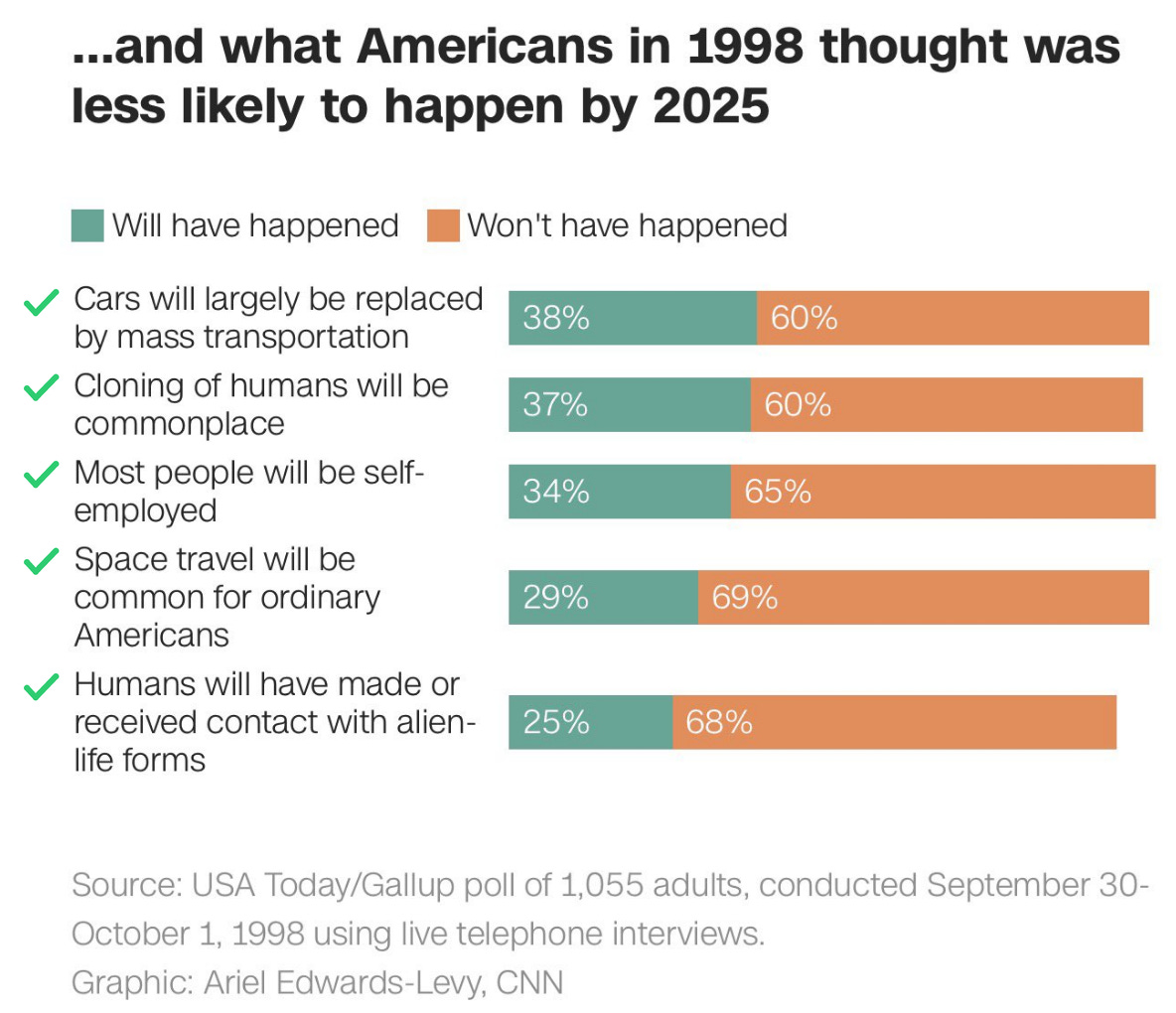
On the other hand, the predictions of what wouldn’t occur were all borne out. We’re more accurate when we predict the status quo to continue than when we predict it to change.
Medical breakthroughs in 2025
Saloni Dattani has published a thorough review of the biggest medical advances in 2025. Here are some of my favorites.
The UK became the first country to roll out a vaccine against gonorrhea (targeted at gay men). The NHS estimates it could prevent up to 100,000 cases over the next decade, given high uptake.
In a late-stage trial, the non-opioid painkiller suzetrigine relieved post-surgery pain as effectively as a standard opioid painkiller but had fewer side effects.
Even more weight-loss and diabetes drugs are coming. The orforglipron pill doesn’t reduce weight as quickly as its competitors but is expected to be cheaper and not require timing with meals.
A baby with a rare genetic disease damaging his brain and liver was treated with a new type of personalized gene editing and recently took his first steps.
Beyond new treatments, Saloni also covers new methods and tools, such as a faster genome sequencing method and a gene editing tool that can insert large pieces of DNA into genomes.
An aesthetic for our time
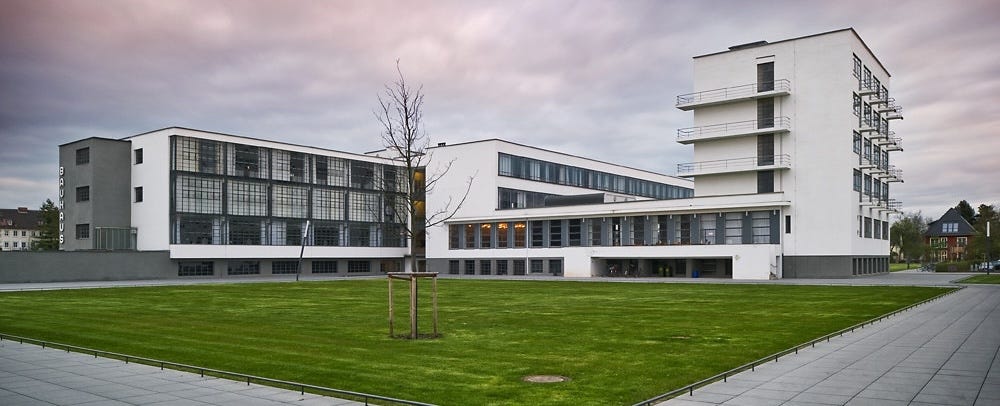
What aesthetic should the twenty-first century adopt? Patrick Collison and Tyler Cowen are funding artists, architects, and designers who seek to answer that question. In their view, the Bauhaus movement defined the aesthetic of the twentieth century through self-conscious ambition. Now they invite submissions with comparable ambition for our time. Applications are open until 31st March.
In brief
The Roots of Progress has posted a selection of talks and related writing from the Progress Conference 2025, which was held in Berkeley, 16th–19th October. Highlights include a16z’s Erin Price-Wright on the importance of hardtech infrastructure amid software progress and Base Power’s Justin Lopas on how to upgrade the American grid to meet rising power demand.
Coefficient Giving’s Abundance and Growth team, which I reported on in the last newsletter, has launched a Substack. They’ve already published several posts: an introduction to the team, 28 thoughts that shape their work on abundance and growth, and a list of economics job market papers focusing on innovation.
That’s all for today. If you like The Update, please subscribe and share with your friends.
I think this is really interesting and little known to the general public. Thanks !
I would read a full essay on “ the reversal is happening because both San Francisco and Sweden have moved toward more centrist crime policies”. Any tips if any already exist?