

Society won’t ignore AI risk
Plus: flash mob shoplifting is falling in the US, AI will make smartphones more expensive, and more

Society won’t ignore AI risk
In recent years, many people have warned that advanced AI could cause large-scale harm or even lead to human extinction. But how will society respond? That factor is crucial, yet often overlooked.
Pessimists believe that the response will be too little and too late. This rests on two claims: that we won’t get clear signs of the risk in advance, and that even if we do, the response will remain feeble.
In a new post, Coefficient Giving’s Nick Gabrieli takes issue with the first of these claims. There will soon be what he calls ‘weak agents’: AI systems that can ‘complete tasks that would take humans days or weeks, but not months’. He argues that if there is indeed a risk that we will lose control of advanced AI, then weak agents will give us early signs. The mere experience of using agents that independently execute tasks can make the risk feel real. Moreover, there will be concrete evidence of misalignment (first two links mine):
Weak agents will probably act misaligned reasonably often . . . [They] will probably:
Be hijackable by prompt injection attacks
Be subtly sycophantic in their text responses
Tell ‘white lies’ to users, e.g. failing to mention mistakes they have made while completing a task
Actively deceive users, e.g. comment out errors in code or spoofing results
Engage in weird/concerning if not actively harmful behavior in some contexts, e.g. scheming against humans on moltbook
I agree that weak agents will likely display concerning behavior. Likewise, human misuse of AI is set to grow more salient as the systems improve.
And if we do get these warning signs, I expect society to react forcefully. A politician as influential as Bernie Sanders has already called for urgent action on AI risk. In my view, the AI safety community has long underestimated society’s likely response. People don’t tend to sleepwalk into disaster.
Flash mob shoplifting is falling in the US
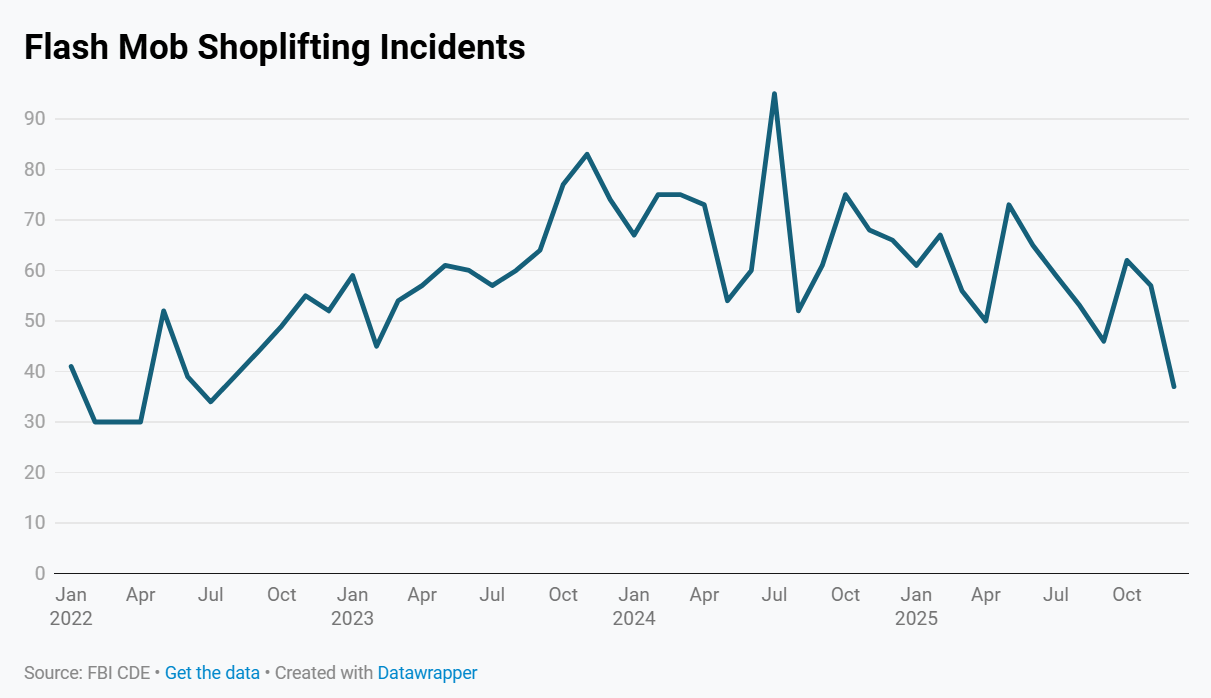
A few years ago, videos of shoplifting teenagers swarming American stores went viral on social media.
But as Jeff Asher reports, these incidents are now becoming less common.
AI will make smartphones and PCs more expensive
On the Dwarkesh Podcast, SemiAnalysis founder Dylan Patel argued that the price of smartphones and PCs will increase drastically as semiconductor production shifts toward data centers for training and running AI models. He estimates that this will add $250 to the price of the next iPhone. The impact on demand could be dramatic, especially toward the lower end of the smartphone market:
It used to be that 1.4 billion smartphones were sold a year. Now we’re at about 1.1 billion. Our projections are that we might drop to 800 million this year, and down to 500 or 600 million next year.
Dylan argues that the impact on PCs will be similar:
This probably leads to people hating AI even more. Today, you already see all the memes on PC subreddits and gaming PC Twitter. It’s cat dancing videos saying, ‘This is why memory prices have doubled and you can’t get a new gaming GPU or desktop.’ It’s going to be even worse when memory prices double again.
Though note that other forecasters suggest the effects on prices and demand will be somewhat less severe.
Mosquitoes and snakes are the world’s deadliest animals
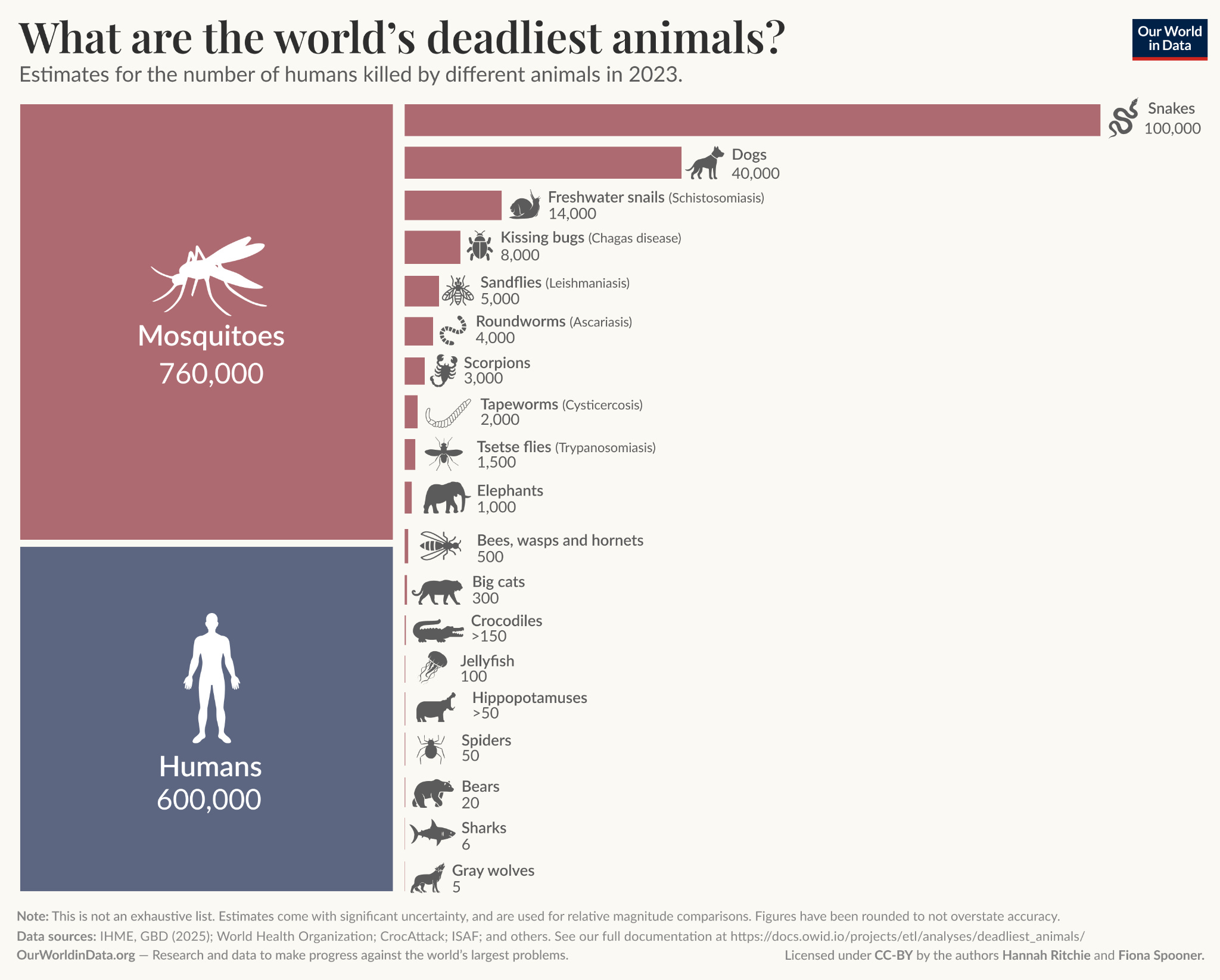
There are many animals that can kill humans, but some do so much more frequently than others. A new Our World in Data chart shows that mosquitoes are by far the deadliest animal, mostly through spreading malaria. Number two is snakes, which kill around 100,000 people per year (see Mathias Kirk Bonde in Works in Progress on how to reduce that number).
The British public says a near-term world war is likely
More than half of Britons now think another world war within the next 5–10 years is fairly or very likely.
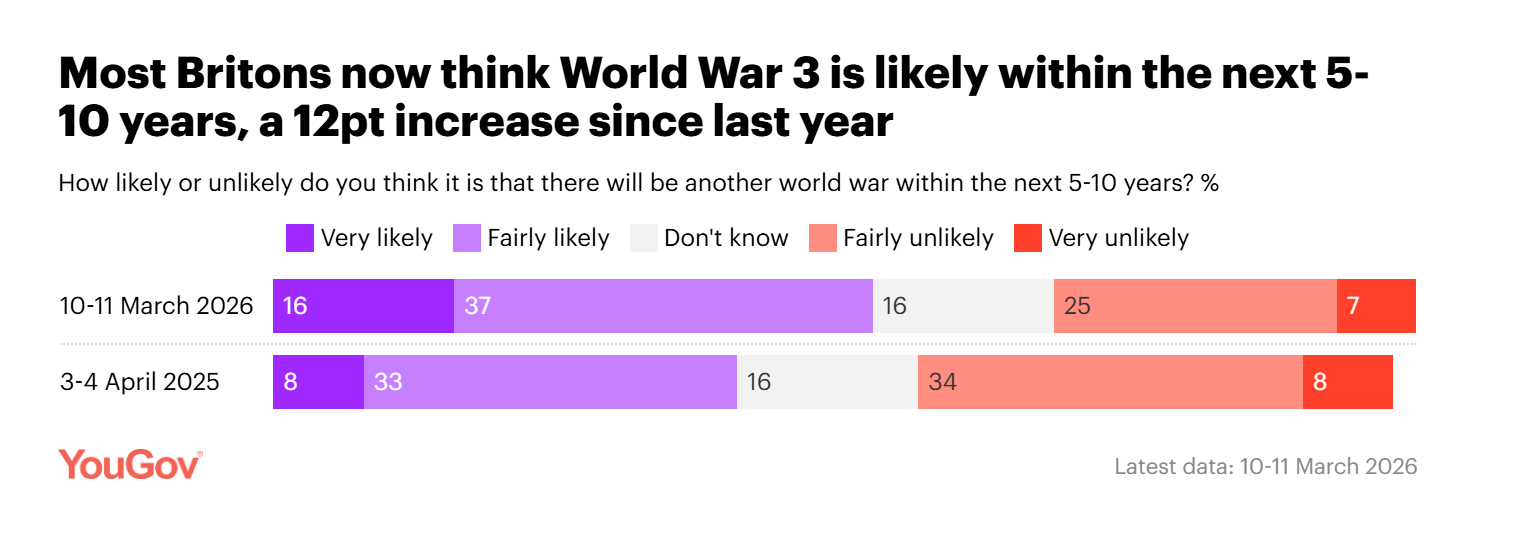
But forecasters on Metaculus estimate that there is only a 25 percent chance of a world war before 2050. The public is often overly pessimistic in surveys of this kind.
In brief
Study finds that AI lowers skill requirements and reduces wage inequalities
High school teachers who grade students too leniently reduce their test scores and future earnings
The government research institute that nurtured Taiwan’s chip industry
How to fund biotechnology projects that academics and venture capitalists don’t pursue
Stuart Ritchie and Tom Chivers on the mystery of dark oxygen at the bottom of the ocean
Land readjustment: pooling plots to let landowners share the gains from housebuilding
Agricultural bioterrorism may be a more likely threat than bioweapons targeting humans
That world in data graphic is interesting and does put a lot of things about animal harms in perspective. But it isn't very *fair* as a *ranking*. It includes roundworms (an entire phylum!) and dogs (a subspecies of gray wolves). There is massive differential in how wide the categories are.
Mosquitoes seem to "win", but actually about 40 species of mosquito can spread malaria, and although obviously some contribute far more to human deaths than others, it seems almost certain that if you track by species, humans kill more humans than any single other species does.
We're also not counting the Plasmodium parasite as the killer in the case of malaria? I mean, OK, it's not technically an "animal", but it's more directly responsible for death than the mosquito.
Unless I am misreading seems like humans are the second biggest killer of humans.