


Welcome to The Update. In today’s issue:
The impact of social media and AI on public discourse
On the UnHerd podcast, Florence Read, Kathleen Stock, Ed West, and James Marriott discuss the cultural and political impact of social media, taking James’s essay ‘The Dawn of the Post-Literate Society’ as their starting point. He argues that social media not only threatens to reduce people’s knowledge and intelligence but could even spell the end of our political system. Democracy is ‘boring’ and may not survive ‘in a discourse as trivialized as ours’, he claims.
But in my view, these types of worries overlook how fast technology is changing. Social media has undergone rapid shifts, and we now see the rise of an even more consequential technology: artificial intelligence. As the philosopher Dan Williams notes, AI’s impact on public discourse may be more positive. ‘A simple test: compare ChatGPT’s output on climate change, vaccines, etc., with the average user’s social media feed.’ While it’s early days for AI, we need to take it into account when we discuss the future impact of online behavior.
But why do you encounter less misinformation when you use ChatGPT than when you scroll social media? There are no doubt several reasons, but one has to do with differences in how misinformation is spread. On social media, it’s typically not the platforms themselves that spread misinformation – it’s some of the users. This means that attempts to rein it in run into concerns about freedom of speech. By contrast, if ChatGPT were to spread misinformation, it would come directly from OpenAI. Consequently, the company is expected to prevent that – which it so far mostly has. Clear responsibilities can make a difference.
Update on Iran
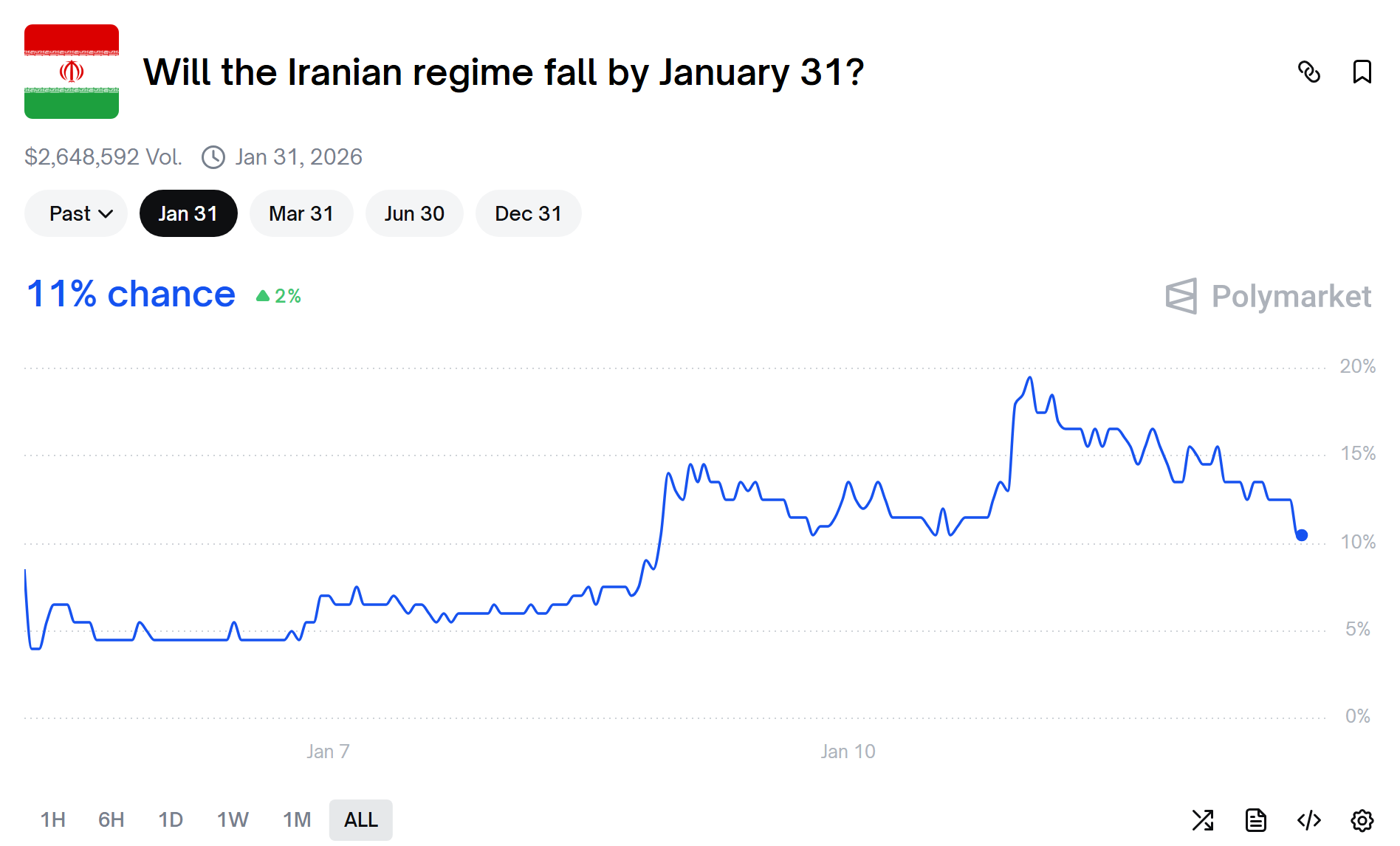
The protests in Iran are continuing and have spread to more than a hundred cities and towns. The Iranian regime has responded with violence and repression, with thousands of protesters killed, according to Time. Prediction market estimates of regime change are fluctuating – Polymarket now estimates an 11 percent chance that the regime will fall by the end of the month and a 41 percent chance that it will happen by the end of the year (see also the professional forecasts in my last issue).
…and Greenland
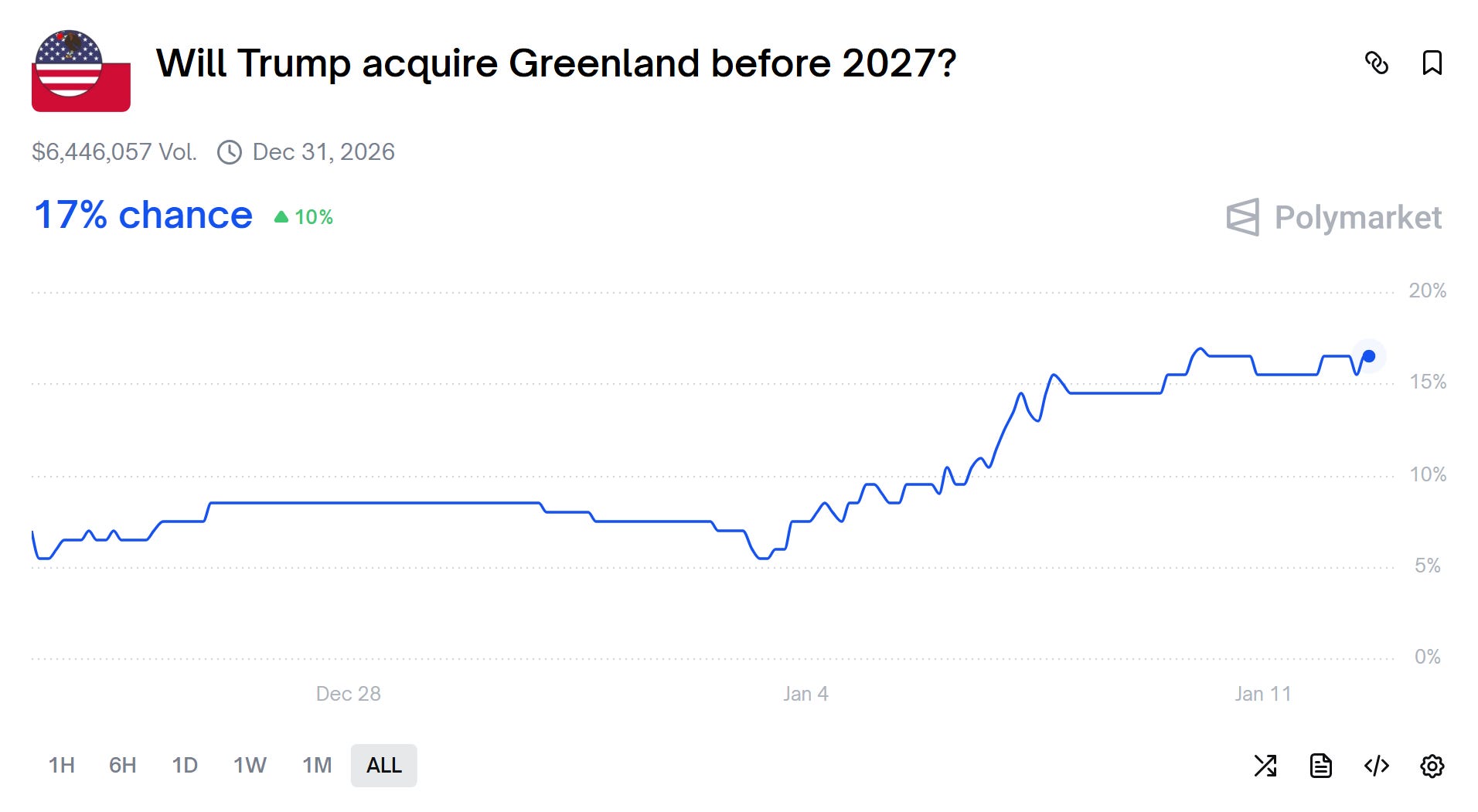
Donald Trump has reiterated his claims to Greenland, arguing that unless the US takes control of it, Russia or China will do so. Trump says that he prefers a deal – ‘but if we don’t do it the easy way, we’re going to do it the hard way’. Polymarket currently estimates a 17 percent chance that Greenland will come under US sovereignty this year. There’s also the possibility of Greenland entering into a compact of free association with the US, as I’ve reported previously.
The growing demand for social skills
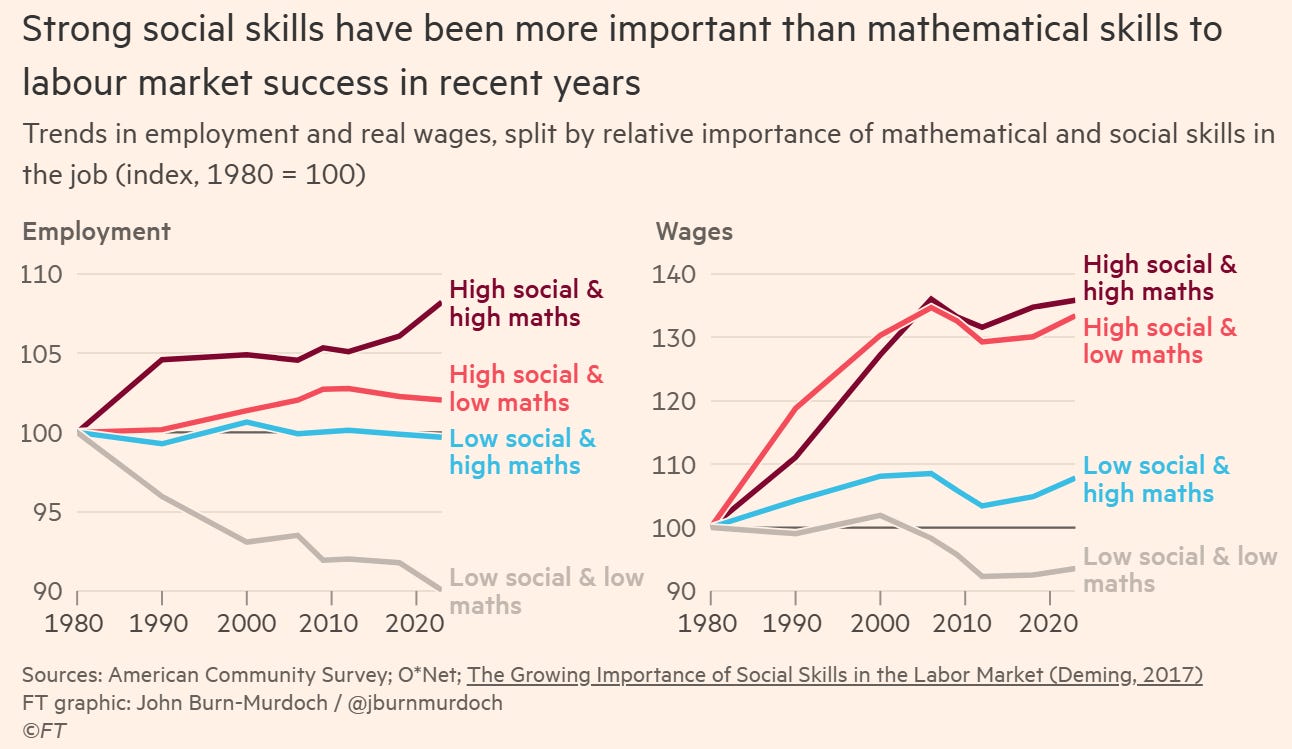
John Burn-Murdoch writes in the Financial Times about the American labor market’s growing demand for social skills, such as the ability to persuade and cooperate with others. As previously noted by the economist David Deming, jobs requiring social skills have seen stronger employment and wage growth in recent decades than jobs requiring mathematical skills. Jobs requiring both social and mathematical skills – such as doctors and consultants – have done best, but jobs with high social and low mathematical requirements – such as lawyers, therapists, and nurses – have also fared well. By contrast, jobs with high mathematical and low social requirements – such as many engineering and technical support roles – have seen weaker employment and wage growth. Tasks requiring social skills tend to be harder to automate, which may explain this pattern.
The volatile American trade deficit
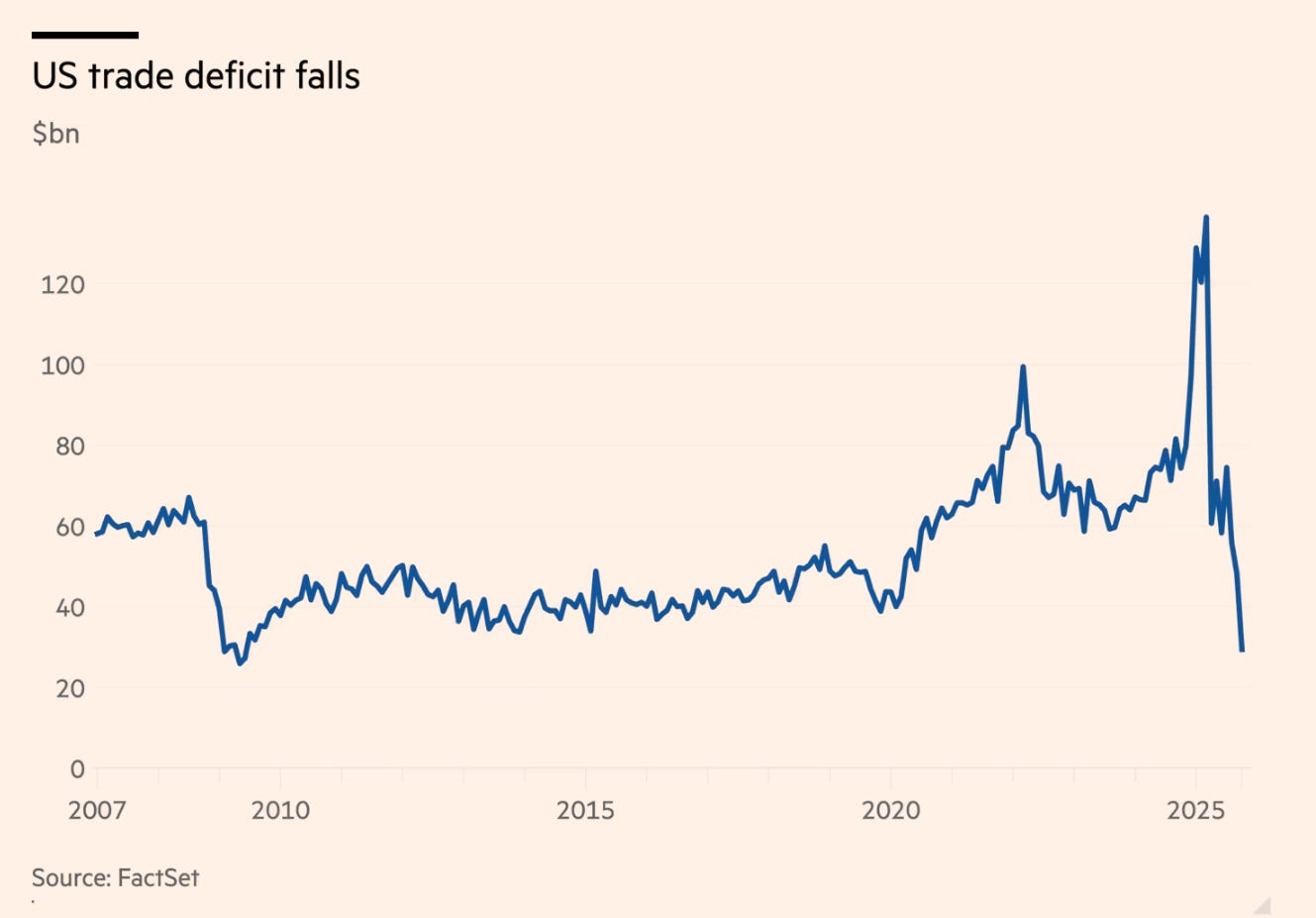
The American trade deficit was extremely volatile during 2025, reacting to constantly shifting tariff announcements. In March, it reached its highest level ever (in current dollars) as companies built stockpiles to avoid higher duties. But it has since fallen sharply – and in October, it reached its lowest level since 2009 due to swings in the trade of gold and pharmaceutical products. This is expected to lift the fourth-quarter growth number, with the Federal Reserve Bank of Atlanta predicting it to be as high as 5.4 percent in annualized terms. But as I’ve argued before, we shouldn’t read too much into volatile quarterly figures, especially when they’re partially driven by trade swings that many analysts believe to be temporary. What really matters is the longer trend.
The worldwide fall in manufacturing
The tariffs have been partly motivated by hopes of reviving American manufacturing – but as The Economist reports, they have so far failed to do so. Employment in manufacturing is down by 0.6 percent since last year.
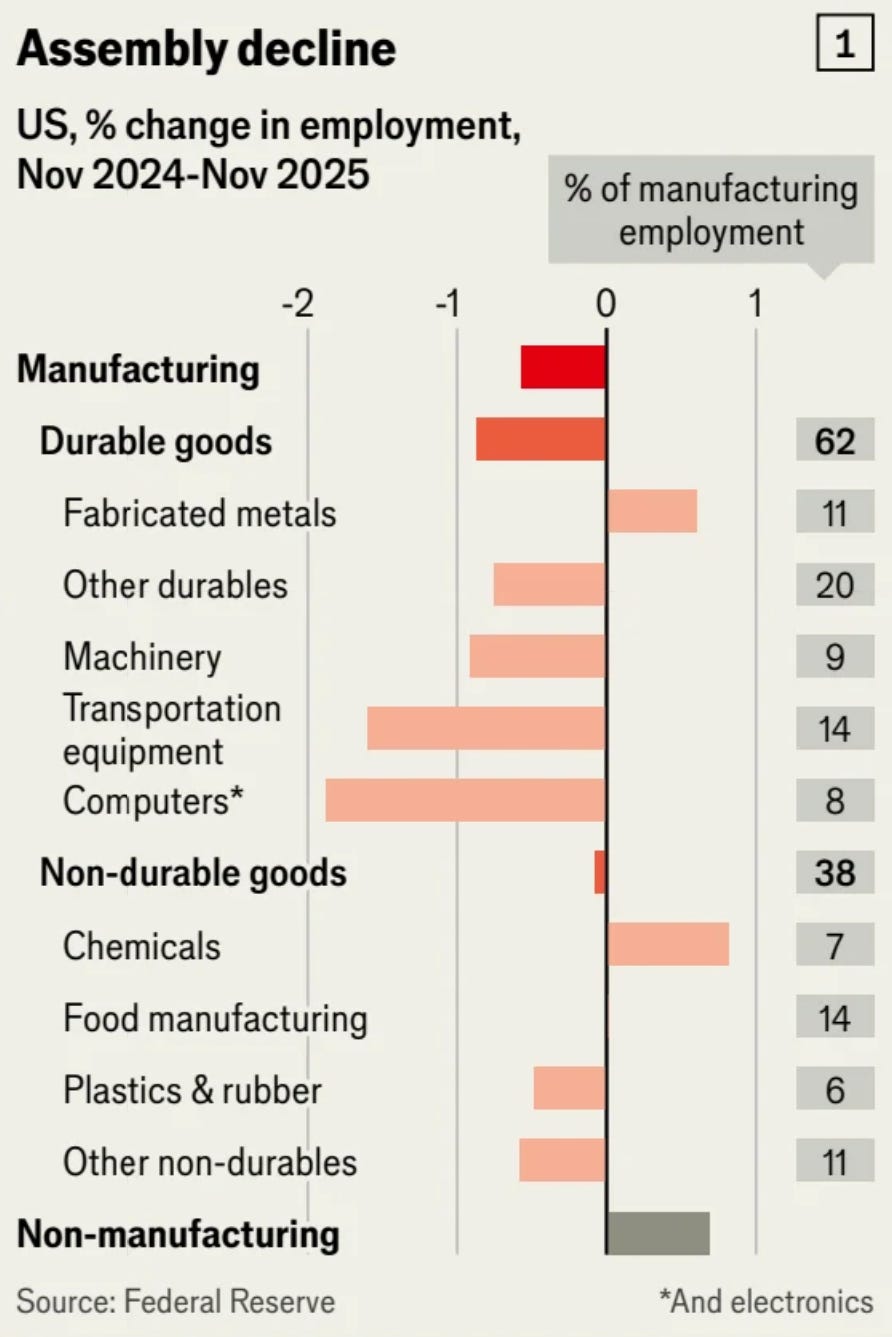
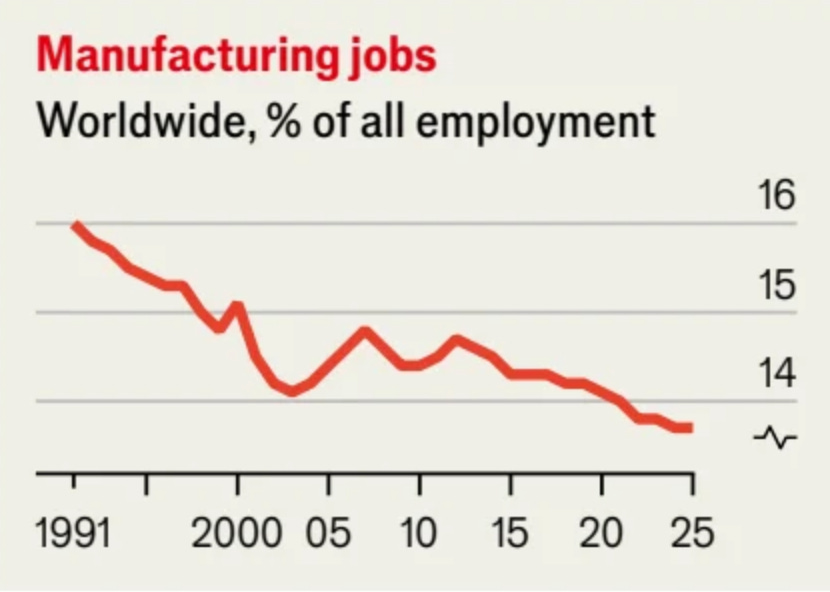
This decline isn’t unique to the US. In spite of many initiatives to save manufacturing jobs, they have shrunk as a fraction of the workforce on every continent except Africa since 2019. Technological trends are powerful, and people often overestimate what policy can do to stop them.
The AI inequality debate
In a recent essay, Philip Trammell and Dwarkesh Patel ask what will happen to inequality once all jobs can be automated. In this world, almost all income would by default flow to capital owners – and as Philip and Dwarkesh note, capital is already unequally distributed. They expect inequality to be exacerbated over time, as rich people save more and earn higher returns. To prevent it from skyrocketing, they suggest a global progressive capital tax.
Their essay has stimulated a lot of debate among economists and people interested in the future of AI, with a particularly thoughtful response coming from Brian Albrecht. One of his arguments concerns the timing of this tax. While Philip and Dwarkesh focus on a world with extremely advanced AI, Brian worries that their proposal risks seeping into debates about what to do here and now. In his view, introducing progressive capital taxes when workers still have a meaningful share of income would actually hurt them, because it would lower wages and reduce economic growth. Consequently, he cautions against implementing such policies any time soon.
That’s all for today. If you like The Update, please subscribe and share with your friends.
@Stefan Schubert, the social media vs AI comparison is useful, but the frame is too narrow. The damage isn't primarily misinformation. It's temporal.
Social media's architecture keeps attention in permanent refresh, fragmenting the capacity to hold anything long enough for it to become memory or consequence. Democracy isn't threatened because discourse is trivialized. It's threatened because a public trained to refresh cannot stay with one truth long enough to demand accountability.
The AI inequality debate has the same blind spot. Trammell and Patel ask how wealth gets distributed once AI automates everything. But there's an extraction already underway: platforms capturing the duration that political agency requires.
Before we debate how abundance gets shared, we might ask what's already being taken from our capacity to demand anything.
I wrote something on this: “You Are Not Distracted. You Are Unfinished.”
https://yauguru.substack.com/p/you-are-not-distracted-you-are-unfinished?r=217mr3