


This is The Update, a guide to the news. The content and format will evolve over time, but the plan is to cover current events and long-term trends as well as the public discourse around them. I’ll start with two posts a week, aiming to gradually increase the cadence. Feel free to send me links for The Update. And if you like it, please tell your friends about it.
In today’s issue
Current events
Are we in an AI bubble?
The Financial Times has a nice chart suggesting maybe not:
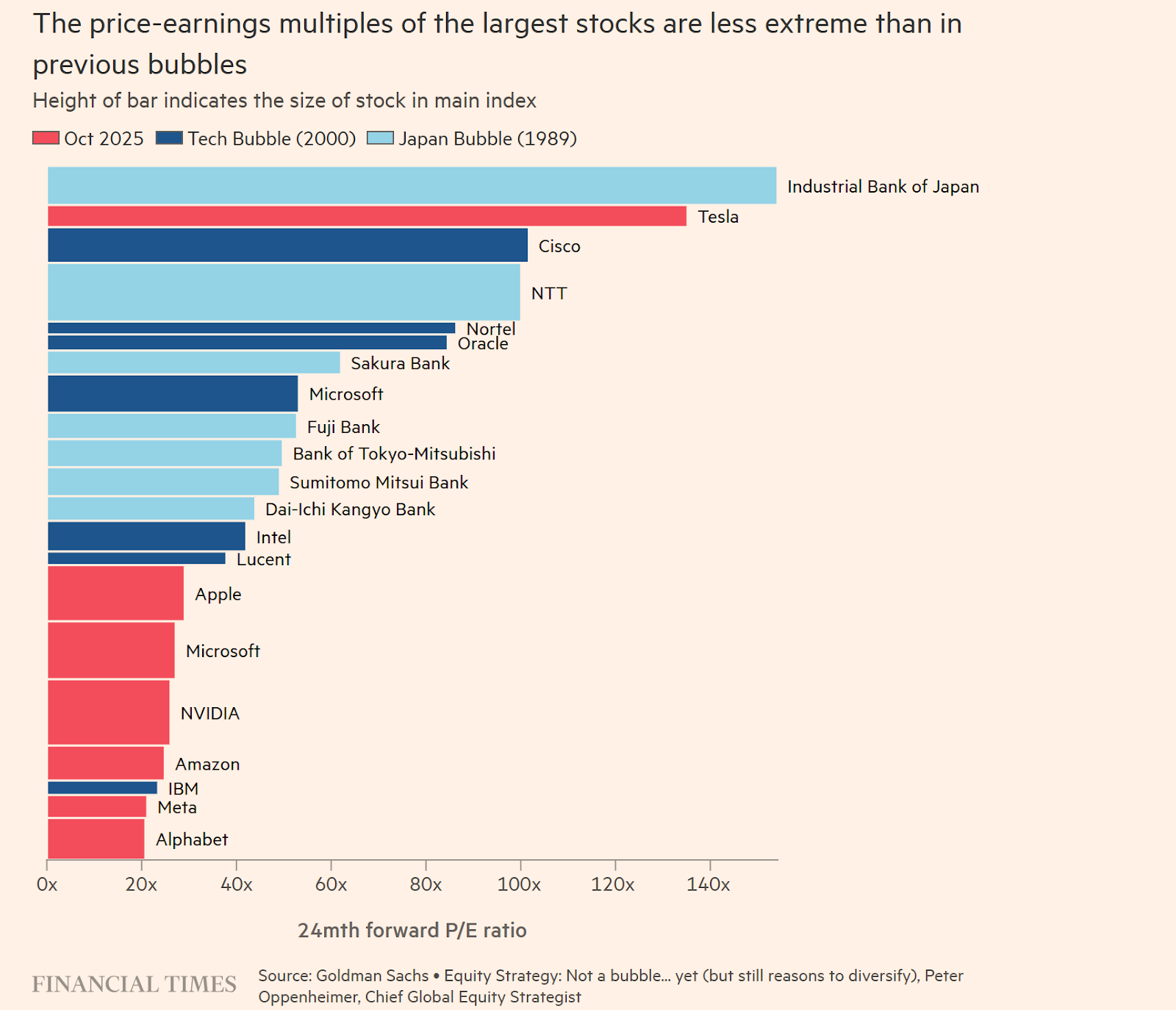
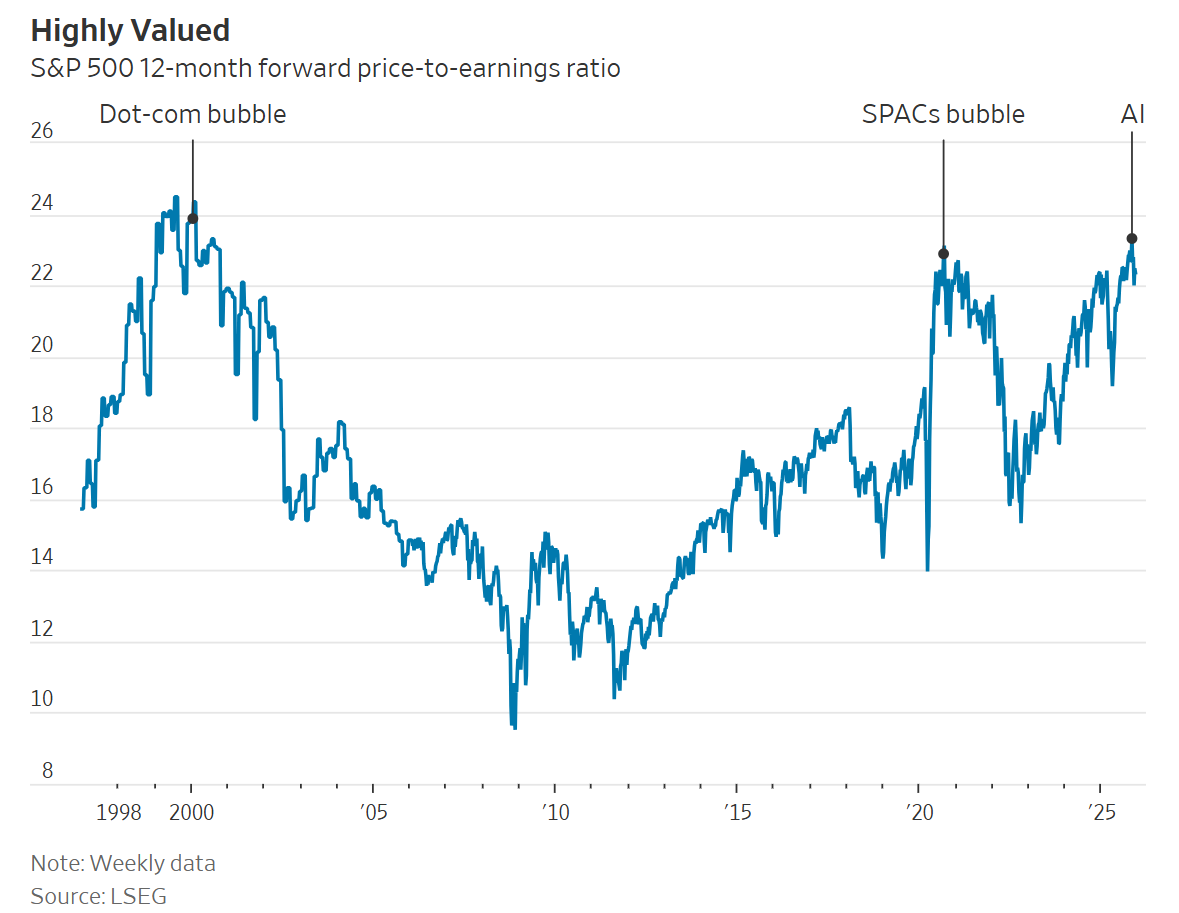
But while the chart is striking, there are some caveats worth adding. The Magnificent Seven aren’t just about cutting-edge AI, but also have – to varying extents – sources of income that could be insulated from a bursting AI bubble. Also, the FT doesn’t include private companies like OpenAI and Anthropic, whose price-to-earnings ratios would likely be higher if they were public. And as James Mackintosh points out in The Wall Street Journal, the price-to-earnings ratio of the S&P 500 as a whole is close to dot-com levels:
YIMBY reforms in the UK
During last year’s election campaign, Labour promised 1.5 million new homes in England by 2029, but housebuilding rates are not on track to meet that target. YIMBY campaigners have been underwhelmed by the government’s efforts, but that may be changing, since housing minister Matthew Pennycook has just set out a substantial planning deregulation agenda. Homes within 800 metres of train stations well-connected to jobs would by default be permitted, as long as they meet a minimum density rule (50 homes per hectare). Pennycook also proposed a number of other reforms, including simpler rules for adding homes on existing plots (up to twice the original footprint) and exemptions from the biodiversity net gain requirement for the smallest projects. The proposals will now go out for consultation until 10th March next year.
Ukrainian EU accession
On Friday, the Financial Times reported that the EU may allow Ukraine to join as soon as 1st January 2027, as part of a peace proposal. It would be a uniquely fast accession, in striking contrast to countries like Albania and Montenegro, which have waited for decades to join. Prediction markets are skeptical that it will actually happen: Manifold estimates the chance of accession before the end of 2027 at four percent, and Metaculus says there’s a nine percent chance that it will happen before the end of 2029 (though the prediction activity is low). Still, the reports themselves are notable. It’s been a long time since European leaders had plans for such an ambitious project.
Russian fatigue
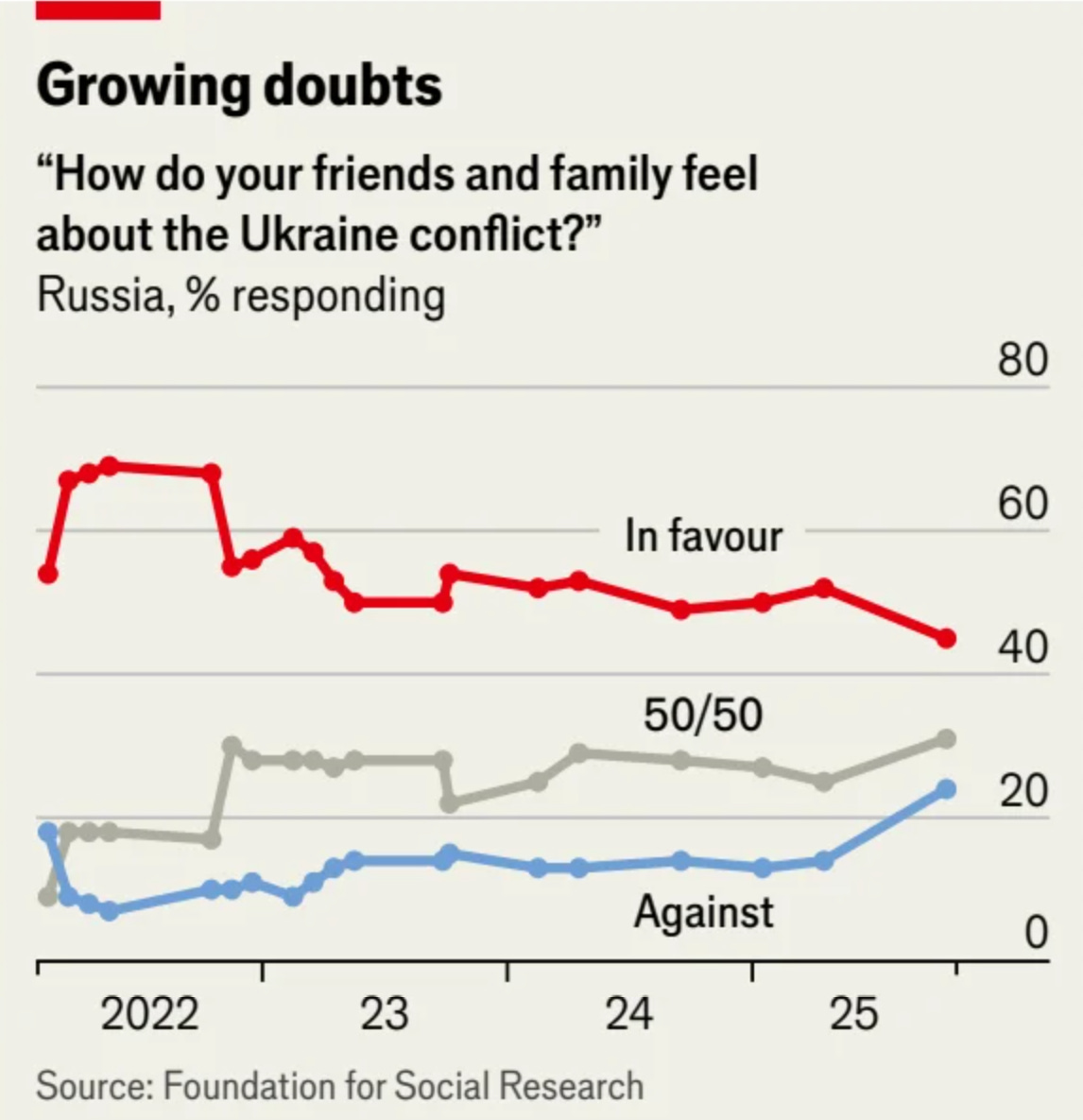
The Economist reports that Russian fatigue over the war may be growing. Since people may not want to share their own views in an authoritarian regime, pollsters have come up with clever indirect techniques. ‘How do your friends and family feel about the Ukraine conflict?’ An increasing number say they’re against it.
GPT-5.2 and GDPval
OpenAI has rolled out its new 5.2 model and claims that it performs at a human expert level on the ambitious GDPval test (thoroughly analyzed at Justified Posteriors). I liked the way they described GDPval: ‘an eval measuring well-specified knowledge work tasks across 44 occupations’. ‘Well-specified’ is a crucial qualification: you can’t actually replace those experts with GPT-5.2, or we’d already see mass unemployment. Since AI companies and their leaders have often skipped these kinds of clarifications, it’s a welcome move.
Trends and analyses
The world economy is doing better than expected
There’s been a lot of doom and gloom about the world economy this year, but annual growth is actually expected to come in higher than anticipated last autumn, Tej Parikh writes in the Financial Times:
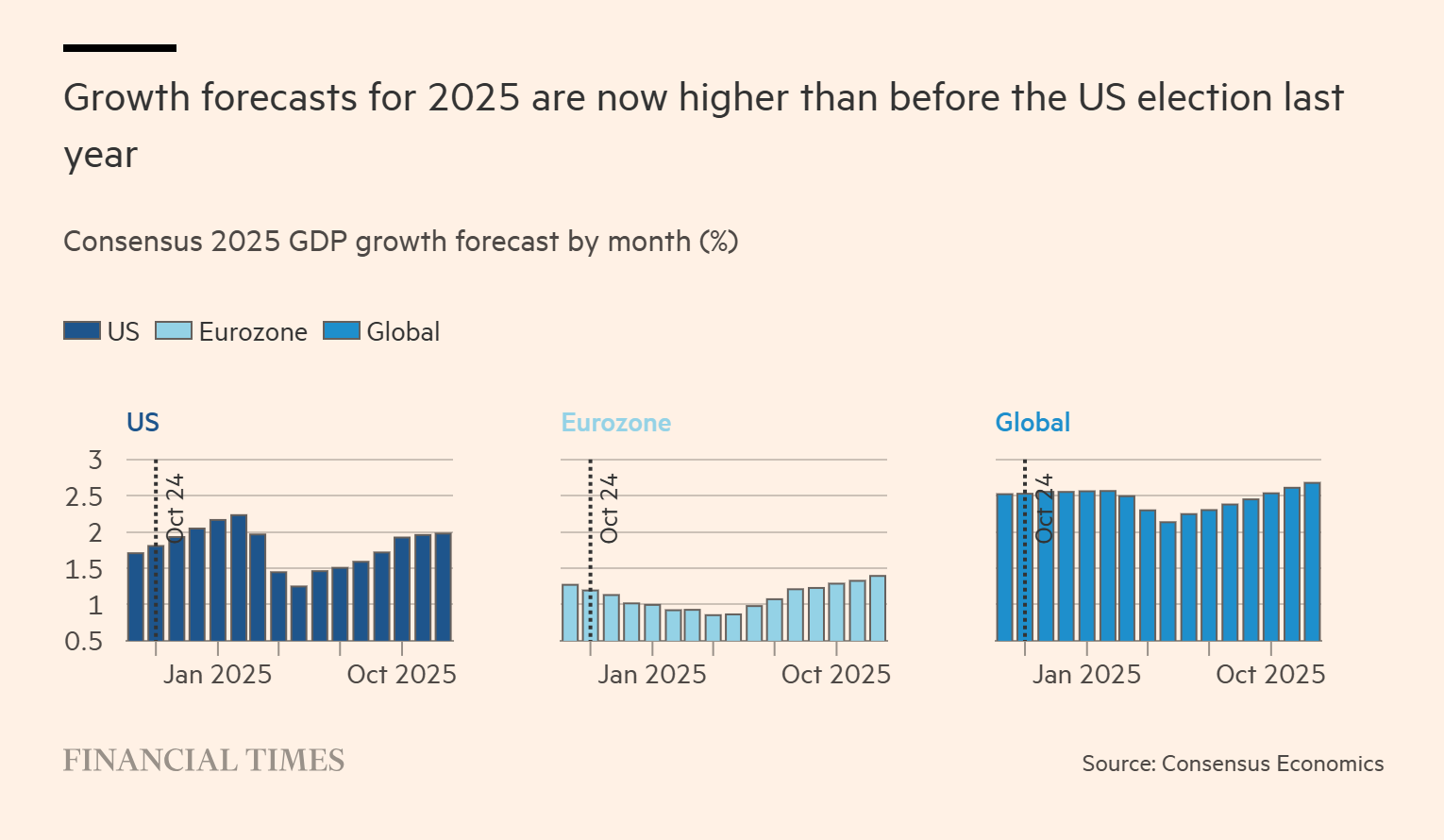
Parikh also makes several other interesting observations about this year’s economic trends, from the relatively muted impact of Trump’s tariffs to the role of AI in American growth.
Global economic convergence has slowed
Dev Patel, Justin Sandefur, and Arvind Subramanian show that the economic convergence between rich and poor countries has slowed. They have several great charts, including this one:
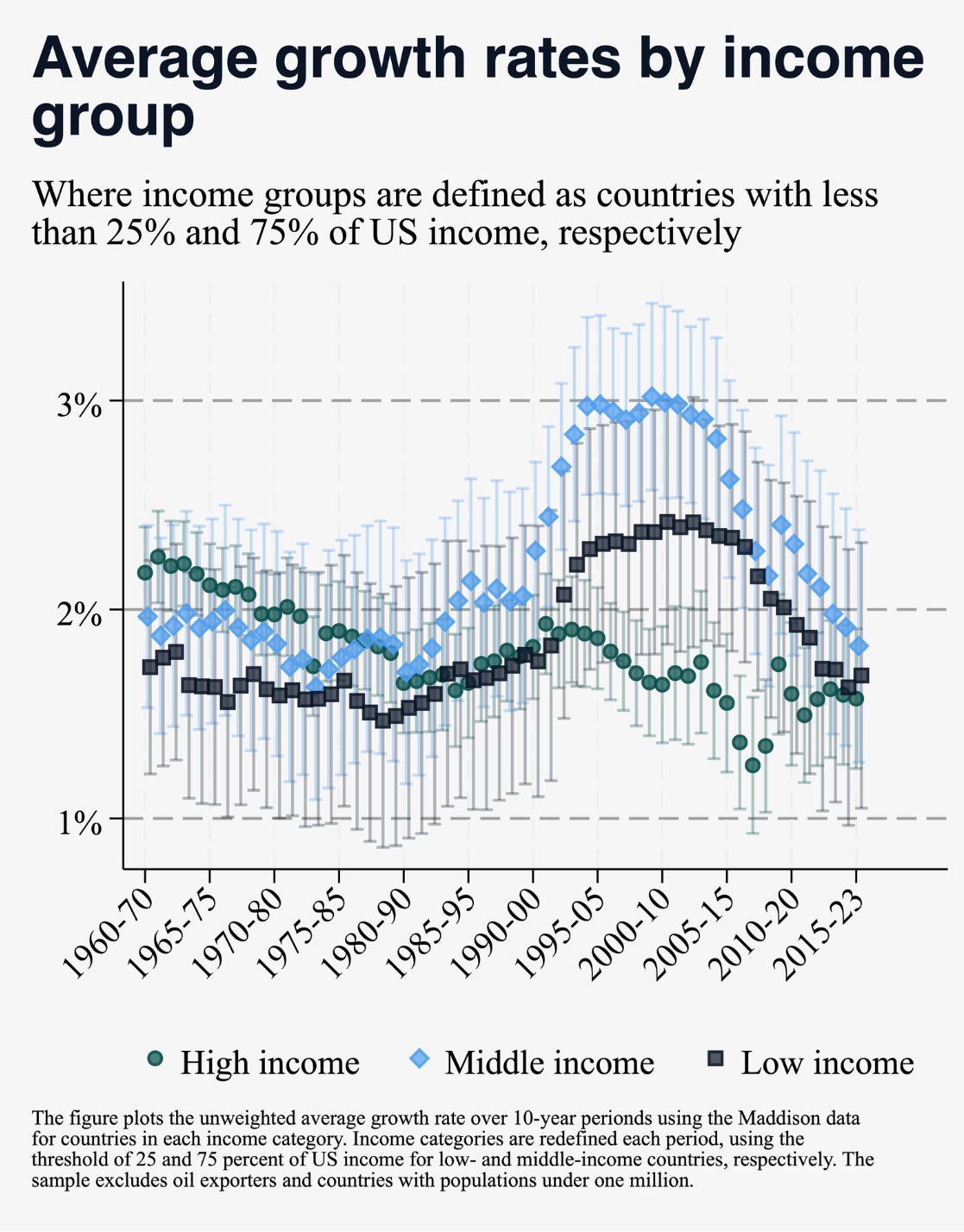
From the 1990s onward, low-income and (in particular) middle-income countries grew much faster than high-income countries, but that has now changed.
Construction productivity is a global problem
In the US and other Western countries, there are lots of complaints about dismal construction productivity, often focusing on country-specific issues like particular regulations. But a recent article by Brian Potter suggests there may be more fundamental factors at play, since construction productivity is stagnant almost everywhere. Even China, which regularly puts up PR videos of buildings being completed almost overnight, has seen construction productivity growth of a few percent at most in recent years. That said, construction productivity is notoriously difficult to measure, as Brian points out. He discusses construction productivity as well as manufacturing productivity in much greater detail in his recent book The Origins of Efficiency.
Why is South Korean fertility so low?
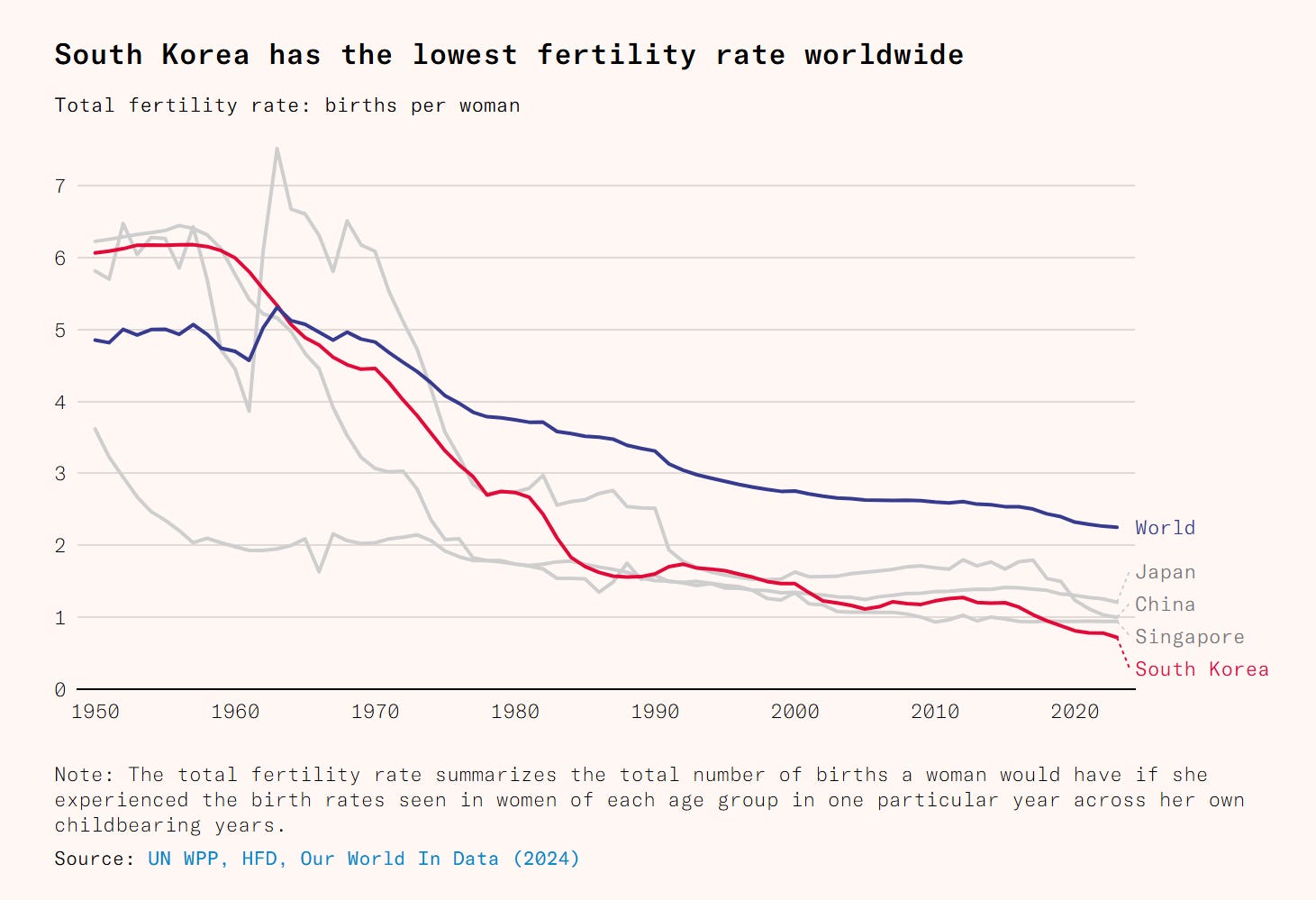
In a recent article at Works in Progress, Phoebe Arslanagić-Little analyzes why South Koreans have so few children. One salient factor is the difficulty of combining motherhood with work. ‘27 percent of female office workers report being coerced into signing illegal contracts promising to resign if they fall pregnant or marry.’ That’s an astonishing figure.
Another key theme in this rich article is the punishing norms around education in South Korea. Private tuition is extremely widespread and seen as necessary to compete. Nearly half of children under six receive private tuition of some form, and overall Korean families spend around a fifth of their disposable income on private tuition and education. This obviously disincentivizes people from having children – or having more of them.
Phoebe has additional material and context at Boom.
Saloni’s guide to data visualization
Saloni Dattani has an in-depth guide to making better charts, packed with practical advice. Charts travel tremendously well, so it’s well worth investing in making them better. This article is a great place to start.
One idea I particularly liked is to have multiple visualizations for the same data. Consider the following visualizations of German property prices. It’s hard to get an intuition for the distribution of different price levels by simply scanning the map, so Saloni added a second visualization specifically about that.
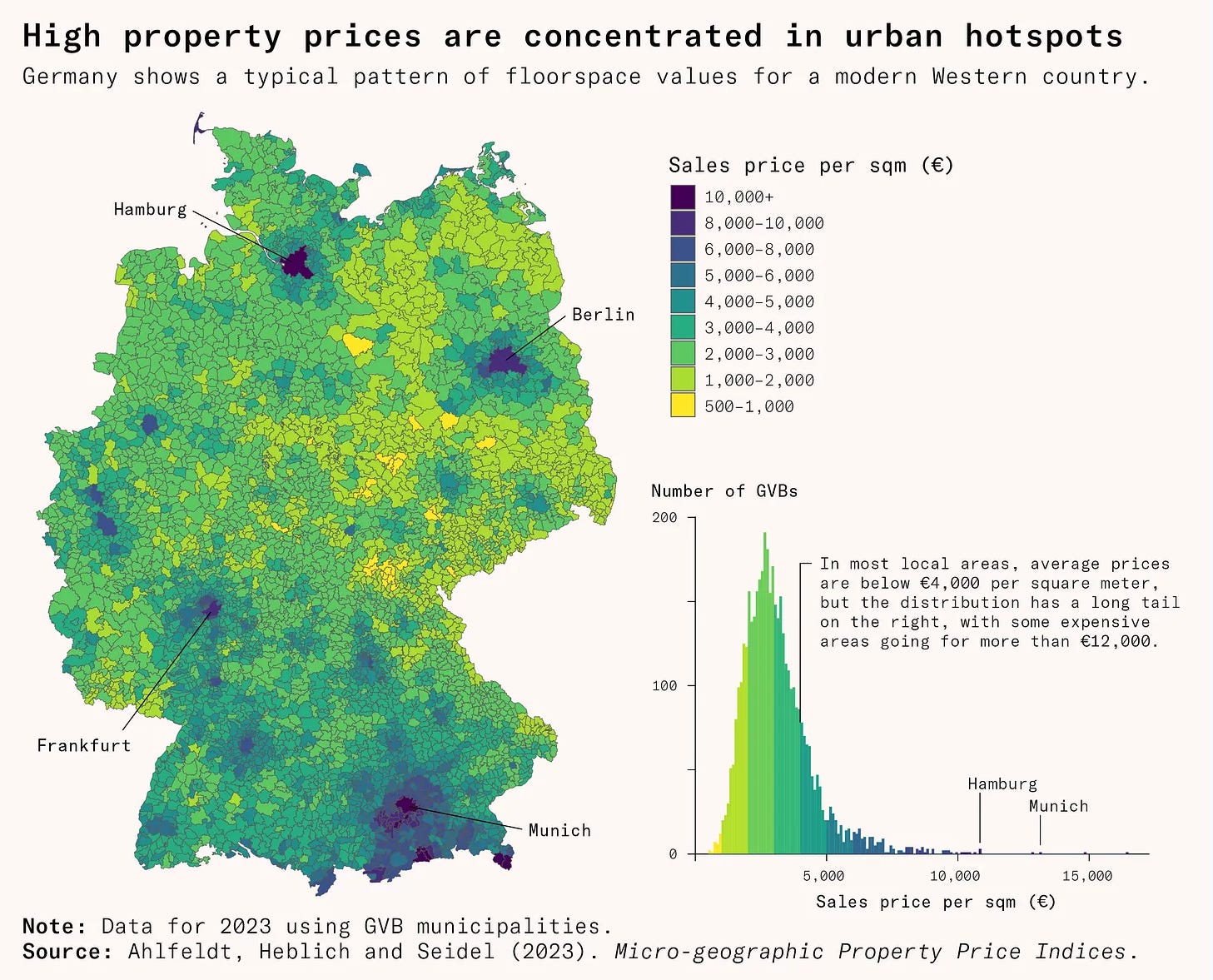
Charts and other visualizations are often accused of being misleading. While some of those accusations are overblown, I think providing multiple visualizations can help address that problem. If a visualization is liable to be misinterpreted in a certain way, you can add a second one that prevents that particular misinterpretation.
There are many other astute observations in this article – I highly recommend it.
When could humans make fire?
A new Nature paper has found evidence that humans could make fire as far back as 400,000 years ago, 350,000 years earlier than the oldest previous evidence. Given how helpful fire has been for human survival, this is a very important finding that illustrates how incomplete our knowledge of human prehistory still is.
I’m often struck by how discoveries like this are communicated in the media. Scientific American framed this finding as ‘ancient humans were making fire 350,000 years earlier than scientists realized’, whereas AP and BBC framed it in terms of what scientists had previously ‘thought’. This conflates what we previously had empirical evidence for with what we had reason to believe. The previous evidence for fire-making was from about 50,000 years ago, but since scientists often discover earlier instances of prehistoric technology, it was reasonable to guess that the ability to make fire was older. This applies to the new finding as well: people could probably make fire even further back in time than 400,000 years.
AI water usage and the Soldier Mindset
Over the last year, there’s been a huge outcry over how much water AI is supposed to consume. But as the effective altruist blogger Andy Masley has shown, it’s driven by misconceptions. In fact, using ChatGPT or other LLMs consumes a fraction as much water as most other daily activities, such as driving or eating meat. Andy was recently interviewed about this at both Hard Fork and Cognitive Revolution.
This outcry is likely driven by resentment of AI and the firms behind it. Many people take a coalitional Soldier Mindset to public discourse, throwing whatever arguments they find into the mix and seeing what sticks. Seán Ó hÉigeartaigh reports that he’s been asked whether people like Andy are making a mistake. ‘Should we instead be looking for alliances wherever possible, and treating arguments getting traction that might lead to less support for unrestrained AI acceleration as “aiding us”?’ As Seán says, there are both practical and principled reasons against this line of thinking – but it no doubt reflects how many people think, consciously or not.
In brief
Ruxandra Teslo and Jack Scannell write for Macroscience that we need more human trials to get more effective drugs. An interesting observation is that scientists often overrate the role of mechanistic foresight for drug development relative to empirical trial-and-error. Ruxandra: ‘For GLP-1 agonists, mechanistic understanding of weight loss effects emerged after, not before, the clinical breakthroughs.’
Rob Wiblin had a wide-ranging and lively interview with Dean Ball, coauthor of Trump’s AI action plan. Dean recently tweeted that intellectually honest safetyists (focused on existential risk from AI) and accelerationists have more in common than both sides realize. This conversation reinforced that perception.
Lauren Gilbert’s new magazine In Development – ‘a new magazine dedicated to exploring how progress actually happens in the developing world’ – has its first call for pitches.
Anuja Uppuluri of Anthropic has created a Goodreads for papers, Papertrail. Well done – it’s surprising this didn’t already exist.
Yeyy!! 🥳
Excellent accuracy and signal-to-noise ratio!
Keen for more