


Welcome to The Update. Did you know you can listen to each issue on the Substack app? The audio is automatically generated but high quality.
In today’s issue:
Governments spend far more on old people than on children
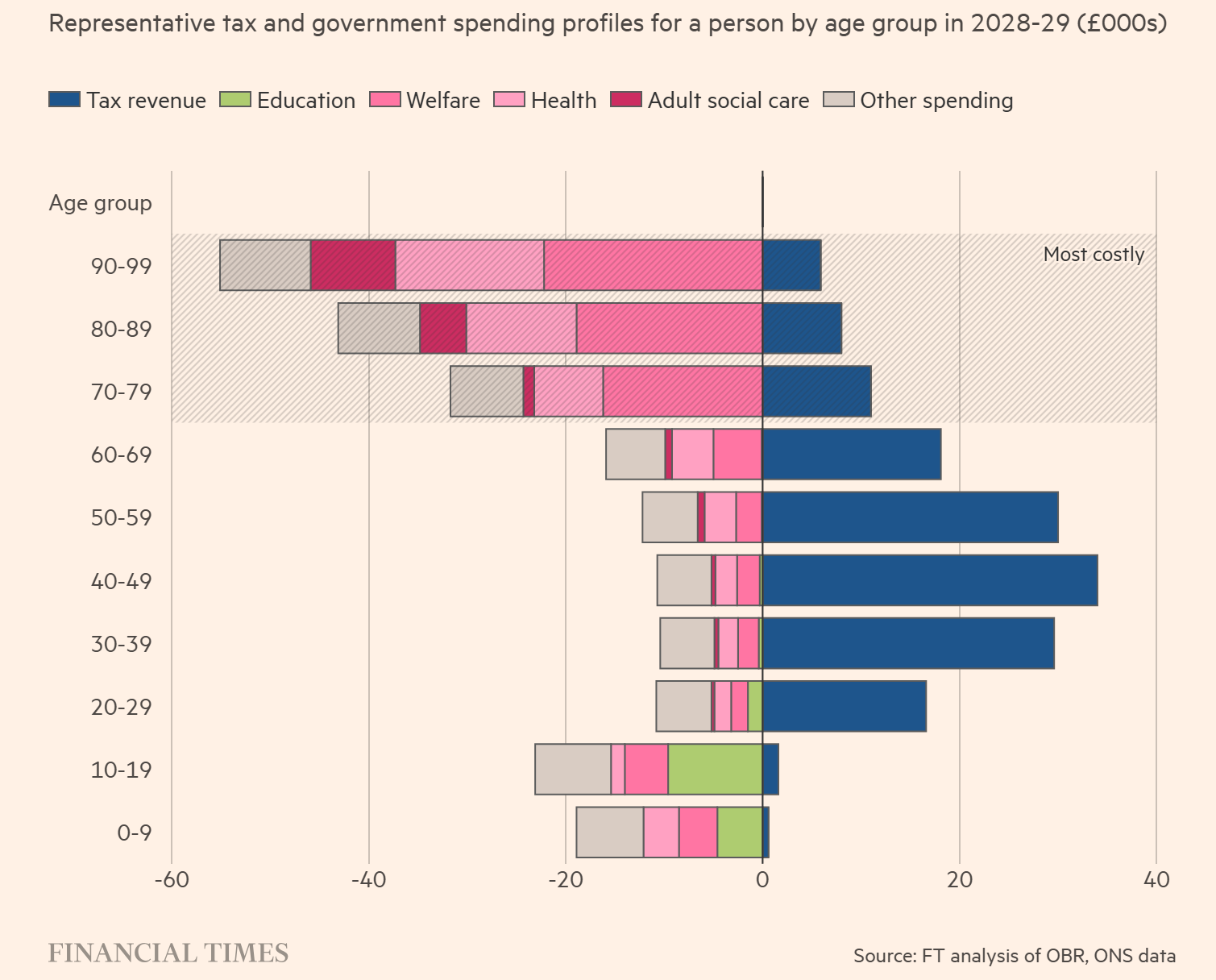
The Financial Times has a striking chart of how a British individual’s fiscal impact varies with age. What’s most notable is how much more the government spends on old people than on children.
This pattern is not unique to Britain. Here is a similar chart for Spain:
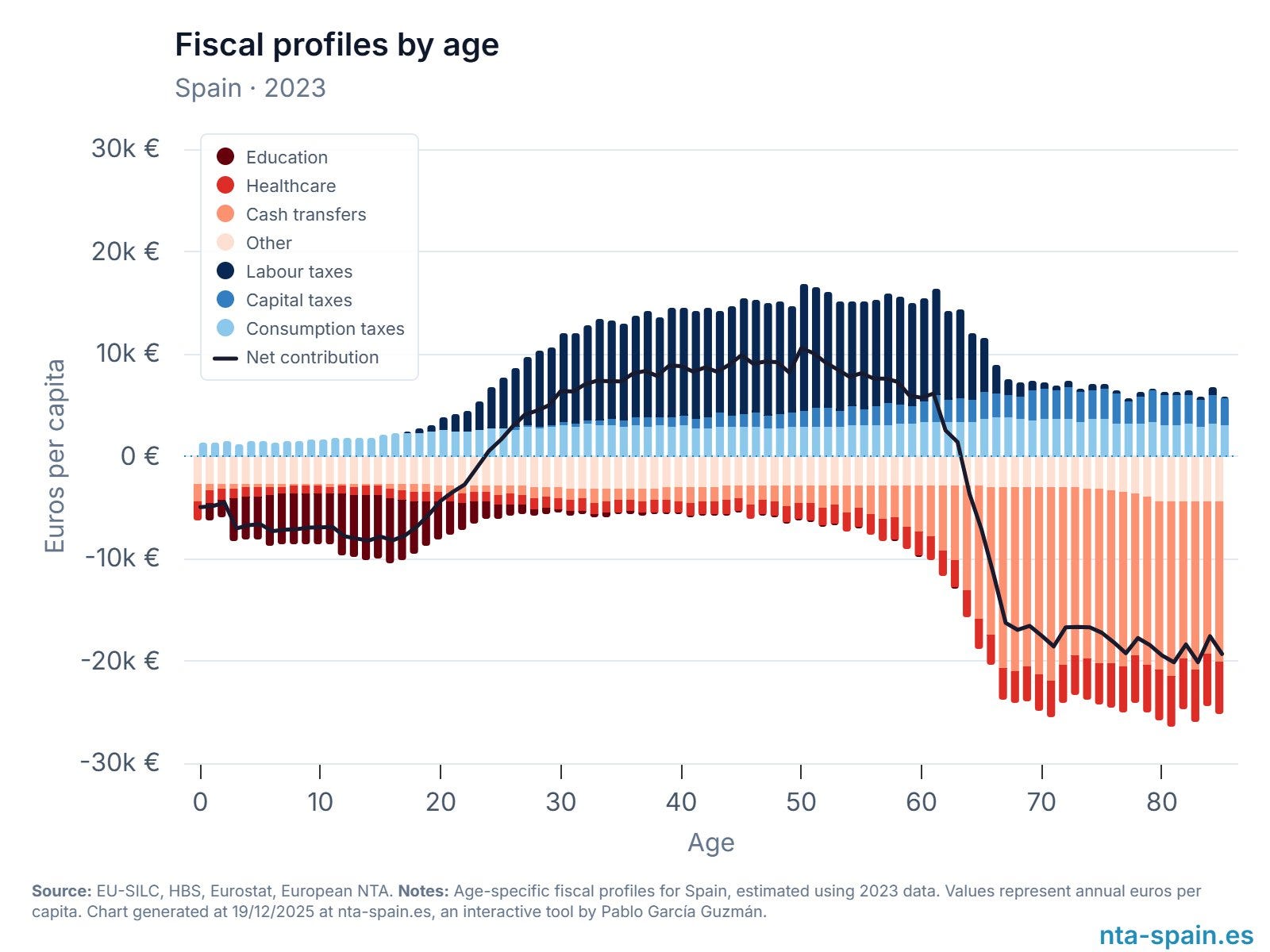
It’s not easy to see how this asymmetry could be justified. Children have the same need for support as old people. One might argue that parents can provide for their children – but that may not be enough, and even if it is, it leaves parents financially worse off. That doesn’t seem fair, especially since children are a positive externality, benefiting all of society.
And there is another reason to spend more on children: the falling fertility rates. Britain’s fertility rate is 1.43, and Spain’s is 1.10: both far below the replacement rate of roughly 2.08. To raise these numbers, a natural step is to lower the cost of having children.
Rising global economic optimism
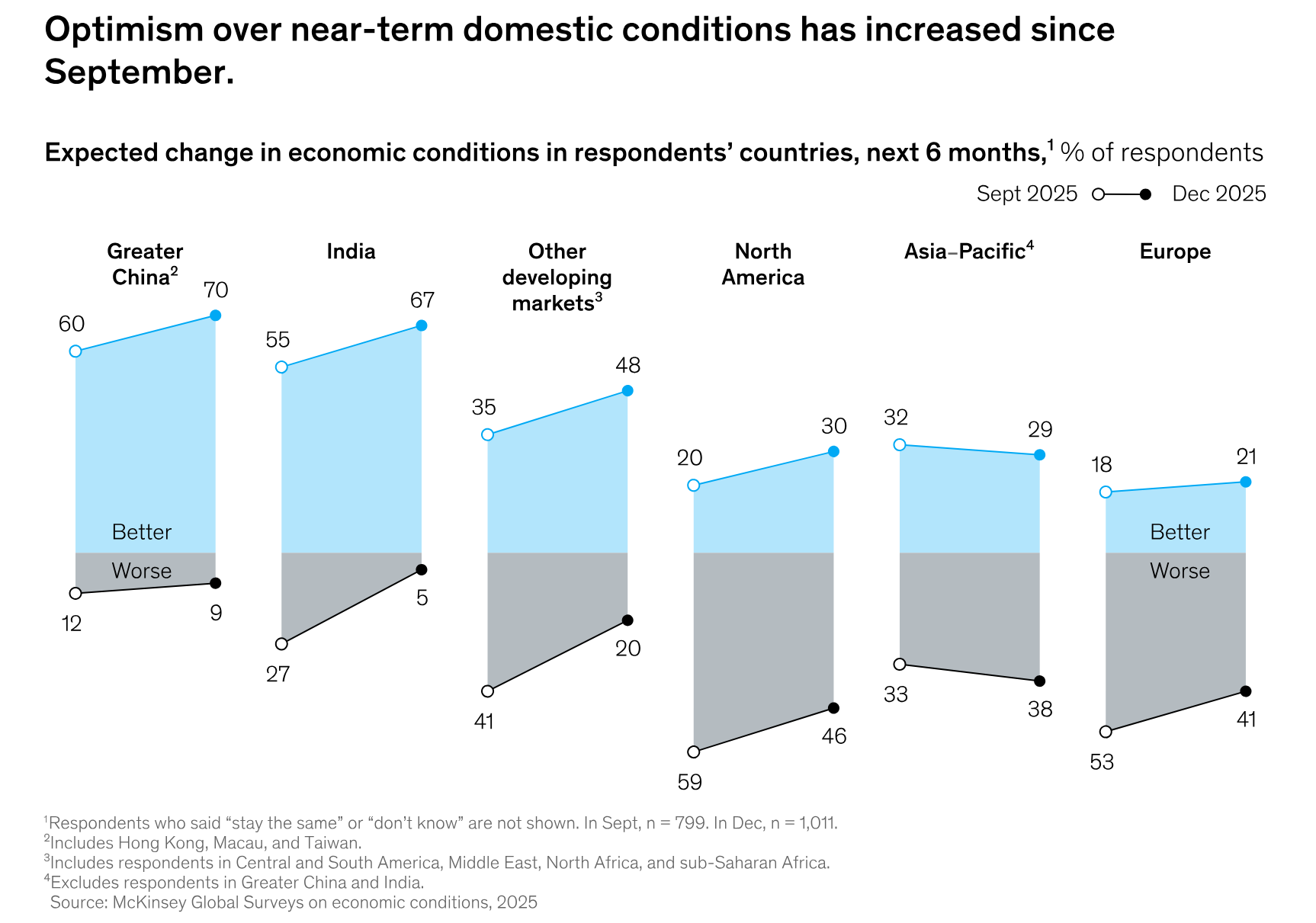
McKinsey’s December survey on global economic expectations found more optimistic sentiments in most regions of the world. The pessimists are still a plurality in North America, Asia-Pacific, and Europe, but globally, a plurality of respondents expect the economic conditions in their country to improve over the next six months.
How education splits the left and the right in British politics
British voters are increasingly divided along educational lines, with graduates mostly voting for the left and voters with GCSEs or below mostly voting for the right.
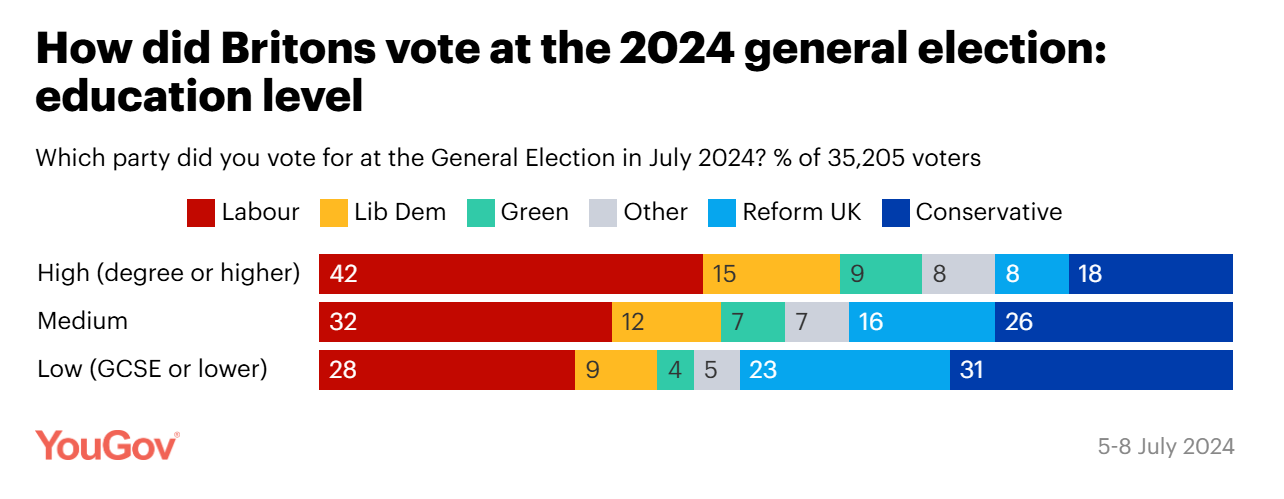
But education also splits each party’s coalition of voters. And interestingly, these splits look different on the left and the right, as the politics professor Ben Ansell shows:
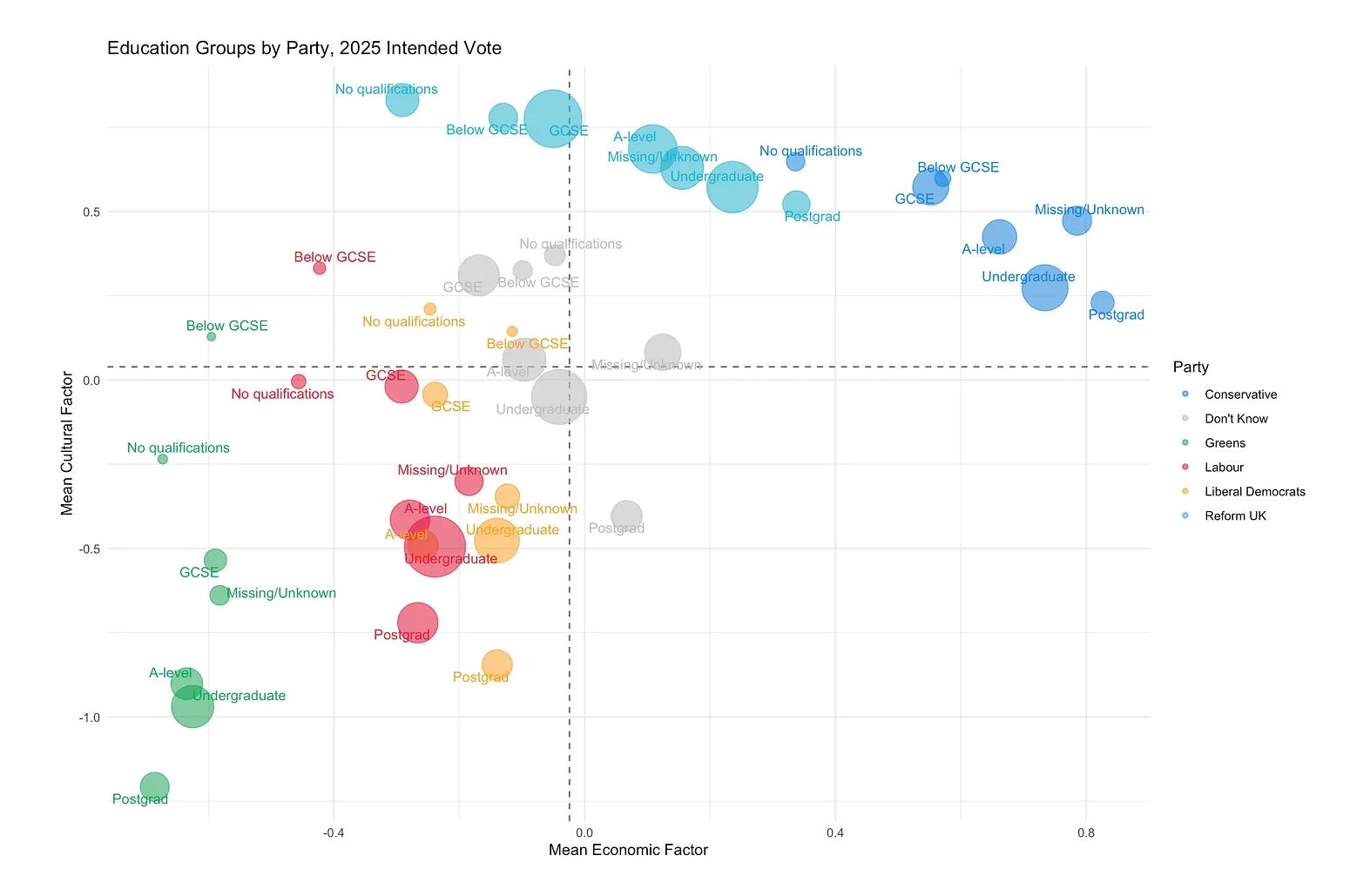
The left-wing coalition broadly agrees on economic questions but is divided on cultural questions like criminal punishment and school discipline, where graduates are much more liberal than non-graduates. By contrast, the right is united by cultural conservatism but differs on economics, where graduates are much more firmly in favor of free markets.
British politics increasingly consists of two blocs, but this chart suggests they’re defined by different dimensions. The left-wing bloc is defined by economics, and the right-wing bloc by culture. Strategically, each side gains from focusing on its defining dimension, as Ansell and The Economist’s Archie Hall point out. Talking about issues that split your voters is bound to make some of them unhappy.
The most central chart in AI
In the latest episode of Justified Posteriors, the economists Seth Benzell and Andrey Fradkin discussed METR’s evaluations of AI capabilities. These ‘evals’ are based on a simple idea: that AI systems can be judged by the longest tasks they can complete, as measured by the time they’d take a human expert. By this metric, AI progress has been very rapid over the last six years. While GPT-2 could only do two-second tasks in 2019, Claude Opus 4.5 can now do tasks that take a human expert almost five hours (and Opus obviously does them faster).
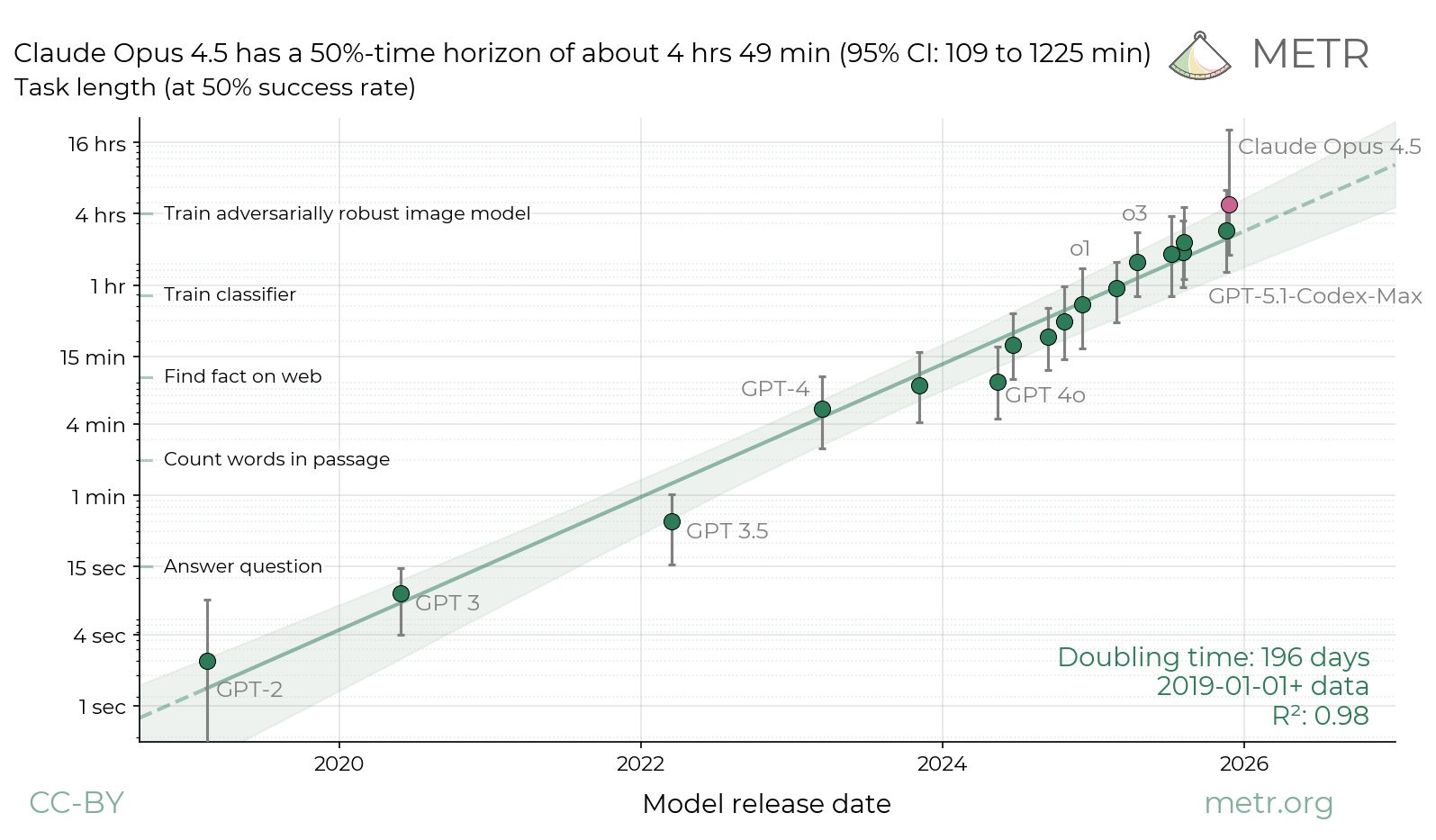
METR’s eval has received an enormous amount of attention – perhaps even more than OpenAI’s eval GDPval, which I covered last week. Some see it as the best metric we have for the speed of AI progress. The OpenAI researcher roon tweeted last month that ‘the METR graph has become a load bearing institution on which our global stock markets depend’. And it plays a central role in the AI 2027 scenario, which predicts that superhuman AI will emerge shortly. A common line of argument is that the most valuable tasks are at most a few years long, and that extrapolating METR’s curve suggests we’ll get there within a decade.
But as Seth and Andrey point out, there are numerous complications. One is that the 50 percent task success rate that’s usually cited is too low to be useful – you want the AI systems to get it right almost all of the time. But a more fundamental issue is that it’s not clear how the relatively well-specified technical tasks METR uses generalize to the poorly defined tasks we often face in the real world. Relatedly, the entrepreneur Steve Newman has argued that collaborative projects are so tightly integrated that they should be seen as one giant task from the perspective of the METR eval. As a consequence, he predicts that ‘we won’t have automated software engineering until AIs are leading 100-person-year projects’.
I think METR’s work is illuminating, but I’ve been disappointed by the tendency to use it to jump to conclusions about superhuman AI being imminent. As Joel Becker and others at METR themselves point out, it’s very hard to say what it teaches us. We need a much more serious debate about METR’s methodology, from researchers spanning AI, social science, and philosophy of science. The most central chart in AI must be properly studied.
The radical jaggedness of AI
Relative to humans, today’s AI systems are remarkably good at some things, like solving math problems, and much less impressive at others, like booking a flight. The Wharton professor Ethan Mollick has labeled this feature ‘jaggedness’. In his latest Substack, he gives a useful overview of jaggedness and its implications for the real-world use of AI.
Recently, the blogger Tomas Pueyo posted an image of AI jaggedness that went viral:
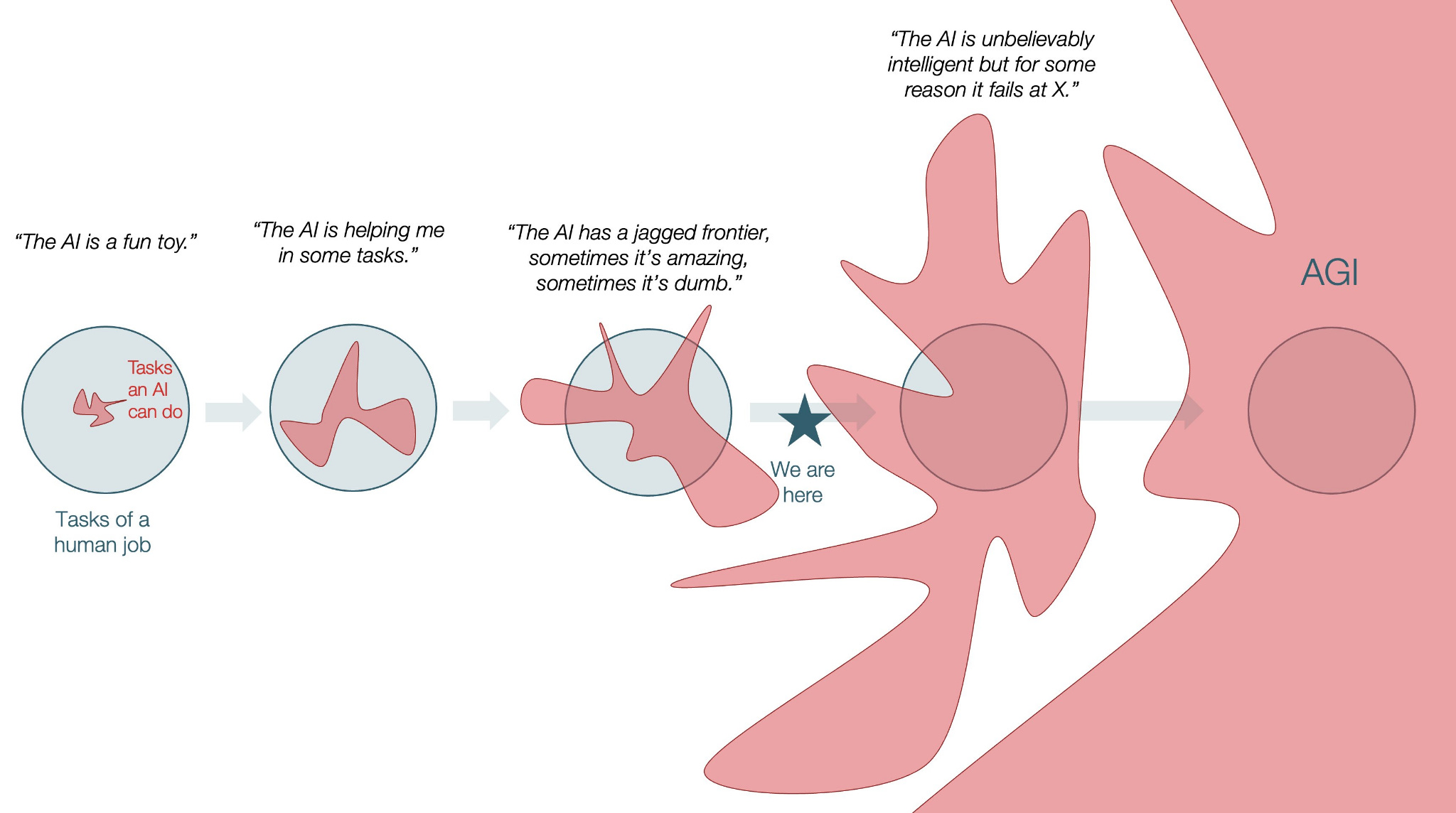
But it actually understates AI jaggedness. Since early AI systems were already superior to humans at some tasks, this image (adapted from Colin Fraser) captures it better:
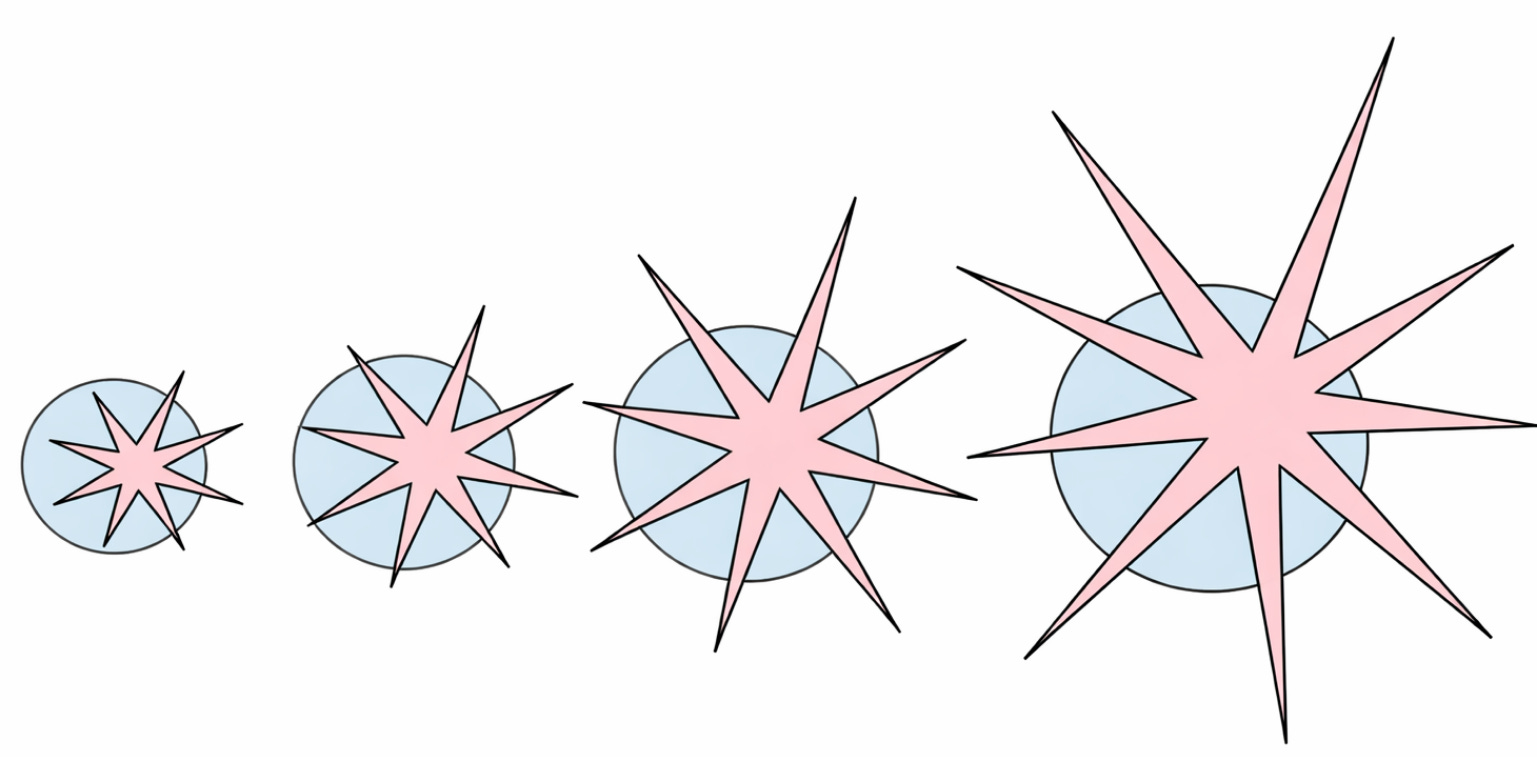
As Ethan points out, jaggedness is an obstacle to automation of tasks and jobs. Even relatively routine office jobs require a range of different abilities, from email writing and record keeping to social interactions and high-level planning. An AI system that can do only some of those things can’t replace such jobs. It’s bottlenecked by the things it can’t do.
But Ethan argues that focusing on bottlenecks can lead to exaggerated pessimism about the real-world use of AI. If you’re held back by ‘a single jagged weakness’, progress can jump once it’s fixed. An example he discusses is PowerPoint decks. Previously, AI-generated PowerPoints were bottlenecked by poor image quality. But with the advent of Google’s Nano Banana Pro, that bottleneck was fixed. Suddenly, it became much easier to create PowerPoints with AI.
At the same time, most jobs don’t consist of circumscribed tasks like creating a PowerPoint presentation. Instead, they involve open-ended tasks entangled with one another in complicated ways. As a result, automating a job in its entirety typically means overcoming many separate constraints, not clearing a single bottleneck. This means that AI jaggedness will continue to be a major impediment to job automation. It’s certainly a concept that should be taken more seriously.
Knowledge that can’t be written down
An important insight in twentieth-century philosophy was that much of our knowledge is tacit – it cannot be easily formalized, and must be learned by doing. You can’t learn to ride a bike or become a good salesperson merely by reading a set of instructions. Stripe Press has released an excellent collection of resources on this topic, featuring films on tacit knowledge in perfumery and knifemaking, and a bibliography ranging from Michael Polanyi’s philosophical classics to detailed portraits of craftsmanship. Many of Stripe’s own books – including The Origins of Efficiency and the forthcoming Maintenance: Of Everything – explore how tacit knowledge drives progress and prosperity. The project is also motivated by the rise of LLMs, since they still struggle with tacit knowledge, as editor Tamara Winter notes.
How to build tunnels that pay for themselves
The British government has announced radical planning reforms that could unlock a million new homes around train stations in the London area alone. But Ben Southwood, Harry Rushworth, Benedict Springbett, and Samuel Hughes argue that these plans face a major obstacle: rail lines into the capital are already stretched to the limit. Crossrail tunnels connecting suburban lines through the city center could dramatically increase capacity – but how can they be financed, given the dire state of the public finances? The authors suggest a clever mechanism: since the planning permissions will create huge windfalls for landowners, the tunnels can be built at no cost to taxpayers if the government claims a share.
Open Philanthropy is Coefficient Giving
The effective altruism–aligned foundation Open Philanthropy is renaming itself Coefficient Giving to reflect a change of direction. Open Philanthropy has long been supported by Cari Tuna and Dustin Moskovitz, but has gradually started partnering with a broader set of donors, including Patrick Collison, Bill Gates, and Lucy Southworth. The new donors have committed more than $200 million this year, much of it going to themed funds such as the Abundance & Growth Fund. While this fund may surprise those who associate Open Philanthropy with causes like global poverty and AI safety, the focus on growth isn’t new: Open Philanthropy has long been an important funder of the YIMBY movement.
In brief
Vaccine skepticism has long been on the rise in the US, and with Robert F Kennedy Jr as health secretary, skeptics now wield real power. As of last week, the Centers for Disease Control and Prevention no longer recommends vaccination against hepatitis B – a disease that can cause liver cancer – for all newborns. In the latest episode of Hard Drugs, Saloni Dattani and Jacob Trefethen dig into the science and history behind this landmark vaccine.
The economist Joachim Voth has announced that his team is launching a set of LLMs trained exclusively on texts from before a historical cutoff, such as 1913 or 1938. The idea is that by chatting with the model, you get a window into ‘how it actually was’ at the time. Since describing that is the historian’s task according to Leopold von Ranke’s famous dictum, the model is called Ranke-4B.
Jason Crawford has published an extensive list of progress links at Roots of Progress, featuring practical resources like jobs, fellowships, and events, alongside progress-related writings and news of technical breakthroughs.
That’s all for today. The Update is back on 2nd January. Merry Christmas and a happy New Year!
"It’s not easy to see how this asymmetry could be justified. Children have the same need for support as old people."
I don’t think that claim holds up. If we’re talking about the elderly who need the kind of intensive care we normally associate with children (help with basic daily tasks, constant supervision, and support with bodily functions), then they are significantly worse off than most children. A more accurate comparison would be sick children, such as pediatric cancer patients, rather than the general population of children.
To give a sense of scale: in the UK alone, dementia currently costs the economy around £42 billion per year, and that figure is projected to nearly double to about £90 billion by 2040 as more people develop the condition and require care. Most of this cost isn’t just medical treatment, but long-term social care and unpaid caregiving by families and friends.
The birth-rate problem can, in principle, be addressed in two ways: by creating more people, or by ensuring that existing people remain healthy and productive for longer. From a person-affecting perspective, the latter is clearly preferable to the former. From that, it follows that resources should be directed less toward increasing the number of children and more toward preventing age-related disease and addressing aging itself.
> It’s not easy to see how this asymmetry could be justified. Children have the same need for support as old people. One might argue that parents can provide for their children – but that may not be enough, and even if it is, it leaves parents financially worse off. That doesn’t seem fair, especially since children are a positive externality, benefiting all of society
It’s pretty easy to see why this is the case right? It is because the government mediates an insurance program for old age. If the pension system were not mediated by the government, “taxes” would be lower but people would end up buying the same good as old-age insurance. It just wouldn’t show up in the government statistics. I agree directionally with your point, but this just seems like a bad way to frame it because there is a pretty obvious explanation for this.